  | |
| Observation data Epoch J2000 Equinox J2000 | |
|---|---|
| Constellation | Camelopardalis |
| Right ascension | 05h 03m 25.091s1 |
| Declination | +60° 26′ 32.08″1 |
| Apparent magnitude (V) | 4.022 |
| Characteristics | |
| Spectral type | G1Ib–IIa3 |
| U−B color index | +0.622 |
| B−V color index | +0.932 |
| R−I color index | +0.492 |
| Astrometry | |
| Radial velocity (Rv) | −1.904 km/s |
| Proper motion (μ) | RA: −5.561 mas/yr1 Dec.: −14.400 mas/yr1 |
| Parallax (π) | 3.8800±0.1635 mas1 |
| Distance | 840 ± 40 ly (260 ± 10 pc) |
| Absolute magnitude (MV) | −3.15 |
| Details | |
| Mass | 6.53 M☉ |
| Radius | 58±136 R☉ |
| Luminosity | 1,5927 L☉ |
| Surface gravity (log g) | 1.793 cgs |
| Temperature | 5,3003 K |
| Metallicity [Fe/H] | −0.068 dex |
| Rotational velocity (v sin i) | 11.79 km/s |
| Age | 533 Myr |
| Other designations | |
| β Cam, 10 Camelopardalis, 10 Cam, BD+60°856, FK5 182, GC 6136, HD 31910, HIP 23522, HR 1603, SAO 13351, ADS 3615 A, WDS J05034+6027 | |
| Database references | |
| SIMBAD | data |
| Data sources: | |
| Hipparcos Catalogue, CCDM (2002), Bright Star Catalogue (5th rev. ed.) | |
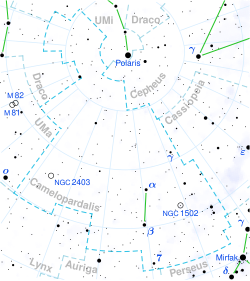
Beta Camelopardalis is the brightest star in the northern constellation of Camelopardalis. Its name is a Bayer designation that is Latinised from β Camelopardalis, and abbreviated Beta Cam or β Cam. This star is bright enough to be faintly visible to the naked eye, having an apparent visual magnitude of 4.02.2 Based upon an annual parallax shift of 3.74 mas as seen from Earth, it is located at a distance of approximately 840 light-years (260 pc) from the Sun. It is moving closer with a radial velocity of −1.90 km/s4 and is most likely a single10 star.
This is a yellow-hued G-type supergiant/bright giant with a stellar classification of G1 Ib–IIa.3 It is an estimated 60 million years old and is spinning with a projected rotational velocity of 11.7 km/s.9 This is an unusually high rate of rotation for an evolved star of this type. One possible explanation is that it may have engulfed a nearby giant planet, such as a hot Jupiter.11
Beta Camelopardalis has 6.5 times the mass of the Sun3 and has expanded to around 58 the Sun's radius.6 The star is radiating 1,592 times the Sun's luminosity from its enlarged photosphere7 at an effective temperature of 5,300 K.3 It is a source of X-ray emission.12
β Cam has two visual10 companions: a 7th-magnitude A5-class star at an angular separation of 84 arcseconds; and a 12th-magnitude star at 15 arcseconds.13
References
References
- Vallenari, A.; et al. (Gaia collaboration) (2023). "Gaia Data Release 3. Summary of the content and survey properties". Astronomy and Astrophysics. 674: A1. arXiv:2208.00211. Bibcode:2023A&A...674A...1G. doi:10.1051/0004-6361/202243940. S2CID 244398875. Gaia DR3 record for this source at VizieR.
- Ducati, J. R. (2002). "VizieR Online Data Catalog: Catalogue of Stellar Photometry in Johnson's 11-color system". CDS/ADC Collection of Electronic Catalogues. 2237. Bibcode:2002yCat.2237....0D.
- Lyubimkov, Leonid S.; et al. (2015). "Carbon abundance and the N/C ratio in atmospheres of A-, F- and G-type supergiants and bright giants". Monthly Notices of the Royal Astronomical Society. 446 (4): 3447. arXiv:1411.2722. Bibcode:2015MNRAS.446.3447L. doi:10.1093/mnras/stu2299.
- Gontcharov, G. A. (2006). "Pulkovo Compilation of Radial Velocities for 35 495 Hipparcos stars in a common system". Astronomy Letters. 32 (11): 759–771. arXiv:1606.08053. Bibcode:2006AstL...32..759G. doi:10.1134/S1063773706110065. S2CID 119231169.
- Gray, David F.; Pugh, Teznie (2012). "The Third Signature of Granulation in Bright-giant and Supergiant Stars". The Astronomical Journal. 143 (4): 92. Bibcode:2012AJ....143...92G. doi:10.1088/0004-6256/143/4/92.
- Van Belle, G. T.; et al. (2009). "Supergiant temperatures and linear radii from near-infrared interferometry". Monthly Notices of the Royal Astronomical Society. 394 (4): 1925. arXiv:0811.4239. Bibcode:2009MNRAS.394.1925V. doi:10.1111/j.1365-2966.2008.14146.x. S2CID 118372600.
- McDonald, I.; et al. (2012). "Fundamental parameters and infrared excesses of Hipparcos stars". Monthly Notices of the Royal Astronomical Society. 427 (1): 343–357. arXiv:1208.2037. Bibcode:2012MNRAS.427..343M. doi:10.1111/j.1365-2966.2012.21873.x. S2CID 118665352.
- Kovtyukh, V. V.; et al. (2012). "Accurate luminosities from the oxygen λ7771-4 Å triplet and the fundamental parameters of F-G supergiants". Monthly Notices of the Royal Astronomical Society. 423 (4): 3268. arXiv:1204.4115. Bibcode:2012MNRAS.423.3268K. doi:10.1111/j.1365-2966.2012.21117.x. S2CID 118683158.
- Rodrigues Da Silva, R.; et al. (2015). "On the Nature of Rapidly Rotating Single Evolved Stars". The Astrophysical Journal. 801 (1): 54. arXiv:1503.03447. Bibcode:2015ApJ...801...54R. doi:10.1088/0004-637X/801/1/54. S2CID 119271718.
- Eggleton, P. P.; Tokovinin, A. A. (September 2008). "A catalogue of multiplicity among bright stellar systems". Monthly Notices of the Royal Astronomical Society. 389 (2): 869–879. arXiv:0806.2878. Bibcode:2008MNRAS.389..869E. doi:10.1111/j.1365-2966.2008.13596.x. S2CID 14878976.
- Rodrigues da Silva, R.; et al. (March 2015). "On the Nature of Rapidly Rotating Single Evolved Stars". The Astrophysical Journal. 801 (1): 6. arXiv:1503.03447. Bibcode:2015ApJ...801...54R. doi:10.1088/0004-637X/801/1/54. S2CID 119271718. 54.
- Haakonsen, Christian Bernt; Rutledge, Robert E. (September 2009). "XID II: Statistical Cross-Association of ROSAT Bright Source Catalog X-ray Sources with 2MASS Point Source Catalog Near-Infrared Sources". The Astrophysical Journal Supplement. 184 (1): 138–151. arXiv:0910.3229. Bibcode:2009ApJS..184..138H. doi:10.1088/0067-0049/184/1/138. S2CID 119267456.
- Mason, Brian D.; et al. (2001). "The 2001 US Naval Observatory Double Star CD-ROM. I. The Washington Double Star Catalog". The Astronomical Journal. 122 (6): 3466. Bibcode:2001AJ....122.3466M. doi:10.1086/323920.