 | |
| Names | |
|---|---|
| IUPAC name
Beryllium hydroxide
| |
Other names
| |
| Identifiers | |
3D model (JSmol)
|
|
| ChEBI | |
| ChemSpider |
|
| ECHA InfoCard | 100.033.048 |
| EC Number |
|
| 1024 | |
| MeSH | Beryllium+hydroxide |
PubChem CID
|
|
| RTECS number |
|
| UNII | |
CompTox Dashboard (EPA)
|
|
| |
| |
| Properties | |
| BeH2O2 | |
| Molar mass | 43.026 g·mol−1 |
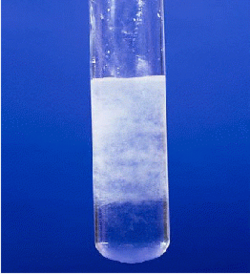
| Appearance | Vivid white, opaque crystals |
| Density | 1.92 g cm−31 |
| Melting point | (decomposes) |
| 0.0000023965 g/L | |
Solubility product (Ksp)
|
6.92×10−222 |
| Acidity (pKa) | 3.73 |
| Structure | |
| Linear | |
| Thermochemistry | |
Heat capacity (C)
|
1.443 J K−1 |
Std molar
entropy (S⦵298) |
47 J·mol−1·K−14 |
Std enthalpy of
formation (ΔfH⦵298) |
−904 kJ mol−14 |
Gibbs free energy (ΔfG⦵)
|
−818 kJ/mol |
| Hazards | |
| Occupational safety and health (OHS/OSH): | |
Main hazards
|
Carcinogenic |
| GHS labelling: | |
   5 5
| |
| Danger | |
| NFPA 704 (fire diamond) | |
| Lethal dose or concentration (LD, LC): | |
LD50 (median dose)
|
4 mg kg−1 (intravenous, rat) |
| NIOSH (US health exposure limits): | |
PEL (Permissible)
|
TWA 0.002 mg/m3 C 0.005 mg/m3 (30 minutes), with a maximum peak of 0.025 mg/m3 (as Be)6 |
REL (Recommended)
|
Ca C 0.0005 mg/m3 (as Be)6 |
IDLH (Immediate danger)
|
Ca [4 mg/m3 (as Be)]6 |
| Related compounds | |
Related compounds
|
Aluminium oxide |
Except where otherwise noted, data are given for materials in their standard state (at 25 °C [77 °F], 100 kPa).
| |



Beryllium hydroxide, Be(OH)2, is an amphoteric hydroxide, dissolving in both acids and alkalis. Industrially, it is produced as a by-product in the extraction of beryllium metal from the ores beryl and bertrandite.7 The natural pure beryllium hydroxide is rare (in form of the mineral behoite, orthorhombic) or very rare (clinobehoite, monoclinic).89 When alkali is added to beryllium salt solutions the α-form (a gel) is formed. If this left to stand or boiled, the rhombic β-form precipitates.10 This has the same structure as zinc hydroxide, Zn(OH)2, with tetrahedral beryllium centers.11
Reactions
Beryllium hydroxide is difficult to dissolve in water. With alkalis it dissolves to form the tetrahydroxoberyllate (also known as tetrahydroxidoberyllate) anion, [Be(OH)4]2−.12 With sodium hydroxide solution:
- 2 NaOH(aq) + Be(OH)2(s) → Na2[Be(OH)4](aq)
With acids, beryllium salts are formed.12 For example, with sulfuric acid, H2SO4, beryllium sulfate is formed:
- Be(OH)2 + H2SO4 → BeSO4 + 2 H2O
Beryllium hydroxide dehydrates at 400 °C to form the soluble white powder, beryllium oxide:12
- Be(OH)2 → BeO + H2O
Further heating at higher temperature produces acid insoluble BeO.12
References
References
- Pradyot Patnaik. Handbook of Inorganic Chemicals. McGraw-Hill, 2002, ISBN 0-07-049439-8
- John Rumble (June 18, 2018). CRC Handbook of Chemistry and Physics (99 ed.). CRC Press. pp. 4–47. ISBN 978-1138561632.
- Handbook of Chemistry and Physics. Cleveland, Ohio: Chemical Rubber Publishing Company. 1951. pp. 1636–1637.
- Zumdahl, Steven S. (2009). Chemical Principles 6th Ed. Houghton Mifflin Company. ISBN 978-0-618-94690-7.
- "Beryllium Hydroxide". American Elements. Retrieved 5 July 2023.
- NIOSH Pocket Guide to Chemical Hazards. "#0054". National Institute for Occupational Safety and Health (NIOSH).
- Jessica Elzea Kogel, Nikhil C. Trivedi, James M. Barker and Stanley T. Krukowski, 2006, Industrial Minerals & Rocks: Commodities, Markets, and Uses, 7th edition, SME, ISBN 0-87335-233-5
- Mindat, http://www.mindat.org/min-603.html
- Mindat, http://www.mindat.org/min-1066.html
- Mary Eagleson, 1994, Concise encyclopedia chemistry, Walter de Gruyter, ISBN 3-11-011451-8
- Greenwood, Norman N.; Earnshaw, Alan (1997). Chemistry of the Elements (2nd ed.). Butterworth-Heinemann. doi:10.1016/C2009-0-30414-6. ISBN 978-0-08-037941-8.
- Egon Wiberg, Arnold Frederick Holleman (2001) Inorganic Chemistry, Elsevier ISBN 0-12-352651-5