Beogradska Banka (Serbo-Croatian: Београдска Банка, lit. 'Bank of Belgrade') was a bank in Yugoslavia, based in Belgrade. It was established in 1971 by merger of two pre-existing credit institutions, the Belgrade United Bank (Serbo-Croatian: Beogradska udružena banka) and Economic Bank in Belgrade (Privredna banka u Beogradu).1: 22
A restructuring in 1978 led the bank to rename itself as United Belgrade Bank (Udružena beogradska banka, UBB), while also using the brand Beobanka.2 In later years, two differentially branded entities, Beobanka and Beogradska Banka, were developed in parallel and partly autonomously from each other. They both became unviable following the breakup of Yugoslavia and were placed into liquidation in 2002, together with two other major Belgrade-based commercial banks.
History
The Belgrade United Bank was established in 1965.3: 55 It merged with the Economic Bank in Belgrade, with effect on 1 January 1971, with the merged entity being named Beogradska banka. The bank opened branches in Vienna, Düsseldorf, Hannover, Stuttgart, Munich, Frankfurt, and East Berlin.
In 1978, Beogradska Banka was restructured together with Yugoslav Investment Bank (YIB). A successor entity for both, branded Investbanka, was established on 1 January 1978,4: 17 affiliated with a new so-called associated bank branded UBB.5 UBB was one of nine associated banks that together formed the backbone of the commercial banking sector in Yugoslavia, together with Jugobanka in Belgrade, Vojvođanska Banka in Novi Sad, Kosovska Banka in Pristina, United Bank of Croatia in Zagreb, Ljubljanska Banka, Privredna Banka Sarajevo, Stopanska Banka in Skopje, and Investment Bank Titograd.6 Slobodan Milošević was the president of UBB from 1978 to 1983,7 giving him the opportunity to travel internationally.8
In the 1990s, Beobanka and Beogradska Banka became separate brands, while the respective entities as well as UBB remained linked together, for example for the purposes of international sanctions against Serbia and Montenegro,91011 for the evasion of which Beogradska Banka became a vehicle as it managed Beobanka's offshore operations.12 Several senior executives and staff, including Beogradska Banka's managing director Zoran Marković, were designated by the EU as supporters of the Milošević regime.11
By 1998, Beobanka and Beogradska Banka were operating autonomously from each other; Beobanka had around 120 retail branches in Serbia and Montenegro, whereas Beogradska Banka was focused on wholesale and international activities in Belgrade.13 In 2001, Beobanka was described as an offshoot of Beogradska Banka.14
Both Beobanka and Beogradska Banka were placed into liquidation in 2002, together with Investbanka and Jugobanka,15 as public confidence in those banks had effectively evaporated.16: 38 The liquidation proceedings were still ongoing by 2015.17
Branding and marketing
In the 1990s, Beobanka and Beogradska Banka adopted different but related logos.1819
From 1994 to 1998, Beobanka was the main sponsor of the Red Star Belgrade football club.20 It also sponsored a basketball club, KK Beobanka (later KK Vojvodina Srbijagas), between 1995 and 2000.
Buildings
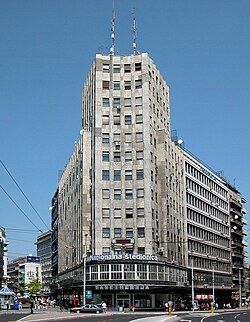
Beogradska Banka had its head office in the Palace Albanija, an iconic interwar building on Terazije in downtown Belgrade.2122
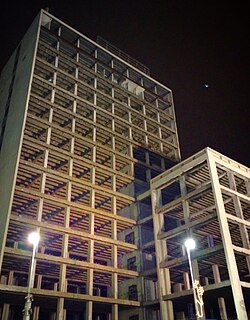
In the 1990s Beobanka located its head office into a building on the Zeleni Venac thoroughfare of Belgrade, originally erected in 1960 for Energoprojekt. In 2007 the building was stripped of its external cladding,23 and became an iconic ruin.24 Its renovation as a business center was announced in 2023.25
References
References
- The Economic Development Institute 1968-69 (PDF), International Bank for Reconstruction and Development, 1968
- "Case No. IT-99-37-I: The Prosecutor of the Tribunal against Slobodan MILOŠEVIĆ, Milan MILUTINOVIĆ, Nikola. ŠAINOVIĆ, Dragoljub OJDANIĆ and Vlajko STOJILJKOVIĆ - Ameended Indictment". International Criminal Tribunal for the Former Yugoslavia. 29 June 2001.
- Predrag Četković (September 2015), The Role of Banks in Economic Development in the Former SFR Yugoslavia, Vienna: Wiener Institut für Internationale Wirtschaftsvergleiche
- "Staff Appraisal Report - Morava Regional Development II Project, Yugoslavia" (PDF). World Bank. 30 January 1981.
- "European Court of Human Rights - Application no. 60642/08 by Emina ALIŠIĆ and Others against Bosnia and Herzegovina, Croatia, "the former Yugoslav Republic of Macedonia", Serbia and Slovenia lodged on 30 July 2005". Strada Lex Europe. 2 March 2010.
- Case of Ališić and Others v. Bosnia and Herzegovina, Croatia, Serbia, Slovenia and the former Yugoslav Republic of Macedonia - Judgment, European Court of Human Rights, 6 November 2012
- "The Milosevic indictment Part 2 - the accused". The Guardian. 29 June 2001.
- Judah, Tim (2002). Kosovo: War and Revenge. Yale University Press. p. 51. ISBN 9780300097252.
- Partial List of Blocked Yugoslav Entities (PDF), Federal Reserve Bank of New York, 8 July 1992
- U.S. Department of the Treasury - Federal Republic of Yugoslavia (Serbia and Montenegro) Sanctions - Notice of blocking, Federal Register Volume 60, Number 74, 18 April 1995
- Council Regulation (EC) No 1294/1999 of 15 June 1999 concerning a freeze of funds and a ban on investment in relation to the Federal Republic of Yugoslavia (FRY) and repealing Regulations (EC) No 1295/98 and (EC)No 1607/98 (PDF)
- Chris Hedges (15 June 1995). "Cyprus Shores Wash Dirty Money". The New York Times.
- M.Vukovic. "Osniva se Beogradska banka - Beobanka". Naša Borba.
- Ian Traynor (29 March 2001). "Search for the missing millions". The Guardian.
- "Serbien – zerbricht das Land? Neuordnung am Rande Europas". AG Friedensforschung an der Uni Kassel/Friedenspolitischer Ratschlag. 2004.
- Jelena Radzic & Ayse Yuce (February 2011), "Banking Development In The Former Yugoslavian Republics", International Business & Economics Research Journal (7(9))
- Slavica Moravčević (18 October 2015). "Zašto su zaista ugašene Beobanka, Investbanka..." Novosti.
- "Vintage Paper Bond Beobanka Share Stock 1992 Bank Yugoslavia". Sigedon Books and Antiques. Retrieved 26 April 2026.
- "Ponuda "Udruzena Beogradska banka" je arhivirana". Kupindo. Retrieved 26 April 2026.
- "Red Star Belgrade Sponsor History". Football Kit Archive. Retrieved 19 April 2026.
- "BEOGRADSKA BANKA AD, BEOGRAD (STARI GRAD) - U STEČAJU". Company Wall. Retrieved 26 April 2026.
- "Office space in "Palata Albanija" building up for sale, price 10 million – Attractive real estate of Beogradska banka on offer". eKapija. 14 September 2025.
- "Belgrade gets the first green facade building - Stattwerk is preparing Beobanka building rehabilitation". eKapija. 27 August 2017.
- Nikola Đorđević (10 July 2021). "Alternative Belgrade: Five lesser-known but essential landmarks". Beyond Emerging Europe.
- "The Beobanka building on Zeleni Venac becomes Branko's Business Center". Real Estate Magazine. 22 January 2023.