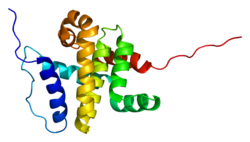
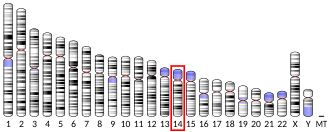
Bcl-2-like protein 2 is a 193-amino acid protein that in humans is encoded by the BCL2L2 gene on chromosome 14 (band q11.2-q12).567 It was originally discovered by Leonie Gibson, Suzanne Cory and colleagues at the Walter and Eliza Hall Institute of Medical Research, who called it Bcl-w.5
Function
This gene encodes a pro-survival (anti-apoptotic) member of the Bcl-2 protein family, and is most similar to Bcl-xL.7 The proteins of this family form hetero- or homodimers and act as anti- and pro-apoptotic regulators. Expression of this gene in cells has been shown to contribute to reduced cell apoptosis under cytotoxic conditions. Studies of the related gene in mice indicated a role in the survival of NGF- and BDNF-dependent neurons. Mutation and knockout studies of the mouse gene demonstrated an essential role in adult spermatogenesis.687
Clinical significance
High levels of Bcl-w are seen in many cancers, including glioblastoma, colorectal cancer, non-small-cell lung carcinoma, and breast cancer.7 Breast cancer patients with metastasis have higher Bcl-w than breast cancer patients only having primary tumor.7 Elevated levels of Bcl-w has been shown to protect neurons from cell death induced by amyloid beta.7 Parkinson's disease patients with a mutant PARK2 gene have elevated Bcl-w.7 Bcl-w has been shown to contribute to cellular senescence.7
Quercetin has been shown to inhibit the PI3K/AKT pathway leading to downregulation of Bcl-w.97
Interactions
BCL2L2 has been shown to interact with:
References
References
- GRCh38: Ensembl release 89: ENSG00000129473 – Ensembl, May 2017
- GRCm38: Ensembl release 89: ENSMUSG00000089682 – Ensembl, May 2017
- "Human PubMed Reference:". National Center for Biotechnology Information, U.S. National Library of Medicine.
- "Mouse PubMed Reference:". National Center for Biotechnology Information, U.S. National Library of Medicine.
- Gibson L, Holmgreen SP, Huang DC, Bernard O, Copeland NG, Jenkins NA, et al. (October 1996). "bcl-w, a novel member of the bcl-2 family, promotes cell survival". Oncogene. 13 (4): 665–675. PMID 8761287.
- "Entrez Gene: BCL2L2 BCL2-like 2".
- Hartman ML, Czyz M (2020). "BCL-w: apoptotic and non-apoptotic role in health and disease". Cell Death & Disease. 11 (4): 2260. doi:10.1038/s41419-020-2417-0. PMC 7174325. PMID 32317622.
- Kelly GL, Strasser A (2020). "Toward Targeting Antiapoptotic MCL-1 for Cancer Therapy". Annual Review of Cancer Biology. 4: 299–313. doi:10.1146/annurev-cancerbio-030419-033510. hdl:11343/252362.
- Paez-Ribes M, González-Gualda E, Doherty GJ, Muñoz-Espín D (2019). "Targeting senescent cells in translational medicine". EMBO Molecular Medicine. 11 (12) e10234. doi:10.15252/emmm.201810234. PMC 6895604. PMID 31746100.
- Hsu SY, Lin P, Hsueh AJ (September 1998). "BOD (Bcl-2-related ovarian death gene) is an ovarian BH3 domain-containing proapoptotic Bcl-2 protein capable of dimerization with diverse antiapoptotic Bcl-2 members". Molecular Endocrinology. 12 (9). Baltimore, Md.: 1432–1440. doi:10.1210/mend.12.9.0166. PMID 9731710.
- O'Connor L, Strasser A, O'Reilly LA, Hausmann G, Adams JM, Cory S, et al. (January 1998). "Bim: a novel member of the Bcl-2 family that promotes apoptosis". The EMBO Journal. 17 (2): 384–395. doi:10.1093/emboj/17.2.384. PMC 1170389. PMID 9430630.
- Ayllón V, Cayla X, García A, Fleischer A, Rebollo A (July 2002). "The anti-apoptotic molecules Bcl-xL and Bcl-w target protein phosphatase 1alpha to Bad". European Journal of Immunology. 32 (7): 1847–1855. doi:10.1002/1521-4141(200207)32:7<1847::AID-IMMU1847>3.0.CO;2-7. PMID 12115603.
- Chen L, Willis SN, Wei A, Smith BJ, Fletcher JI, Hinds MG, et al. (February 2005). "Differential targeting of prosurvival Bcl-2 proteins by their BH3-only ligands allows complementary apoptotic function". Molecular Cell. 17 (3): 393–403. doi:10.1016/j.molcel.2004.12.030. PMID 15694340.
- Bae J, Hsu SY, Leo CP, Zell K, Hsueh AJ (October 2001). "Underphosphorylated BAD interacts with diverse antiapoptotic Bcl-2 family proteins to regulate apoptosis". Apoptosis. 6 (5): 319–330. doi:10.1023/A:1011319901057. PMID 11483855. S2CID 23119757.
- Holmgreen SP, Huang DC, Adams JM, Cory S (June 1999). "Survival activity of Bcl-2 homologs Bcl-w and A1 only partially correlates with their ability to bind pro-apoptotic family members". Cell Death and Differentiation. 6 (6): 525–532. doi:10.1038/sj.cdd.4400519. PMID 10381646.
Further reading
Further reading
- Nagase T, Seki N, Ishikawa K, Ohira M, Kawarabayasi Y, Ohara O, et al. (October 1996). "Prediction of the coding sequences of unidentified human genes. VI. The coding sequences of 80 new genes (KIAA0201-KIAA0280) deduced by analysis of cDNA clones from cell line KG-1 and brain". DNA Research. 3 (5): 321–9, 341–54. doi:10.1093/dnares/3.5.321. PMID 9039502.
- Ross AJ, Waymire KG, Moss JE, Parlow AF, Skinner MK, Russell LD, et al. (March 1998). "Testicular degeneration in Bclw-deficient mice". Nature Genetics. 18 (3): 251–256. doi:10.1038/ng0398-251. PMID 9500547. S2CID 32843609.
- Middleton G, Wyatt S, Ninkina N, Davies AM (2001). "Reciprocal developmental changes in the roles of Bcl-w and Bcl-x(L) in regulating sensory neuron survival". Development. 128 (3). Cambridge, England: 447–457. doi:10.1242/dev.128.3.447. PMID 11152643.
- O'Reilly LA, Print C, Hausmann G, Moriishi K, Cory S, Huang DC, et al. (May 2001). "Tissue expression and subcellular localization of the pro-survival molecule Bcl-w". Cell Death and Differentiation. 8 (5): 486–494. doi:10.1038/sj.cdd.4400835. PMID 11423909.
- Puthalakath H, Villunger A, O'Reilly LA, Beaumont JG, Coultas L, Cheney RE, et al. (September 2001). "Bmf: a proapoptotic BH3-only protein regulated by interaction with the myosin V actin motor complex, activated by anoikis". Science. 293 (5536). New York, N.Y.: 1829–1832. Bibcode:2001Sci...293.1829P. doi:10.1126/science.1062257. PMID 11546872. S2CID 5638023.
- Denisov AY, Madiraju MS, Chen G, Khadir A, Beauparlant P, Attardo G, et al. (June 2003). "Solution structure of human BCL-w: modulation of ligand binding by the C-terminal helix". The Journal of Biological Chemistry. 278 (23): 21124–21128. doi:10.1074/jbc.M301798200. PMID 12651847.
- Hinds MG, Lackmann M, Skea GL, Harrison PJ, Huang DC, Day CL (April 2003). "The structure of Bcl-w reveals a role for the C-terminal residues in modulating biological activity". The EMBO Journal. 22 (7): 1497–1507. doi:10.1093/emboj/cdg144. PMC 152889. PMID 12660157.
- Wilson-Annan J, O'Reilly LA, Crawford SA, Hausmann G, Beaumont JG, Parma LP, et al. (September 2003). "Proapoptotic BH3-only proteins trigger membrane integration of prosurvival Bcl-w and neutralize its activity". The Journal of Cell Biology. 162 (5): 877–887. doi:10.1083/jcb.200302144. PMC 2172834. PMID 12952938.
- Zhu X, Wang Y, Ogawa O, Lee HG, Raina AK, Siedlak SL, et al. (June 2004). "Neuroprotective properties of Bcl-w in Alzheimer disease". Journal of Neurochemistry. 89 (5): 1233–1240. doi:10.1111/j.1471-4159.2004.02416.x. PMID 15147516.
- Kimura K, Wakamatsu A, Suzuki Y, Ota T, Nishikawa T, Yamashita R, et al. (January 2006). "Diversification of transcriptional modulation: large-scale identification and characterization of putative alternative promoters of human genes". Genome Research. 16 (1): 55–65. doi:10.1101/gr.4039406. PMC 1356129. PMID 16344560.
- Denisov AY, Chen G, Sprules T, Moldoveanu T, Beauparlant P, Gehring K (February 2006). "Structural model of the BCL-w-BID peptide complex and its interactions with phospholipid micelles". Biochemistry. 45 (7): 2250–2256. doi:10.1021/bi052332s. PMID 16475813.
- Certo M, Del Gaizo Moore V, Nishino M, Wei G, Korsmeyer S, Armstrong SA, et al. (May 2006). "Mitochondria primed by death signals determine cellular addiction to antiapoptotic BCL-2 family members". Cancer Cell. 9 (5): 351–365. doi:10.1016/j.ccr.2006.03.027. PMID 16697956.
External links
External links