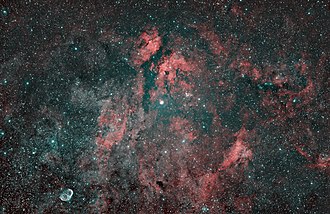
  Credit: Erik Larsen | |
| Observation data Epoch J2000 Equinox ICRS | |
|---|---|
| Constellation | Cygnus |
| Right ascension | 20h 21m 38.55s1 |
| Declination | +37° 31′ 58.9″1 |
| Apparent magnitude (V) | 9.0 - 10.82 |
| Characteristics | |
| Spectral type | M3.5 Ia3 (M2 - M54) |
| B−V color index | +3.13 - +3.214 |
| Variable type | SRc3 |
| Astrometry | |
| Radial velocity (Rv) | −20.971 km/s |
| Proper motion (μ) | RA: −3.710 mas/yr1 Dec.: −6.307 mas/yr1 |
| Parallax (π) | 0.5760±0.0500 mas1 |
| Distance | 5,418+470 −430 ly (1,662+144 −132 pc)5 |
| Absolute magnitude (MV) | −7.716 |
| Details | |
| Mass | 1947 M☉ |
| Radius | 1,1871 R☉ |
| Luminosity | 150,0007 204,000+159,000 −56,0008 L☉ |
| Temperature | 3,5357 K |
| Age | >97a Myr |
| Other designations | |
| BC Cyg, BD+37°3903, HIP 100404, IRAS 20197+3722, 2MASS J20213855+3731589 | |
| Database references | |
| SIMBAD | data |
BC Cygni (abbreviated to BC Cyg), also known as BD+37°3903, is a red supergiant or hypergiant9 pulsating variable star of spectral type M3.5Ia in the constellation Cygnus.
It is considered a member of the Cygnus OB1 stellar association, and within it the open cluster Berkeley 87,10 which would place at a distance of 1,673 parsecs (5,000 ly) of the Solar System;11 it is less than a degree north of another variable red supergiant, BI Cygni. According to its Gaia Data Release 3 parallax, it is at about 1,700 pc.1
BC Cygni was found to have a luminosity of 145,000 L☉ and an effective temperature of 2,858 K in the year 1900, and a luminosity of 112,000 L☉ and a temperature of 3,614 K in the year 2000. It is one of largest stars known, at its brightest and coolest calculated to be 1,553 R☉ compared to 856 R☉ at its hottest and faintest.12 If it were in the place of the Sun, its photosphere would engulf the entire inner Solar System and reach close to the orbit of Jupiter. With a mass of about 19 M☉, it is estimated that the stellar mass loss, as dust, as the atomic and molecular gas could not be evaluators is 3.2×10⁻⁹ M☉ per year.13
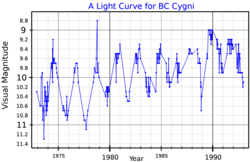
Louisa Wells discovered that the star's brightness varied, based on the examination of 15 photographic plates. That discovery was announced in 1911.15 It was given its variable star designation, BC Cygni, in 1914.16 The brightness of BC Cyg varies from visual magnitude +9.0 and +10.8 with a period of 720 ± 40 days.2 Between around the year 1900 and 2000 appears to have increased its average brightness of 0.5 magnitudes.4
Notes
Notes
- This is only the age at which the star enters the red supergiant phase.
References
References
- Vallenari, A.; et al. (Gaia collaboration) (2023). "Gaia Data Release 3. Summary of the content and survey properties". Astronomy and Astrophysics. 674: A1. arXiv:2208.00211. Bibcode:2023A&A...674A...1G. doi:10.1051/0004-6361/202243940. S2CID 244398875. Gaia DR3 record for this source at VizieR.
- Kiss, L. L.; Szabó, Gy. M.; Bedding, T. R. (2006). "Variability in red supergiant stars: Pulsations, long secondary periods and convection noise". Monthly Notices of the Royal Astronomical Society. 372 (4): 1721–1734. arXiv:astro-ph/0608438. Bibcode:2006MNRAS.372.1721K. doi:10.1111/j.1365-2966.2006.10973.x. S2CID 5203133.
- Samus, N. N.; Durlevich, O. V.; et al. (2009). "VizieR Online Data Catalog: General Catalogue of Variable Stars (Samus+ 2007-2013)". VizieR On-line Data Catalog: B/GCVS. Originally Published in: 2009yCat....102025S. 1. Bibcode:2009yCat....102025S.
- Turner, David G.; Rohanizadegan, Mina; Berdnikov, Leonid N.; Pastukhova, Elena N. (2006). "The Long-Term Behavior of the Semiregular M Supergiant Variable BC Cygni". The Publications of the Astronomical Society of the Pacific. 118 (849): 1533. Bibcode:2006PASP..118.1533T. doi:10.1086/508905.
- Bailer-Jones, C. A. L.; Rybizki, J.; Fouesneau, M.; Demleitner, M.; Andrae, R. (2021-03-01). "Estimating distances from parallaxes. V: Geometric and photogeometric distances to 1.47 billion stars in Gaia Early Data Release 3". The Astronomical Journal. 161 (3): 147. arXiv:2012.05220. Bibcode:2021AJ....161..147B. doi:10.3847/1538-3881/abd806. ISSN 0004-6256. Data about this star can be seen here.
- Levesque, Emily M.; Massey, Philip; Olsen, K. A. G.; Plez, Bertrand; Josselin, Eric; Maeder, Andre; Meynet, Georges (2005). "The Effective Temperature Scale of Galactic Red Supergiants: Cool, but Not As Cool As We Thought". The Astrophysical Journal. 628 (2): 973–985. arXiv:astro-ph/0504337. Bibcode:2005ApJ...628..973L. doi:10.1086/430901. S2CID 15109583.
- Comerón, F.; Djupvik, A. A.; Schneider, N.; Pasquali, A. (October 2020). "The historical record of massive star formation in Cygnus". Astronomy & Astrophysics. 2009: A62. arXiv:2009.12779. Bibcode:2020A&A...644A..62C. doi:10.1051/0004-6361/202039188. S2CID 221970180.
- Davies, Ben; Beasor, Emma R. (March 2020). "The 'red supergiant problem': the upper luminosity boundary of Type II supernova progenitors". MNRAS. 493 (1): 468–476. arXiv:2001.06020. Bibcode:2020MNRAS.493..468D. doi:10.1093/mnras/staa174. S2CID 210714093.
- Stickland, D. J. (1985). "IRAS observations of the cool galactic hypergiants". The Observatory. 105: 229. Bibcode:1985Obs...105..229S.
- Sokal, Kimberly R.; Skinner, Stephen L.; Zhekov, Svetozar A.; Güdel, Manuel; Schmutz, Werner (2010). "Chandra Detects the Rare Oxygen-type Wolf-Rayet Star WR 142 and OB Stars in Berkeley 87". The Astrophysical Journal. 715 (2): 1327. arXiv:1004.0462. Bibcode:2010ApJ...715.1327S. doi:10.1088/0004-637X/715/2/1327. S2CID 119232391.
- de la Fuente, Diego; Román-Zúñiga, Carlos G.; Jiménez-Bailón, Elena; Alves, João; Garcia, Miriam; Venus, Sean (2021). "Clustered star formation toward Berkeley 87/ON2. I. Multiwavelength census and the population overlap problem". Astronomy and Astrophysics. 650: A156. arXiv:2103.06062. Bibcode:2021A&A...650A.156D. doi:10.1051/0004-6361/202040065. S2CID 232170603.
- Turner, David G.; Rohanizadegan, Mina; Berdnikov, Leonid N.; Pastukhova, Elena N. (2006-11-02). "The Long-Term Behavior of the Semiregular M Supergiant Variable BC Cygni". Publications of the Astronomical Society of the Pacific. 118 (849): 1533. Bibcode:2006PASP..118.1533T. doi:10.1086/508905. ISSN 1538-3873.
- Josselin, E.; Plez, B. (2007). "Atmospheric dynamics and the mass loss process in red supergiant stars". Astronomy and Astrophysics. 469 (2): 671. arXiv:0705.0266. Bibcode:2007A&A...469..671J. doi:10.1051/0004-6361:20066353. S2CID 17789027.
- "Download Data". aavso.org. AAVSO. Retrieved 1 October 2021.
- Fleming, Williamina; Pickering, Edward C. (September 1911). "Stars Having Peculiar Spectra. 31 New Variable Stars". Harvard College Observatory Circular. 167: 1–3. Bibcode:1911HarCi.167....1F.
- Dunér, Nils Christofer; Hartwig, Ernst; Müller, G. (September 1914). "Benennung von neu entdeckten veränderlichen Sternen". Astronomische Nachrichten. 199 (5): 65–88. Bibcode:1914AN....199...65D. doi:10.1002/asna.19141990502.