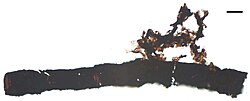
Banded tubes are a type of phytoclast consisting of micrometre-scale tubes with a banded internal ornamentation, and known from terrestrial and freshwater1 settings from the Early Silurian onwards.2
The bands on the walls were an early improvisation to aid the easy flow of water,3 and served as tracheids, although they are not equivalent in their construction. Banded tubes were lignified,4 giving them a more rigid structure than hydroids, allowing them to cope with higher levels of water pressure.5
Banded tubes have a markedly different ultrastructure from plant tracheids, and display a wide variety of wall structures, which implies that they were produced by a variety of different organisms, or perhaps were widely variable within a single nematophyte-like organism.1
Proposed functions include water transport, feeding (cf. fungal hyphae), and anchorage (cf. rhizoids).1
Some banded tubes can be assigned to genera such as Nematoplexus and Nematasketum; in the case of the latter, which is probably fungal, they occur in bundles alongside other tubes.6
References
References
- Taylor, W. A.; Wellman, C. H. (2009). "Ultrastructure of Enigmatic Phytoclasts (Banded Tubes) from the Silurian-Lower Devonian: Evidence for Affinities and Role in Early Terrestrial Ecosystems". PALAIOS. 24 (3): 167–180. Bibcode:2009Palai..24..167T. doi:10.2110/palo.2008.p08-046r.
- Niklas, K. J.; Smocovitis, V. (1983). "Evidence for a Conducting Strand in Early Silurian (Llandoverian) Plants: Implications for the Evolution of the Land Plants". Paleobiology. 9 (2): 126–137. doi:10.2307/2400461. JSTOR 2400461.
- Niklas, K. J. (1985). "The Evolution of Tracheid Diameter in Early Vascular Plants and Its Implications on the Hydraulic Conductance of the Primary Xylem Strand". Evolution. 39 (5): 1110–1122. doi:10.2307/2408738. JSTOR 2408738. PMID 28561493.
- Niklas, K.; Pratt, L. (1980). "Evidence for lignin-like constituents in Early Silurian (Llandoverian) plant fossils". Science. 209 (4454): 396–397. Bibcode:1980Sci...209..396N. doi:10.1126/science.209.4454.396. PMID 17747811.
- Sperry, J. S. (2003). "Evolution of Water Transport and Xylem Structure". International Journal of Plant Sciences. 164 (3): S115–S127. doi:10.1086/368398. JSTOR 3691719.
- Edwards, D.; Axe, L. (2012). "Evidence for a fungal affinity for Nematasketum, a close ally of Prototaxites". Botanical Journal of the Linnean Society. 168 (1): 1–18. doi:10.1111/j.1095-8339.2011.01195.x.