| Baccaurea macrocarpa | |
|---|---|
| |
Scientific classification 
| |
| Kingdom: | Plantae |
| Clade: | Embryophytes |
| Clade: | Tracheophytes |
| Clade: | Spermatophytes |
| Clade: | Angiosperms |
| Clade: | Eudicots |
| Clade: | Rosids |
| Order: | Malpighiales |
| Family: | Phyllanthaceae |
| Genus: | Baccaurea |
| Species: | B. macrocarpa
|
| Binomial name | |
| Baccaurea macrocarpa | |
| Synonyms1 | |
| |
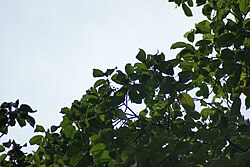
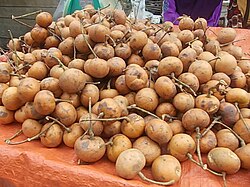
Baccaurea macrocarpa, also called tampoi, is a small, tropical rainforest substory fruit tree in the family Phyllanthaceae native to Southeast Asia, especially Borneo.2 It is dioecious, and the female tree bear fruit directly on the trunk and large branches. The fruit is large, orange-skinned, white-fleshed, with a delicious tangy flavour somewhat like mandarin (tangerine). Depending on conditions, the fruit may closely clothe the trunk beautifully, like the fruit of many Ficus species.

References
References
- "WCSP". World Checklist of Selected Plant Families. Retrieved 5 January 2022.
- Khoo, Hock Eng; Azlan, Azrina; Kong, Kin Weng; Ismail, Amin (2016-05-31). "Phytochemicals and Medicinal Properties of Indigenous Tropical Fruits with Potential for Commercial Development". Evidence-Based Complementary and Alternative Medicine. 2016 (2016): 1–20. doi:10.1155/2016/7591951. PMC 4906201. PMID 27340420.