| Relative key | D major |
|---|---|
| Parallel key | B major |
| Dominant key | F-sharp minor |
| Subdominant key | E minor |
| Component pitches | |
| B, C♯, D, E, F♯, G, A | |
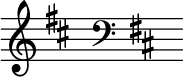
B minor is a minor scale based on B, consisting of the pitches B, C♯, D, E, F♯, G, and A. Its key signature has two sharps. Its relative major is D major and its parallel major is B major.
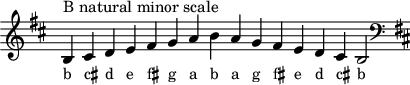
The B natural minor scale is:
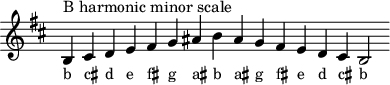
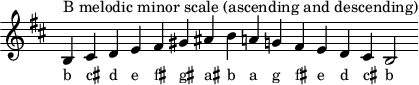
Changes needed for the melodic and harmonic versions of the scale are written in with accidentals as necessary. The B harmonic minor and melodic minor scales are:
Christian Friedrich Daniel Schubart (1739–1791) regarded B minor as a key expressing a quiet acceptance of fate and very gentle complaint, something commentators find to be in line with Bach's use of the key in his St John Passion.1 By the end of the Baroque era, however, conventional academic views of B minor had shifted: Composer-theorist Francesco Galeazzi (1758–1819)2 opined that B minor was not suitable for music in good taste. Beethoven labelled a B-minor melodic idea in one of his sketchbooks as a "black key".3
Scale degree chords
The scale degree chords of B minor are:
- Tonic – B minor
- Supertonic – C-sharp diminished
- Mediant – D major
- Subdominant – E minor
- Dominant – F-sharp minor
- Submediant – G major
- Subtonic – A major
Notable compositions in B minor
- Johann Sebastian Bach
- Ludwig van Beethoven
- Bagatelle Op. 126/4
- Alban Berg
- Piano Sonata, Op. 1
- Johannes Brahms
- Ballade (Intermezzo) Op. 10/3
- Rhapsody Op. 79/1
- Clarinet Quintet, Op. 115
- Intermezzo Op. 119/1
- Alexander Borodin
- Frédéric Chopin
- Scherzo No. 1, Op. 20
- Étude, Op. 25, No. 10
- Prelude in B minor "Tolling Bells", Op. 28, No. 6
- Piano Sonata No. 3, Op. 58
- Mazurka Op. 30/2
- Mazurka, Op. 33/4
- Waltz, Op. 69, No. 2
- Antonín Dvořák
- Cello Concerto, Op. 104
- Edward Elgar
- César Franck
- Edvard Grieg
- Joseph Haydn
- String Quartet, Op. 33/1
- String Quartet, Op. 64/2
- Johann Nepomuk Hummel
- Piano Concerto No. 3, Op. 89
- Franz Liszt
- Piano Sonata, S. 178
- Ballade No. 2, S. 171
- Felix Mendelssohn
- String Symphony No. 10 in B minor, MWV N 10
- Wolfgang Amadeus Mozart
- Adagio, K. 540
- Flute Quartet, K. 285: II. Adagio
- Niccolò Paganini
- Violin Concerto No. 2, Op. 7
- Sergei Rachmaninoff
- Moments musicaux No. 3, Op. 16
- Prelude in B minor, Op. 32, No. 10
- Études-Tableaux No. 4 in B minor, Op. 39
- Camille Saint-Saëns
- Violin Concerto No. 3, Op. 61
- Domenico Scarlatti
- 12 of his 555 piano sonatas: K 27, 87, 173, 197, 227, 293, 376, 377, 408, 409, 497, 498
- Franz Schubert
- Symphony No. 8 (Unfinished), D. 759
- Rondo in B minor for violin and piano, D. 895
- Alexander Scriabin
- Fantaisie in B minor, Op. 28
- Pyotr Ilyich Tchaikovsky
- Georg Philipp Telemann
- 12 Fantasias for Solo Flute: Nos. 3 and 9
- Sonata for two flutes or violins No. 5
- Antonio Vivaldi
- Trio Sonata Op. 1/11
- Violin Sonata, Op. 2/5
- Concerto for violin Op. 3/10
- Violin Sonata, Op. 5/4
- Violin Concerto for four violins Op. 9/12
References
References
Notes
- Tusa 1993, pp. 2–3, n. 5.
- Galeazzi 1817, p. .
- Tusa 1993, p. 2, n. 3.
Sources
- Galeazzi, Francesco (1817). Elementi teorico-pratici di musica con un saggio sopra l'arte di suonare il violino analizzata, ed a dimostrabili principi ridotta. Ascoli. See also Francesco Galeazzi, The Theoretical-Practical Elements of Music, Parts III and IV; English translation, with introduction and commentary, by Deborah Burton and Gregory W. Harwood (Champaign, Illinois: University of Illinois Press, 2012); ISBN 978-0-252-03708-5.
- Tusa, Michael C. (1993). "Beethoven's 'C-Minor Mood': Some Thoughts on the Structural Implications of Key Choice". In Christoph Reynolds (ed.). Beethoven Forum. Vol. 2. Lincoln: University of Nebraska Press. ISBN 978-0803239098.