39°59′09″N 22°04′57″E / 39.98591°N 22.08256°E / 39.98591; 22.08256
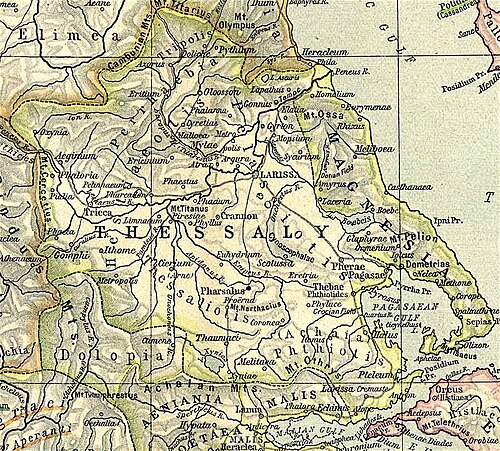
Azorus or Azoros (Ancient Greek: Ἄζωρος or Ἀζώριον1) was a town and polis (city-state)2 in Perrhaebia in ancient Thessaly situated at the foot of Mount Olympus. Azorus, with the two neighbouring towns of Pythium and Doliche, formed a Tripolis.3
During the Roman–Seleucid War, the Tripolis was ravaged by an army of the Aetolian League in the year 191 BCE.4 During the Third Macedonian War the three towns surrendered to the army of Perseus of Macedon in the year 171 BCE,5 but that same year the Romans reconquered the three.6 In the year 169 BCE troops arrived from the Roman consul Quintus Marcius Philippus who camped between Azorus and Doliche.78
The three cities minted a common coin with the inscription "ΤΡΙΠΟΛΙΤΑΝ".2
The site of Azorus is the palaiokastro (old fort) at the modern village of Azoros.910 According to the 5th-century grammarian Hesychius of Alexandria the town was named after the mythological Azorus, helmsman of the Argo.11
References
References
- Ptolemy. The Geography. Vol. 3.13.42.
- Mogens Herman Hansen & Thomas Heine Nielsen (2004). "Thessaly and Adjacent Regions". An inventory of archaic and classical poleis. New York: Oxford University Press. pp. 721-722. ISBN 0-19-814099-1.
- Livy. Ab urbe condita Libri [History of Rome]. Vol. 42.53, 44.2.
- Livy. Ab urbe condita Libri [History of Rome]. Vol. 36.10.
- Livy. Ab urbe condita Libri [History of Rome]. Vol. 42.53.
- Livy. Ab urbe condita Libri [History of Rome]. Vol. 42.67.
- Polybius. The Histories. Vol. 28.13.1.
- Livy. Ab urbe condita Libri [History of Rome]. Vol. 44.2.
- Talbert, Richard, ed. (2000). Barrington Atlas of the Greek and Roman World. Princeton University Press. p. 55. ISBN 978-0-691-03169-9, with accompanying Map-by-Map Directory.
- Lund University. Digital Atlas of the Roman Empire.
- Schmitz, Leonhard (1849). "Azorus". Dictionary of Greek and Roman Biography and Mythology. Vol. 1.