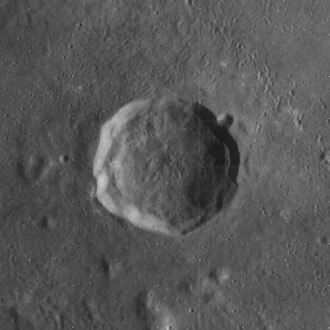
 Lunar Orbiter 4 image | |
| Coordinates | 30°42′N 1°30′E / 30.7°N 1.5°E / 30.7; 1.5 |
|---|---|
| Diameter | 38.88 km (24.16 mi)1 |
| Depth | 3.74 km (2.32 mi)2 |
| Colongitude | 358° at sunrise |
| Formation | Copernican3 or Eratosthenian4 |
| Eponym | Autolycus |
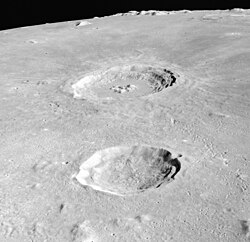
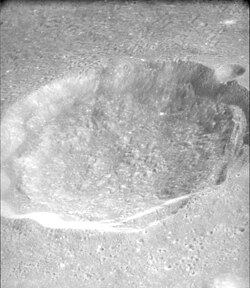
Autolycus is a lunar impact crater that is located in the southeast part of Mare Imbrium. T. W. Webb described it as having a similar outer blanket as Aristillus crater.5 Per Patrick Moore, "under a low sun radiating ridges can be made out extending from it".6 West of the formation is Archimedes,7 a formation more than double the size of Autolycus. Just to the north is Aristillus,6 and the outer ramparts of these two craters overlap in the intermediate stretch of the lunar mare.
This crater is named after the ancient Greek astronomer Autolycus of Pitane (fl. c. 310 B.C.). Its designation was officially adopted by the International Astronomical Union in 1935.1 The original name Autolicus was included in the lunar nomenclature of Italian selenographer Giovanni Riccioli in 1935.8
Description
The rim of Autolycus is somewhat irregular, although generally circular overall. It has a small outer rampart and an irregular interior with no central peak.9: 41 The northeast rim is overlain by a small impact crater, Autolycus A.10
Autolycus possesses a light ray system that extends for a distance of over 400 kilometers. Due to its rays, it is mapped as part of the Copernican System.3 However, dating of samples from the Apollo 15 landing site suggests an older age of 2.1 ga,1112 which places it in the Eratosthenian period.4 Some of the ray material appears to overlay the flooded floor of Archimedes, and thus Autolycus is older than Archimedes. Aristillus (to the north), however, has rays that overlay both Autolycus and Archimedes, and thus it is the youngest of the three craters.
The first man-made impact upon the Moon was when the Luna 2 probe crash-landed just to the west-southwest of the crater rim on September 13, 1959,3 according to a Hungarian astronomer who claimed to see an explosion of dust.
Satellite craters
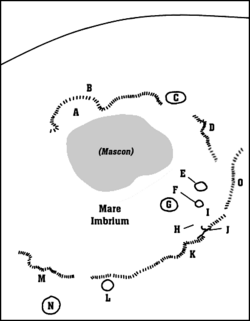
By convention these features are identified on lunar maps by placing the letter on the side of the crater midpoint that is closest to Autolycus.13
| Autolycus9: 292 | Latitude | Longitude | Diameter |
|---|---|---|---|
| A | 30.9° N | 2.2° E | 4 km |
| K | 31.2° N | 5.4° E | 3 km |
References
References
- "Autolycus". Gazetteer of Planetary Nomenclature. USGS Astrogeology Research Program.
- Joshi, Maitri P. (February 2017). "Physical properties of lunar craters". Research in Astronomy and Astrophysics. 17 (3). id. 24. Bibcode:2017RAA....17...24J. doi:10.1088/1674-4527/17/3/24.
- Wilhelms, Don E.; McCauley, John F.; Trask, Newell J. (1987). The geologic history of the Moon. USGS Professional Paper 1348. Washington: U.S. Government Printing Office. doi:10.3133/pp1348. Plate 11: Copernican System.
- Iqbal, W.; et al. (March 2021). Investigating a Potential Source of Young Ages at Apollo 15 Landing Site. 52nd Lunar and Planetary Science Conference, held virtually, 15-19 March, 2021. LPI Contribution No. 2548. id. 1917. Bibcode:2021LPI....52.1917I.
- Webb, Rev. T. W. (1962). Celestial Objects for Common Telescopes (6th revised ed.). Dover. pp. 115, 154–159. Reprint: ISBN 978-0-486-20917-3
- Moore, Patrick (2001). On the Moon. Sterling Publishing Co. pp. 175–176. ISBN 978-0-304-35469-6.
- Grego, Peter (2005). The Moon and How to Observe It. Astronomers' Observing Guides Series. London: Springer-Verlag. p. 109, 126, 140. ISBN 1-85233-748-6.
- Whitaker, Ewen A. (1999). Mapping and Naming the Moon. Cambridge University Press. p. 60–61, 211. ISBN 978-0-521-62248-6.
- Bussey, B.; Spudis, P. (2004). The Clementine Atlas of the Moon. New York: Cambridge University Press. ISBN 978-0-521-81528-4.
- "Autolycus A". Gazetteer of Planetary Nomenclature. USGS Astrogeology Research Program.
- Ryder, G.; et al. (February 1991). "Probable age of Autolycus and calibration of lunar stratigraphy". Geology (ISSN 0091-7613). 19: 143–146. Bibcode:1991Geo....19..143R. doi:10.1130/0091-7613(1991)019<0143:PAOAAC>2.3.CO;2.
- Hiesinger, Harald; et al. (April 2016). How old is Autolycus crater?. EGU General Assembly 2016, held 17-22 April, 2016 in Vienna Austria. id. EPSC2016-9655. Bibcode:2016EGUGA..18.9655H.
- Grego, P. (2015). "Satellite Crater". In Hargitai, H.; Kereszturi, Á. (eds.). Encyclopedia of Planetary Landforms. New York, NY: Springer. doi:10.1007/978-1-4614-3134-3_328.