| Inverse | diminished sixth |
|---|---|
| Name | |
| Other names | - |
| Abbreviation | A31 |
| Size | |
| Semitones | 5 |
| Interval class | 5 |
| Just interval | 125:96,2 21:16, 64:49 |
| Cents | |
| 12-Tone equal temperament | 500 |
| 24-Tone equal temperament | 500 |
| Just intonation | 457 |
In classical music from Western culture, an augmented third (ⓘ) is an interval of five semitones. It may be produced by widening a major third by a chromatic semitone.13 For instance, the interval from C to E is a major third, four semitones wide, and both the intervals from C♭ to E, and from C to E♯ are augmented thirds, spanning five semitones.
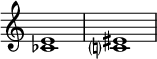
Being augmented, it is considered a dissonant interval.4
Its inversion is the diminished sixth, and its enharmonic equivalent is the perfect fourth.
The just augmented third, E♯, is 456.99 cents or 125:96. ⓘ The Pythagorean augmented third, E♯+++, is 521.51 cents or 177147:131072, eleven just perfect fifths. ⓘ
References
References
- Benward & Saker (2003). Music: In Theory and Practice, Vol. I, p.54. ISBN 978-0-07-294262-0.
- Haluska, Jan (2003). The Mathematical Theory of Tone Systems, p.xxvi. ISBN 0-8247-4714-3. Classic augmented third.
- Hoffmann, F.A. (1881). Music: Its Theory & Practice, p.89-90. Thurgate & Sons. Digitized Aug 16, 2007. Archaically: superfluous third.
- Benward & Saker (2003), p.92.