| ATP-grasp domain | |||||||
|---|---|---|---|---|---|---|---|
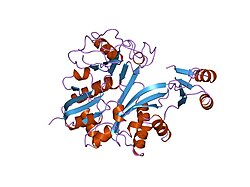 Ribbon diagram of glycinamide ribonucleotide synthetase (1gso) demonstrating the ATP grasp superfamily fold.1 | |||||||
| Identifiers | |||||||
| Symbol | ATP-grasp | ||||||
| Pfam | PF02222 | ||||||
| Pfam clan | CL0179 | ||||||
| ECOD | 206.1.3 | ||||||
| InterPro | IPR013815 | ||||||
| |||||||
In molecular biology, the ATP-grasp fold is a unique ATP-binding protein structural motif made of two α+β subdomains that "grasp" a molecule of ATP between them. ATP-grasp proteins have ATP-dependent carboxylate-amine/thiol ligase activity.23
Structure
Proteins of the ATP-grasp family have an overall structural configuration organised into three domains referred to as the N-terminal domain (or A-domain), the central domain (or B-domain), and the C-terminal domain (or C-domain).3
Function
ATP-grasp enzymes catalyse the ATP-dependent ligation of a carboxylate-containing molecule to an amino or thiol group-containing molecule. The reactions typically involve formation of acylphosphate intermediates. These enzymes are involved in various metabolic pathways including purine biosynthesis, fatty acid synthesis, and gluconeogenesis.4
Examples of proteins containing this domain
- D-alanine-D-alanine ligase
- glutathione synthetase
- biotin carboxylase
- carbamoyl phosphate synthetase
- ribosomal protein S6 modification enzyme (RimK)
- urea amidolyase
- tubulin-tyrosine ligase
- enzymes involved in purine biosynthesis
- ATP-grasp ligases involved in Graspetide natural product 5biosynthesis
Evolution and distribution
The ATP-grasp fold is evolutionarily conserved across different enzyme families and its presence is ubiquitous across prokaryotes and eukaryotes.3
Use in research
Researchers have developed several types of inhibitors for these enzymes, including mechanism-based inhibitors, ATP-competitive inhibitors, and non-competitive inhibitors. Some ATP-grasp enzymes are being studied as potential targets for antibiotics and anti-obesity drugs.3
References
References
- Wang W, Kappock TJ, Stubbe J, Ealick SE (November 1998). "X-ray crystal structure of glycinamide ribonucleotide synthetase from Escherichia coli". Biochemistry. 37 (45): 15647–15662. doi:10.1021/bi981405n. PMID 9843369.
- Eroglu B, Powers-Lee SG (November 2002). "Mutational analysis of ATP-grasp residues in the two ATP sites of Saccharomyces cerevisiae carbamoyl phosphate synthetase". Archives of Biochemistry and Biophysics. 407 (1): 1–9. doi:10.1016/s0003-9861(02)00510-6. PMID 12392708.
- Fawaz MV, Topper ME, Firestine SM (December 2011). "The ATP-grasp enzymes". Bioorganic Chemistry. 39 (5–6): 185–191. doi:10.1016/j.bioorg.2011.08.004. PMC 3243065. PMID 21920581.
- Galperin MY, Koonin EV (December 1997). "A diverse superfamily of enzymes with ATP-dependent carboxylate-amine/thiol ligase activity". Protein Science. 6 (12): 2639–2643. doi:10.1002/pro.5560061218. PMC 2143612. PMID 9416615.
- https://pmc.ncbi.nlm.nih.gov/articles/PMC9353652/