| State of Athmallik ଆଠମଲ୍ଲିକ ରାଜ୍ୟ | |||||||
|---|---|---|---|---|---|---|---|
| Princely State of British India | |||||||
| 16th century–1948 | |||||||
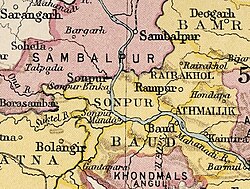 | |||||||
| Athmallik State in the Imperial Gazetteer of India | |||||||
| Capital | Kaintragarh | ||||||
| Demonym | Athmallikia | ||||||
| Area | |||||||
• | 1,890 km2 (730 sq mi) | ||||||
| Population | |||||||
• | 64,276 | ||||||
| Government | |||||||
| • Type | Monarchy | ||||||
| • Motto | salus populi suprema lex esto | ||||||
| Raja | |||||||
• 11th century | Pratap Deo | ||||||
• 1785-1802 | Lakshmidhar Deo | ||||||
• 1852-1879 | Jogindra Deo | ||||||
• 1876-1901 | Maharaja Mahendra Deo | ||||||
• 1901-1918 | Bibhubendra Deo | ||||||
• 1918-1948 | Kishore Chandra Deo | ||||||
| Historical era | 11th century | ||||||
• Established | 16th century | ||||||
| 1948 | |||||||
| |||||||
| Today part of | Angul, Odisha | ||||||

Athmallik State (Odia: ଆଠମଲ୍ଲିକ) was a princely states of India during the period of the British Raj. It Came under the Eastern States Agency.The state was a former jagir recognized as a state in 1874 and had its capital in Kaintragarh near the town of Athmallik.1 located in the present-day Angul district of Odisha. It had an area of 1,890 square kilometres (730 sq mi) and a population of 64,276 and with an average annual revenue of Rs.2,17,000 at the colonial period.
History
The Princely State of Athmallik was a part of the ex-state of Baudh until 18th century and was recognized as a separate princely state in 1874. Athmallik was one of the 26 feudatory states of Odisha. Kaintragarh was the capital of Athmallik State.
Earlier the region was called as Domgarh a Dom tribe king was ruled under him. The history of princely states reveals that the royal dynasty of Athmallik evolved from 'Kadamba Dynasty'. This Kadamba Dynasty is symbolised with a Kadamba flower upon which an umbrella and two swords are embedded. The presiding deity of this Dynasty and region is “Maa Maheswari".
It is told that in 11th Century AD Pratap Deo, a prince from Jaipur Royal Dynasty came to visit Jaganath temple in puri and later occupied Domgarh after defeating a Dom Tribe King and established this State and declared himself as king of this area. Pratap Deo was said to have found a Honda (Metal Vessel) which was considered to be lucky enough, after which the territory was then named as "Hondapa".
"Maharaja Mahendra Deo Samant" was the only ruler of the dynasty who the title of "Maharaj" Usually the kings of big states like " Mayurbhanj" " Patna" "Sonepur" "Kalahandi" had the title "Maharaj" but the people and British impressed because of great works done by him so they gave the title" Maharaj" . During his period the population of his state was very low therefore revenue was also low . He started developing agricultural lands and started farming and promoted agriculture and education so the people from other princely states like Rairakhol, Sonepur, Boudh, Talcher, and British territory Angul came and settled there. Villages of Athmallik has semifeudal chiefs or "village heads" such as "Pradhans" and "Gountias" . There are many communities both tribal and non tribal . people from Chasa (agricultural caste)community who are village heads are called with the title "Pradhan" they had large amount of land and many "halia" (agricultural labourer) they are on the top of social hierarchy. They have a significant presence in royal court. They have also involved in other jobs like teaching. They hold most of the land resources of the state and more linked with royal court and peoples .they got privilege in field of education and political roles, because they hold most of the land resources of the state.Village heads who are from other communities like gond, kondh, Brahmins are called as "Gountia".
On 1 January 1948 the last ruler of Athmallik Raja Kishore Chandra Deo Samant signed the Instrument of accession to the Indian Union after independence and following which it merged with the state of Odisha forming a part of the Dhenkanal District. In 1 April 1999, the Dhenkanal District was divided to create the Angul District, and Athmallik became a sub-division of Angul.
Rulers
Rulers of the State of Athmallik are as follows:.2
- Raja Pratap Deo (11th century)
- Raja Lakshmidhar Deo Samant (1785-1802)
- Raja Jogindra Deo Samant (1852-1879)
- Maharaja Mahendra Deo (1876-1901)
- Raja Bibhendra Deo S (1901-1918)
- Raja Kishore Chandra Deo (b. 1904) (3 Nov 1918 – 1 Jan 1948)
Titular
- Raja Surajmani Deo (b. 1995)
References
References
- L. E. B. Cobden-Ramsay, Feudatory States of Orissa: Bengal District Gazetteers, p. 115
- "Rulers". Rulers.org. Retrieved 26 October 2012.
External links
External links
- Athmallik State – Pictures of the Palace Archived 24 May 2018 at the Wayback Machine
20°43′11″N 84°31′48″E / 20.71972°N 84.53000°E / 20.71972; 84.53000