| Astronotus | |
|---|---|
| |
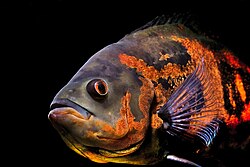
| Oscar (A. ocellatus) | |
Scientific classification 
| |
| Kingdom: | Animalia |
| Phylum: | Chordata |
| Class: | Actinopterygii |
| Order: | Cichliformes |
| Family: | Cichlidae |
| Subfamily: | Cichlinae |
| Tribe: | Astronotini Hoedeman, 1947 |
| Genus: | Astronotus Swainson, 1839 |
| Type species | |
| Lobotes ocellatus Agassiz, 1831
| |
Astronotus is a genus of South American fish from the family Cichlidae. There are three commonly recognized species in the genus (listed below), though genetic evidence suggests that additional species exist; several of these possibly distinct populations also have very different juvenile coloration from the three recognized species.12 Astronotus ocellatus and Astronotus crassipinnis are found in the Amazon Basin, while Astronotus crassipinnis is also found in the Paraná and Paraguay rivers. The third species (Astronotus mikoljii) 2is only found in the Orinoco River and Gulf of Paria basins in Venezuela and Colombia. Astronotus species grow to 35 cm in size, and are monomorphic. They are opportunistic omnivores and consume a range of smaller fish, fruits, nuts, crustaceans, mollusks and other invertebrates in the wild.
One species, the oscar (Astronotus ocellatus), is popular in the aquarium trade. A. ocellatus forms monogamous pairs which spawn in the open, typically on a flattened stone or in a shallow depression. The juvenile colouration is different from that of the adult and may aid in camouflage of the fry.
In contrast, Astronotus crassipinnis is seldom exported for the aquarium trade.
Astronotus mikoljii, 2 differs from Astronotus crassipinnis and Astronotus ocellatus in pre-orbital depth, caudal peduncle depth, head width, and caudal peduncle length, with significant differences in average percentage values. Osteologically, it differs from the two described species by lacking a hypurapophysis on the parahypural bone (hypural complex) and having two or three supraneural bones.
In some classifications the Astronotus is the sole genus in the monogeneric tribe Astronotini of the subfamily Cichlinae.3
Species
There are currently three recognized species in this genus:4
| Image | Scientific name | Common name | Distribution |
|---|---|---|---|
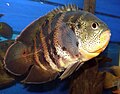 |
Astronotus crassipinnis (Heckel, 1840) | southern Amazon basin and the Paraná–Paraguay basins. | |
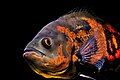 |
Astronotus ocellatus (Agassiz, 1831) | Oscar, velvet cichlid, and marble cichlid | Peru, Ecuador, Colombia, Brazil, and French Guiana, and occurs in the Amazon River basin, along the Amazon, Içá, Negro, Solimões, and Ucayali River systems |
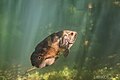 |
Astronotus mikoljii Alfredo Perez Lozano, Oscar M. Lasso-Alcalá, Pedro S. Bittencourt, Taphorn, Nayibe Perez and Izeni Pires Farias. 2022 | Mikolji’s Oscar | From the Orinoco River and Gulf of Paria Basins, northern South America5 |
References
References
- "Astronotus mikoljii". 29 July 2022.
- Perez Lozano A, Lasso-Alcalá OM, Bittencourt PS, Taphorn DC, Perez N, Farias IP (2022): A new species of Astronotus (Teleostei, Cichlidae) from the Orinoco River and Gulf of Paria basins, northern South America. ZooKeys 1113: 111–152. https://doi.org/10.3897/zookeys.1113.81240
- Wm. Leo Smith; Prosanta Chakrabarty; John S. Sparks (2008). "Phylogeny, taxonomy, and evolution of Neotropical cichlids (Teleostei: Cichlidae: Cichlinae)". Cladistics. 24 (5): 624–641. doi:10.1111/j.1096-0031.2008.00210.x. S2CID 86253260. Abstract
- Froese, Rainer; Pauly, Daniel (eds.). "Species in genus Astronotus". FishBase. February 2013 version.
- Alfredo Perez Lozano, Oscar M. Lasso-Alcalá, Pedro S. Bittencourt, Donald C. Taphorn, Nayibe Perez and Izeni Pires Farias. 2022. A New Species of Astronotus (Teleostei, Cichlidae) from the Orinoco River and Gulf of Paria Basins, northern South America. ZooKeys. 1113: 111-152. DOI: 10.3897/zookeys.1113.81240
Further reading
Further reading
- Colatreli, Meliciano, Toffoli, Farias, and Hrbek (2012). Deep phylogenetic divergence and lack of taxonomic concordance in species of Astronotus (Cichlidae). International Journal of Evolutionary Biology 2012. doi:10.1155/2012/915265