| Asthenocormus Temporal range:
| |
|---|---|
| |
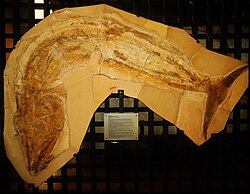
| Fossil of Asthenocormus | |
Scientific classification 
| |
| Kingdom: | Animalia |
| Phylum: | Chordata |
| Class: | Actinopterygii |
| Order: | †Pachycormiformes |
| Family: | †Pachycormidae |
| Subfamily: | †Asthenocorminae |
| Genus: | †Asthenocormus Woodward, 1895 |
| Species: | †A. titanius
|
| Binomial name | |
| †Asthenocormus titanius (Wagner, 1863)
| |

Asthenocormus is an extinct genus of large marine pachycormiform ray-finned fish. It contains a single species, A. titanius.1 A member of the edentulous suspension feeding clade within the Pachycormiformes, fossils have been found in the Upper Jurassic plattenkalks of Bavaria, Germany.234
References
References
- Sepkoski, Jack (2002). "A compendium of fossil marine animal genera". Bulletins of American Paleontology. 364: 560. Archived from the original on July 23, 2011. Retrieved 2009-02-27.
- Maxwell, Erin; Lambers, Paul; Lopez-Arbarello, Adriana; Schweigert, Günter (2020). "Re-evaluation of pachycormid fishes from the Late Jurassic of Southwestern Germany". Acta Palaeontologica Polonica. 65. doi:10.4202/app.00749.2020. ISSN 0567-7920.
- Liston, J. J. (2008), Arratia, G.; Schultze, H.-P.; Wilson, M. V. H. (eds.), A review of the characters of the edentulous pachycormiforms Leedsichthys, Asthenocormus and Martillichthys nov. gen., Munich, Germany: F. Pfeil, ISBN 978-3-89937-080-5, retrieved 2024-02-26
- Friedman, Matt; Shimada, Kenshu; Martin, Larry D.; Everhart, Michael J.; Liston, Jeff; Maltese, Anthony; Triebold, Michael (2010-02-19). "100-Million-Year Dynasty of Giant Planktivorous Bony Fishes in the Mesozoic Seas". Science. 327 (5968): 990–993. doi:10.1126/science.1184743. ISSN 0036-8075.