| Aspidosperma polyneuron | |
|---|---|
| |
Scientific classification 
| |
| Kingdom: | Plantae |
| Clade: | Embryophytes |
| Clade: | Tracheophytes |
| Clade: | Spermatophytes |
| Clade: | Angiosperms |
| Clade: | Eudicots |
| Clade: | Asterids |
| Order: | Gentianales |
| Family: | Apocynaceae |
| Genus: | Aspidosperma |
| Species: | A. polyneuron
|
| Binomial name | |
| Aspidosperma polyneuron | |
| Synonyms3 | |
| |
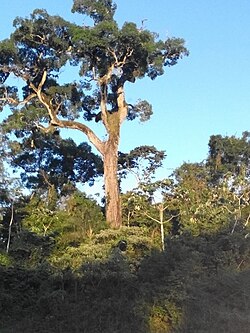
Aspidosperma polyneuron, commonly known as Peroba and Peroba Rosa,1 is a species of tree native to eastern and southern Brazil, northeastern Argentina (Misiones Province), and Paraguay in eastern South America, and to Colombia, Peru, and Venezuela in northwestern South America.34 It is a characteristic tree of the Atlantic Forest of eastern Brazil. In addition, it is useful for beekeeping.567
It is a popular timber tree, and has been over-exploited across parts of its range. The IUCN Red List assesses the species as Endangered.1
A carboline alkaloid contained in Aspidosperma polyneuron is called Polyneuridine.8
Description
It grows up to a height of 40 m, at a rate of 50 cm/year; in the forest, it is an emergent tree.
It flowers from September to November and fruits from October to November.
Uses
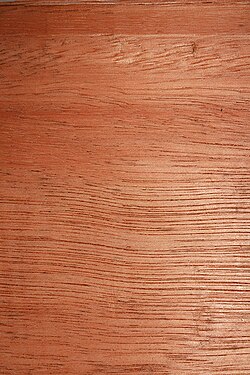
The wood is dark pink, with a specific gravity of 0.7 g/cm³. It is easy to work. In Argentina, Paraguay, and Brazil, it is used for construction, furniture, carpentry, and flooring.
References
References
- Americas Regional Workshop (Conservation & Sustainable Management of Trees, Costa Rica, November 1996) (1998). "Aspidosperma polyneuron". IUCN Red List of Threatened Species. 1998 e.T32023A9674981. doi:10.2305/IUCN.UK.1998.RLTS.T32023A9674981.en. Retrieved 22 March 2026.
{{cite journal}}: CS1 maint: multiple names: authors list (link) CS1 maint: numeric names: authors list (link) - "Aspidosperma polyneuron". Germplasm Resources Information Network. Agricultural Research Service, United States Department of Agriculture. Retrieved 2008-04-02.
- "Aspidosperma polyneuron Müll.Arg". Plants of the World Online. Royal Botanic Gardens, Kew. Retrieved 22 March 2026.
- "Kew World Checklist of Selected Plant Families".
- Walderley, M.G.L., Shepherd, G.J., Melhem, T.S. & Giulietti, A.M. (eds.) (2005). Flora Fanerogâmica do Estado de São Paulo 4: 1-392. Instituto de Botânica, São Paulo.
- Oliveira-Filho, A.T. (2006). Catálogo das Árvores nativas de Minas Gerais: 1-423. Editora UFLA, Lavas, Brasil.
- Hokche, O., Berry, P.E. & Huber, O. (eds.) (2008). Nuevo Catálogo de la Flora Vascular de Venezuela: 1-859. Fundación Instituto Botánico de Venezuela.
- Antonaccio, L. D.; Pereira, N. A.; Gilbert, B.; Vorbrueggen, H.; Budzikiewicz, H.; Wilson, J. M.; Durham, L. J.; Djerassi, Carl. (June 1962). "Alkaloid Studies. XXXIII. 1 Mass Spectrometry in Structural and Stereochemical Problems. VI. 2 Polyneuridine, A New Alkaloid from Aspidosperma polyneuron and Some Observations on Mass Spectra of Indole Alkaloids 3". Journal of the American Chemical Society. 84 (11): 2161–2169. doi:10.1021/ja00870a030.
External links
External links
- (in Portuguese) Aspidosperma polyneuron
- (in Portuguese) Aspidosperma polyneuron
- (in Portuguese) Aspidosperma polyneuron