| Murphy's Asemonea jumping spider | |
|---|---|
| |
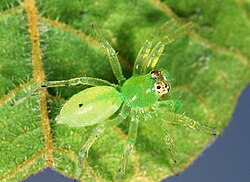
| juvenile male | |

| |
| juvenile male | |
Scientific classification 
| |
| Kingdom: | Animalia |
| Phylum: | Arthropoda |
| Subphylum: | Chelicerata |
| Class: | Arachnida |
| Order: | Araneae |
| Infraorder: | Araneomorphae |
| Family: | Salticidae |
| Genus: | Asemonea |
| Species: | A. murphyae
|
| Binomial name | |
| Asemonea murphyae | |
| Synonyms2 | |
| |
Asemonea murphyae is a species of jumping spider in the genus Asemonea that lives in Kenya and South Africa. It spins sheet webs on the underside of leaves, where the female will also lay closely-packed eggs. First described in 1980 by Fred Wanless, the spider is named after the British arachnologist Frances Murphy. Asemonea murphyae thrives in a wide range of environments, particularly by the side of rivers, streams and tracks. A small spider, with a forward section, or carapace, that is between 1.48 and 2.00 mm (1⁄16 and 1⁄16 in) long and, behind that, an abdomen between 2.4 mm (1⁄8 in) long, it is generally yellow with a green tint that enables it to blend into its environment. The female is smaller than the male. The species can be distinguished from other spiders in the same genus by its copulatory organs, particularly the design of the female's epigyne and of the male's pedipalp with its distinctive forked spike on its palpal tibia. Unlike other jumping spiders, Asemonea murphyae moult in the open.
Taxonomy and etymology
Asemonea murphyae is a species of jumping spider, a member of the family Salticidae, that was first described by the British arachnologist Fred Wanless in 1980.2 He originally allocated the species to the genus Asemonea, first raised by Octavius Pickard-Cambridge in 1869. The genus is related to Lyssomanes.3 Molecular analysis demonstrates that the genus is similar to Goleba and Pandisus.4
In Wayne Maddison's 2015 study of spider phylogenetic classification, the genus Asemonea was the type genus for the subfamily Asemoneinae, split from Lyssomaninae.5 A year later, in 2016, Jerzy Prószyński named it as the type genus for the Asemoneines group of genera, which was also named after the genus.6 The spider is named after Frances Murphy, a leading member of the British Arachnological Society.78 The species was originally named Asemonea murphyi but was renamed with its current ending by Wanda Wesołowska and Charles Haddad in 2001.9
Description

Asemonea murphyae is small with a typical total length of between 3.4 and 3.92 mm (1⁄8 and 1⁄8 in). It has a body divided into two main sections. The male has a pear-shaped carapace, the upper part of its main forward section, that is between 1.78 and 2.00 mm (1⁄16 and 1⁄16 in) long and between 1.5 and 1.58 mm (1⁄16 and 1⁄16 in) wide. It is yellow-orange or yellow-brown with a lighter whitish or whitish-yellow eye field. Its eyes are mounted on tubercles and in the majority cases surrounded by black markings and a fringe of white hair. The part of the underside of this forward section, called its sternum, is heart-shaped and whitish-yellow. The spider's face, or clypeus is pale yellow. The chelicerae are whitish with two teeth to the front and five to the back while the part of its mouthparts known as its labium is shiny whitish-yellow.
The main rear section of the male spider, its abdomen, is pale yellow and between 2.18 and 2.5 mm (1⁄16 and 1⁄8 in) long and typically 1.3 mm (1⁄16 in). It has a faint dark pattern. The spider's spinnerets are long, thin and pale yellow, apart from the very tips. The spider has long thin legs that are generally a pale yellow, ranging from whitish-yellow to yellow-brown. They have patches of black. Its pedipalps, sensory organs near its face. are orange-brown with a then palpal femur and furrow on the top surface. At the end of its pedipalp is its copulatory organ. It has a long thin apophysis, or spike, on its femur and an apophysis on the tibia that has a forked end.1011
The female looks similar to the male. It is slightly smaller, typically between 3.4 and 3.42 mm (1⁄8 and 1⁄8 in) in total length with a carapace that is between 1.48 and 1.52 mm (1⁄16 and 1⁄16 in) long and 12 mm (1⁄2 in) and an abdomen typically 1.96 mm (1⁄16 in) long. Its carapace is pale yellow, tending to whitish-yellow in the eye field. There are traces of black bands across its surface]. Its eyes are surrounded by black rings and creamy-white hairs, while its clypeus and labium are similar to the male. It has shiny yellow-brown chelicerae. The female spider's abdomen is whitish-yellow with a pattern of scattered black spots and bars. It has pale yellow spinnerets and whitish-yellow to pale yellow-brown legs. It visible external part of its copulatory organs, its epigyne, has a small depression in the centre. The copulatory openings lead to simple seminal ducts and large bulbous spermathecae, or receptacles.12
The spider is similar to other species in the genus. The species can be confused with the related Asemonea maculata, particularly as the pattern on its abdomen is alike.12 It can be distinguished from Asemonea fimbriata by the lack of hairs on the legs, but can be most easily differentiated from other species by its copulatory organs. The male's forked tibial apophysis is particularly distinctive.13 The female is similar to Asamonea ornatissima, differing in the internal structure of the epigyne.14 Despite their very different species distribution, the male resembles both Asemonea pinangensis and Asemonea tanikawai, but differs in the form of its pedipalp.15
Behaviour
Like other Asemonea spiders, Asemonea murphyae rarely jumps. Instead, the spider will generally walk and run. It spins sheet webs on the underside of leaves, where the female will also lay its eggs. The eggs are generally placed close together.16 The spider is predominantly a diurnal hunter that uses its good eyesight to spot its prey.1712 it preys on a range of insects, but rarely flies and then only when they are caught in its web.18 The spider is also likely to eat nectar if it is available.19 It uses visual displays during courtship and transmits vibratory signals through silk to communicate to other spiders.20 Unlike other jumping spiders, Asemonea murphyae moult in the open.12
Distribution and habitat
Asemonea murphyae is lives in Kenya and South Africa.21 The male holotype was found near Naro Moru in central Kenya in 1974. The specimen was found by Frances M. Murphy and held in her collection. The first female paratype was discovered in forest near Kitale in 1972. The spider lives in liminal spaces, including shaded bushes at the side of a river and low shrubs at the edge of a track.12 Other examples have been found near rivers and streams on the side of Mount Elgon at altitudes between 2,130 and 2,250 m (6,990 and 7,380 ft) above sea level.9 The spider lives in the west and central parts of the country.22 The first example to be found in South Africa was discovered near Cathedral Peak in KwaZulu-Natal at an altitude of 1,200 m (3,900 ft) above sea level. This confirmed that the species also lives in low-growing grasses and ferns in Afromontane grassland.23
References
References
Citations
- Wanless 1980.
- World Spider Catalog 2017.
- Jackson 1990, p. 1.
- Maddison 2015, p. 236.
- Maddison 2015, p. 235.
- Prószyński 2017, p. 122.
- Wanless 1980, p. 233.
- Sherwood 2022, p. 140.
- Wesołowska 2001, p. 579.
- Wanless 1980, pp. 231–232.
- Wesołowska 2001, p. 580–581.
- Wanless 1980, p. 232.
- Wanless 1980, p. 229.
- Wanless 1980, p. 239.
- Ikeda 1996, p. 116.
- Jackson 1990, p. 2.
- Richman & Jackson 1992, p. 33.
- Jackson 1990, p. 3.
- Jackson et al. 2001, p. 28.
- Richman & Jackson 1992, p. 34.
- Kioko et al. 2021, p. 142.
- Wesołowska 2001, p. 581.
- Wesołowska & Haddad 2013, p. 185.
Bibliography
- Ikeda, Hiroyoshi (1996). "A new species of the genus Asemonea (Araneae: Salticidae) from Japan". Acta Arachnologica. 45 (2): 113–117. doi:10.2476/asjaa.45.113. Retrieved 20 September 2023.
- Jackson, Robert R. (1990). "Comparative study of Lyssomanine jumping spiders (Araneae: Salticidae): Silk use and predatory behaviour of Asemonea, Goleba, Lyssomanes, and Onomastus". New Zealand Journal of Zoology. 17 (1): 1–6. doi:10.1080/03014223.1990.1042257.
- Jackson, Robert R.; Pollard, Simon D.; Nelson, Ximena J.; Edwards, G. B.; Barrion, Alberto T. (2001). "Jumping spiders (Araneae: Salticidae) that feed on nectar". Journal of Zoology. 255 (1): 25–29. doi:10.1017/S095283690100108X.
- Kioko, Grace M.; Marusik, Yuri M.; Li, Shuqiang; Kioko, Esther N.; Ji, Liqiang (2021). "Checklist of the spiders (Araneae) of Kenya". African Invertebrates. 62 (1): 47–229. doi:10.3897/AfrInvertebr.62.58776.
- Maddison, Wayne P. (2015). "A phylogenetic classification of jumping spiders (Araneae: Salticidae)". The Journal of Arachnology. 43 (3): 231–292. doi:10.1636/arac-43-03-231-292. S2CID 85680279.
- Prószyński, Jerzy (2017). "Pragmatic classification of the World's Salticidae (Araneae)". Ecologica Montenegrina. 12: 1–133. doi:10.37828/em.2017.12.1.
- Richman, David B.; Jackson, Robert R. (1992). "A review of the ethology of jumping spiders (Araneae, Salticidae)". Bulletin of the British Arachnology Society. 9 (2): 33–37.
- Sherwood, Danniella (2022). "Few and far between: a history of women in British arachnology 1800–2000" (PDF). Arachnology. 19: 137–149. doi:10.13156/arac.2022.19.sp1.137.
- Wanless, Fred R. (1980). "A revision of the spider genera Asemonea and Pandisus (Araneae: Salticidae)". Bulletin of the British Museum (Natural History) Zoology. 39 (4): 213–257. doi:10.5962/bhl.part.13273.
- Wesołowska, Wanda (2001). "New and rare species of the genus Asemonea O. P.-Cambridge, 1869 from Kenya (Araneae: Salticidae)". Genus. 12: 577–584.
- Wesołowska, Wanda; Haddad, Charles R. (2013). "New data on the jumping spiders of South Africa (Araneae: Salticidae)". African Invertebrates. 54 (1): 177–240. doi:10.5733/afin.054.0111. S2CID 59450669.
- World Spider Catalog (2017). "Asemonea murphyae Wanless, 1980". World Spider Catalog. 24.5. Bern: Natural History Museum. Retrieved 23 September 2023.