| Arum apulum | |
|---|---|

| |
Scientific classification 
| |
| Kingdom: | Plantae |
| Clade: | Embryophytes |
| Clade: | Tracheophytes |
| Clade: | Spermatophytes |
| Clade: | Angiosperms |
| Clade: | Monocots |
| Order: | Alismatales |
| Family: | Araceae |
| Genus: | Arum |
| Species: | A. apulum
|
| Binomial name | |
| Arum apulum (Carano) P.C.Boyce
| |
| Synonyms2 | |
| |
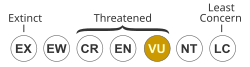
Arum apulum, known as Apulian arum, is a flowering plant species in the family Araceae.
Description
Arum apulum is a tuberous herbs that spreads clonally through discoid vertically oriented tubers.2 Flowers are borne on a spadix.2
Its flowers release a dung scent detectable by pollinators of the Sphaeroceridae and Chironomidae families. The dominant volatile compounds are l-decene, dimethyl-octadiene, and p-cresol.34
Habitat
The species is endemic to Italy, where it grows in low scrub at altitudes of 300 to 400 meters in central Apulia.12 It is threatened by habitat destruction.1
Taxonomy
Within the genus Arum, it belongs to subgenus Arum, section Dioscoridea, and subsection Dischroochiton.2
A. apulum is tetraploid, with a chromosome count of 2n = 56.2
References
References
- Wagensommer, R.P. (2017). "Arum apulum". IUCN Red List of Threatened Species. 2017 e.T13133499A83442507. doi:10.2305/IUCN.UK.2017-3.RLTS.T13133499A83442507.en. Retrieved 19 November 2021.
- Boyce 1993.
- Kite 2000.
- Gibernau, Macquart & Przetak 2004.
Bibliography
Bibliography
- Gibernau, Marc; Macquart, David; Przetak, Gilles (2004). "Pollination in the genus Arum – a review" (PDF). Aroideana. 27: 148–166. ISSN 0197-4033.
- Kite, Geoffrey C.; et al. (2000). "Inflorescence odours and pollinators of Arum and Amorphophallus (Araceae)" (PDF). Reproductive Biology in Systematics, Conservation and Economic Botany. pp. 295–315. ISBN 1-900347-62-8.
- Boyce, Peter C. (1993-05-14). The Genus Arum. Kew Royal Botanic Gardens. ISBN 0-11-250085-4.