| Armazic | |
|---|---|
| Armazian | |
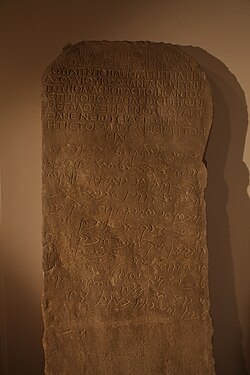 The Stele of Serapeitis, written in both Greek and the Armazic script. | |
| Native to | Armenia and Georgia |
| Region | South Caucasus |
| Era | 1–100 AD1 |
Afro-Asiatic
| |
| Aramaic | |
| Language codes | |
| ISO 639-3 | xrm |
| Glottolog | None |
Armazic (also called Armazian) is an extinct written Aramaic language used as a language of administration in the South Caucasus in the first centuries AD.2 Both the Armazic language and script were related to the Aramaic of northern Mesopotamia. The name "Armazic" was introduced by the Georgian scholar Giorgi Tsereteli in reference to Armazi, an ancient site near Mtskheta, Georgia, where several specimens of a local idiom of written Aramaic have been found, most famous among them the Stele of Serapeitis, bilingual in Greek. Beyond several sites in eastern Georgia, an Armazic-type inscription is also present on the temple of Garni in Armenia. The latest specimen of Armazic is an inscription of a 3rd-century plate from Bori, Georgia.3
References
References
- "Armazic - MultiTree". LINGUIST List. Archived from the original on 12 December 2019. Retrieved 2024-04-19.
1st-2nd centuries AD.
- Mgaloblishvili, Tamila; Rapp, Stephen H. (2011). "Chapter Seventeen: Manichaeism in late antique Georgia?". In van den Berg, Jacob Albert; Kotzé, Annemaré; Nicklas, Tobias; Scopello, Madeleine (eds.). In Search of Truth: Augustine, Manichaeism and other Gnosticism: Studies for Johannes van Oort at Sixty. Leiden: Brill. p. 287f. ISBN 978-90-04-18997-3. Retrieved 1 September 2014.
- Rapp, Stephen H. (2014). The Sasanian World through Georgian Eyes: Caucasia and the Iranian Commonwealth in Late Antique Georgian Literature. Ashgate Publishing. p. 215. ISBN 978-1472425522.