| Armadillo Formation | |
|---|---|
| Stratigraphic range: | |
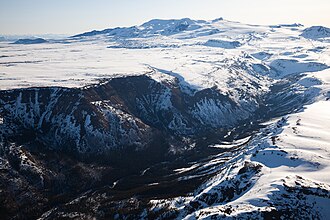 Basaltic lava flows of the Armadillo Formation are exposed in Sezill Creek valley | |
| Type | Geological formation1 |
| Unit of | Mount Edziza volcanic complex2 |
| Underlies | Ice Peak Formation, Spectrum Formation, Big Raven Formation, Nido Formation1 |
| Overlies | Little Iskut Formation, Raspberry Formation1 |
| Lithology | |
| Primary | Alkali basalt, comendite, trachyte1 |
| Location | |
| Coordinates | 57°30′N 130°36′W / 57.5°N 130.6°W / 57.5; -130.62 |
| Region | British Columbia1 |
| Country | Canada1 |
| Type section | |
| Named for | Armadillo Peak1 |
| Named by | Souther et al.3 |
| Year defined | 19843 |
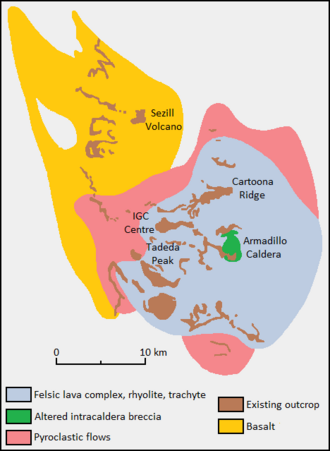 Paleogeological map showing the inferred maximum extent of the Armadillo Formation at the end of the Armadillo eruptive period | |
The Armadillo Formation is a stratigraphic unit of Miocene age in northwestern British Columbia, Canada.
Name
The Armadillo Formation takes its name from Armadillo Peak, a volcanic peak east of Raspberry Pass in the middle of the Mount Edziza volcanic complex.14
Geology
The Armadillo Formation has a volume of 159 km3 (38 mi3), making it the most voluminous of the 13 geological formations comprising the Mount Edziza volcanic complex.2 It conformably overlies the Little Iskut Formation, as well as the Raspberry Formation. It is overlain by the Ice Peak Formation, Nido Formation, Spectrum Formation and Big Raven Formation.1
The Armadillo Formation consists of volcanic rocks of both felsic and mafic compositions. They are the products of a long period of bimodal volcanism, having issued from multiple eruptive centres. The felsic rocks include trachyte and comenditic rhyolite which form pyroclastic deposits, lava domes and lava flows. Basalt is the main mafic rock of the Armadillo Formation and forms lava flows.1
K–Ar dating of the Armadillo Formation has yielded ages of 10.2 ± 1.4 million years for comendite, 6.9 ± 0.3 million years and 6.1 ± 0.1 million years for comenditic ash flows, 6.9 ± 0.3 million years for comenditic glass and 6.5 ± 0.2 million years, 6.3 ± 0.5 million years, 6.2 ± 0.1 million years and 6.1 ± 0.2 million years for hawaiite.1 The first age is anomalously old and most likely results from excessive atmospheric argon.3
References
References
- Souther, J. G. (1992). The Late Cenozoic Mount Edziza Volcanic Complex, British Columbia. Geological Survey of Canada (Report). Memoir 420. Canada Communication Group. pp. 32, 61, 71, 246, 267. doi:10.4095/133497. ISBN 0-660-14407-7.
- Edwards, Benjamin Ralph (1997). Field, kinetic, and thermodynamic studies of magmatic assimilation in the Northern Cordilleran Volcanic Province, northwestern British Columbia (PhD thesis). University of British Columbia. p. 10. ISBN 0-612-25005-9.
- "Armadillo Formation". Lexicon of Canadian Geologic Units. Government of Canada. Retrieved 2023-08-04.
- "Little Iskut River". BC Geographical Names. Government of British Columbia – B.C. Geographical Names Office (BCGNO). Archived from the original on 2021-09-30. Retrieved 2023-06-28.