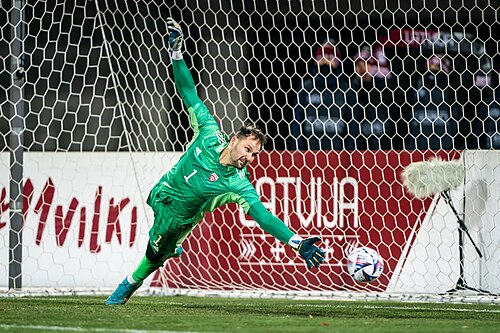
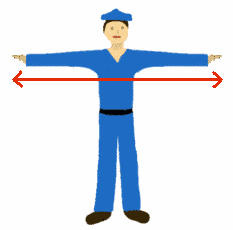
Arm span or reach (sometimes referred to as wingspan, or spelled armspan) is the physical measurement of the length from one end of an individual's arms (measured at the fingertips) to the other when raised parallel to the ground at shoulder height at a 90° angle. The arm span measurement is usually very close to the person's height. Age, sex, and ethnicity1 have to be taken into account to best predict height from arm span.2 Arm span may be used as a height measurement when it cannot be obtained for health reasons.
Arm span in sports
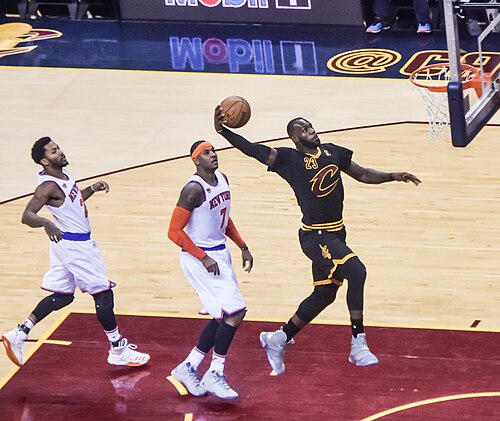
An above-average reach may be advantageous in sports such as Australian rules football, basketball, tennis, boxing, mixed martial arts, volleyball, discus throw, fencing, rock climbing, and swimming. For instance, boxer Sonny Liston, while 185 cm (6 ft 1 in) tall, had a reach of 213 cm (7 ft 0 in).3 Another example is former UFC Heavyweight and Light Heavyweight Champion Jon Jones, who is 193 cm (6 ft 4 in) tall, but has an advantageous reach of 215 cm (7 ft 0.5 in).4 This unusually long reach has allowed them to hit from relatively safe distances where opposing fighters cannot hit back. However, a long arm span is mechanically disadvantageous on the bench press.
Arm span, functional reach and joint centration
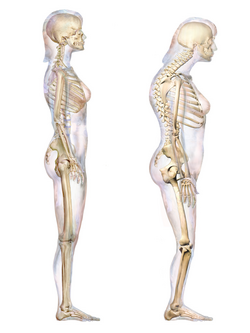
A person's arm span is influenced by the positioning and alignment of their joints and especially their shoulder joints. Joint centration is when joints are optimally positioned and aligned in a centered way both when a person is still and when they are moving. In regard to the shoulders, whereby they are centrated they are broader set and the arm span is increased. This is considered relatively to if they were decentrated i.e. if the shoulders were hunched forwards as part of a person's usual posture, they would not be optimally positioned and aligned and their arm span would be reduced.5
Neck (cervical spine) decentration is a primary catalyst for shoulder decentration due to the way in which the joints influence each other in a kinetic chain.6 For example, a person with the forward head posture condition will also usually have the rounded shoulder posture condition.7 As such, in order to achieve maximum arm span, without straining, it is also necessary that the neck, and other joints, are also positioned and aligned optimally. Arm span influences a person's functional reach (how far they can reach forward to achieve a practical goal while maintaining their sense of balance) and the biomechanical leverage which can be applied by their arms.8 Both of which are useful in many competitive physical events. For these reasons, sport and athletic training regimes seek to optimise a person's arm span and maximise functional reach efficiency by performing various exercises which centrate the joints, thereby also improving their respective stability and mobility, and enhance postural control.9 Such sports include basketball,10 baseball,11, tennis,12 boxing and MMA.
Procedure
The most common and easily accessible method of measuring armspan uses the demi-span. Using a tape measure, measure from the individual's sternal notch (center of the breastbone) to their middle finger as it is stretched out to one side, then double the demi-span for the actual armspan measurement. Demi-span is used because measuring from fingertip to fingertip is difficult, requiring two people or markings on a wall.
Height estimation
For bed-ridden patients, direct measurement of height is typically impractical. Since on average, a person's arm-span and height are equal, the measured span may be used as a good estimate of height.13
Arm span in healthcare
Arm span is sometimes used when a height measurement is needed but the individual cannot stand on a traditional stadiometer or against a wall due to abnormalities of the back or legs, such as scoliosis, osteoporosis, amputations, or those who are confined to a bed or use a wheelchair. Other, possibly more accurate measuring techniques include knee length or recumbent length when possible.14
Because any decrease in height will cause an increase in the ratio of arm span to height, a large span to height ratio may sometimes be an indicator of a health problem that caused a vertical height loss such as postural changes due to ageing or any spinal conditions such as degenerative disc disease.
References
References
- Reeves SL, Varakamin C, Henry CJ (June 1996). "The relationship between arm-span measurement and height with special reference to gender and ethnicity". European Journal of Clinical Nutrition. 50 (6): 398–400. PMID 8793422.
- Capderou A, Berkani M, Becquemin MH, Zelter M (January 2011). "Reconsidering the arm span-height relationship in patients referred for spirometry". The European Respiratory Journal. 37 (1): 157–63. doi:10.1183/09031936.00199209. PMID 20530045.
- David J. Epstein, The Sports Gene: Inside the Science of Extraordinary Athletic Performance (New York: Current, 2013), p 135.
- "12 MMA Fighters With Incredible Ape Indices". UFC.com. Archived from the original on 6 October 2014. Retrieved 15 November 2019.
- Edelle C., Field-Fote (2009). Spinal Cord Injury Rehabilitation. Philadelphia: F. A. Davis. p. 164. ISBN 978-0-8036-1717-9.
- Cohen, Steven (May 2025). "The Baseball Athlete". Clinics in Sports Medicine. Philadelphia: Elsevier. ISBN 9780443297977.
- Edelle C., Field-Fote (2009). Spinal Cord Injury Rehabilitation. Philadelphia: F. A. Davis. p. 164. ISBN 978-0-8036-1717-9.
- Foran, Bill (2026). Complete Conditioning for Basketball: National Basketball Strength and Conditioning Association. Champaign: Human Kinetics. pp. 14–15. ISBN 978-1-7182-1660-0.
- Foran, Bill (2026). Complete Conditioning for Basketball: National Basketball Strength and Conditioning Association. Champaign: Human Kinetics. pp. 4–5. ISBN 978-1-7182-1660-0.
- Fu, Dr. Michael. "3 Tips for Shoulder Injury Prevention". NBPA. National Basketball Players Association. Retrieved 6 May 2026.
- Cohen, Steven (May 2025). "The Baseball Athlete". Clinics in Sports Medicine. Philadelphia: Elsevier. ISBN 9780443297977.
- Vagy, Jared; Matsumoto, Tyson. "Reaching Alignment: Joint Centration for Athletes". medbridge. Retrieved 29 May 2026.
{{cite web}}: CS1 maint: multiple names: authors list (link) - Tharp R. "Estimating height in bedridden patients". RxKinetics. Retrieved 7 September 2018.
- Froehlich-Grobe K, Nary DE, Van Sciver A, Lee J, Little TD (August 2011). "Measuring height without a stadiometer: empirical investigation of four height estimates among wheelchair users". American Journal of Physical Medicine & Rehabilitation. 90 (8): 658–66. doi:10.1097/PHM.0b013e31821f6eb2. PMC 3148840. PMID 21681063.
Further reading
- Tan MP, Wynn NN, Umerov M, Henderson A, Gillham A, Junejo S, Bansal SK (February 2009). "Arm span to height ratio is related to severity of dyspnea, reduced spirometry volumes, and right heart strain". Chest. 135 (2): 448–454. doi:10.1378/chest.08-1270. PMID 18849402.