| Ardagh Fort | |
|---|---|
| Lios Ardach (Irish) | |
| Reerasta Rath, Ravenstar Fort, Ardagh Ringfort1 | |
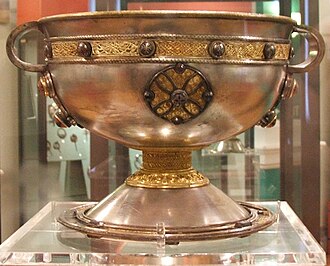 The Ardagh Chalice, buried at Ardagh Fort c. 1740 | |
Location within Ireland | |
| 52°29′37″N 9°04′05″W / 52.493580°N 9.068153°W / 52.493580; -9.068153 | |
| Type | ringfort |
| Periods | Bronze/Iron Age |
| Cultures | Gaelic Ireland |
| Location | Reerasta South, Ardagh, County Limerick, Ireland |
| Region | Shannon Valley |
| History | |
| Built | 1000 BC |
| Site notes | |
| Material | earth |
| Elevation | 103 m (338 ft) |
| Diameter | 62 m (203 ft) |
| Owner | State |
Official name | Ardagh Ringfort |
| Reference no. | 4592 |
Ardagh Fort is a ringfort (rath) and National Monument in County Limerick, Ireland, famous as the discovery site of the Ardagh Hoard.
Location
Ardagh Fort is located immediately west of the crossroads at Ardagh, atop a hill 103 m (338 ft) above sea level, overlooking the Daar River.3
History
The hillfort dates to the late Bronze Age or early Iron Age, c. 1000 BC.
In late September 1868 two local boys, Jimmy Quin and Paddy Flanagan,4 were digging potatoes at the southwest edge of the fort5 — farmers often avoided forts, believing them to be abodes of the Aos Sí (fairies), but they may have chosen the site in the belief that it would protect against potato blight. There, they discovered the Ardagh Hoard: a beautiful silver and gold chalice, a stemmed copper-alloy cup, and four brooches, all from the 8th or 9th centuries AD. There was also a wooden cross from the Penal era: it bore the inscription "727", presumably short for "1727", and the goods may have been concealed c. 1740. Catholic Mass is said to have been said at the rath in the penal era.67
Description
A rath with a high bank and deep ditch to the north and south; the east and west walls were never built. It covers 0.3 ha (3⁄4 acre).89
References
References
- Redknap, Mark (1 January 2001). Pattern and Purpose in Insular Art: Proceedings of the Fourth International Conference on Insular Art Held at the National Museum & Gallery, Cardiff 3-6 September 1998. Oxbow. ISBN 9781842170588 – via Google Books.
- "National Monuments in State Care: Ownership & Guardianship" (PDF). National Monuments Service. 4 March 2009. p. 6.
- Academy, Royal Irish (1 January 1917). "Proceedings of the Royal Irish Academy: Mathematical, astronomical, and physical science". The Academy – via Google Books.
- "Memorial to Ardagh Chalice to be unveiled - Limerick Leader". Archived from the original on 18 November 2017. Retrieved 25 May 2019.
- Anderson, John P. (1 January 2010). Joyce's Finnegans Wake: The Curse of Kabbalah. Universal-Publishers. ISBN 9781599428581 – via Google Books.
- "Limerick Diocesan Heritage Project - Ardagh-Carrickerry Parish".
- "The Ardagh Chalice: History and Decoration - Claddagh Design".
- Shiels, Damian (13 September 2011). "Hillforts, Ringforts & Hoards: The Archaeology of Ardagh, Co. Limerick".
- "Ardagh Ring Fort". 21 June 2011. Archived from the original on 3 April 2017. Retrieved 2 April 2017.