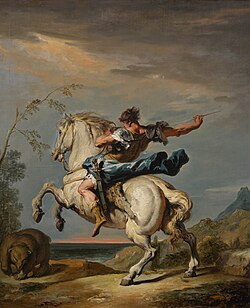
In Greek mythology, Arcas (/ˈɑːrkəs/; Ancient Greek: Ἀρκάς) was a hunter who became king of Arcadia. He was remembered for having taught people the arts of weaving and baking bread and for spreading agriculture to Arcadia.
Family
Arcas was the son of Zeus and Callisto.1 In other accounts, his birth mother was called Megisto, daughter of Ceteus, son of Lycaon,2 or else Themisto, daughter of Inachus.3
Arcas was married to either Laodamia (Leaneira), daughter of Amyclas of Sparta; Meganeira, daughter of Crocon;4 the nymph Chrysopeleia; or the Dryad Erato. He also left a number of children, including the sons Azan, Apheidas, Elatus, and Triphylus,5 an illegitimate son Autolaus6 and at least two daughters, Hyperippe7 and Diomeneia.8 Arcas's other sons were Erymanthus9 and Pelasgus.10
| Relation | Names | Sources | |||
|---|---|---|---|---|---|
| Apollodorus's Bibliotheca | Pausanias's Description of Greece | ||||
| Parents | Callisto and Zeus | ✓ | ✓ | ||
| Wife | Leanira | ✓ | |||
| Meganira | ✓ | ||||
| Chrysopelia | ✓ | ||||
| Erato | ✓ | ||||
| Laodameia | ✓ | ||||
| Unknown | ✓ | ||||
| Children | Elatus | ✓ | ✓ | ||
| Apheidas | ✓ | ✓ | |||
| Azan | ✓ | ||||
| Triphylus | ✓ | ||||
| Pelasgus | ✓ | ||||
| Hyperippe | ✓ | ||||
| Diomeneia | ✓ | ||||
| Erymanthus | ✓ | ||||
| Autolaus | ✓ | ||||
Mythology
Callisto was a nymph in the retinue of the goddess Artemis, or in some sources the daughter of King Lycaon. As she would not be with anyone but Artemis, Zeus cunningly disguised himself as Artemis and raped Callisto. The child resulting from their union was called Arcas.111213
Hera became jealous, and in anger, she transformed Callisto into a bear. She would have done the same or worse to her son, but Zeus hid Arcas in an area of Greece, which would come to be called Arcadia, in his honor. Arcas was given into a care of one of the Pleiades, Maia. There, Arcas safely lived until one day, during one of the court feasts held by king Lycaon (Arcas's maternal grandfather), Arcas was placed upon the burning altar as a sacrifice to the gods. He then said to Zeus, "If you think that you are so clever, make your son whole and un-harmed". Zeus became enraged and made Arcas whole and directed his anger toward Lycaon, turning him into the first werewolf.1415
Then, Arcas became the new king of Arcadia and the country's greatest hunter. One day, when Arcas went hunting in the woods, he came across his mother. Seeing her son after so long, she went forth to embrace him. Not knowing that the bear was his mother, he went to kill her with an arrow. In one version of the story, Arcas hunted Callisto because she had entered the forbidden sanctuary of Zeus on Mt. Lykaion.16 Zeus however, watching over them, stopped Arcas from shooting Callisto and raised them into the heavens as constellations (Boötes17 and Ursa Major). When Hera heard of that, she became so angry that she asked Tethys to keep them in a certain place so that the constellations would never sink below the horizon and receive water.18 Arcas's bones were brought from Mount Maenalos to an altar of Hera in Mantinea according to the instructions of the Delphic Oracle.19
Notes
Notes
- Hyginus, Fabulae 155; Pseudo-Clement, Recognitions 10, p. 123, ll. 44-45 where he was erroneously called Orcas
- Hyginus, De astronomia 2.1.6, and 2.6.2, with Araethus of Tegea as authority
- Eustathius ad Homer, Iliad p. 300; Stephanus of Byzantium, s.v. Arcadia (Ἀρκαδία); Pseudo-Clement, Recognitions 10, p. 123, l. 40
- Apollodorus, 3.9.1
- Apollodorus, 3.9.1; Pausanias, 8.4.1-2 & 10.9.5
- Pausanias, 8.4.2 & 8.25.11
- Pausanias, 5.1.4
- Pausanias, 8.9.9
- Pausanias, 8.24.1
- Pausanias, 2.14.4
- Apollodorus, 3.8.2
- Pausanias, 8.3.6
- Hyginus, Fabulae 176
- Ovid, Metamorphoses 2.401 ff.
- Ovid, Fasti 2.155 ff.
- Pseudo-Eratosthenes, Catast. fr. 1
- Ridpath 1988, p. 35
- Ovid, Metamorphoses 2.496 ff.
- Pausanias 8.9.3
References
References
- Apollodorus, The Library with an English Translation by Sir James George Frazer, F.B.A., F.R.S. in 2 Volumes, Cambridge, MA, Harvard University Press; London, William Heinemann Ltd. 1921. ISBN 0-674-99135-4. Online version at the Perseus Digital Library. Greek text available from the same website.
- Gaius Julius Hyginus, Fabulae from The Myths of Hyginus translated and edited by Mary Grant. University of Kansas Publications in Humanistic Studies. Online version at the Topos Text Project.
- Pausanias, Description of Greece with an English Translation by W.H.S. Jones, Litt.D., and H.A. Ormerod, M.A., in 4 Volumes. Cambridge, MA, Harvard University Press; London, William Heinemann Ltd. 1918. ISBN 0-674-99328-4. Online version at the Perseus Digital Library
- Pausanias, Graeciae Descriptio. 3 vols. Leipzig, Teubner. 1903. Greek text available at the Perseus Digital Library.
- Publius Ovidius Naso, Fasti translated by James G. Frazer. Online version at the Topos Text Project.
- Publius Ovidius Naso, Fasti. Sir James George Frazer. London; Cambridge, MA. William Heinemann Ltd.; Harvard University Press. 1933. Latin text available at the Perseus Digital Library.
- Publius Ovidius Naso, Metamorphoses translated by Brookes More (1859–1942). Boston, Cornhill Publishing Co. 1922. Online version at the Perseus Digital Library.
- Publius Ovidius Naso, Metamorphoses. Hugo Magnus. Gotha (Germany). Friedr. Andr. Perthes. 1892. Latin text available at the Perseus Digital Library.
- Ridpath, Ian (1988). Star Tales. Universe Books.