| Aranatha | |
|---|---|
 | |
| Venerated in | Jainism |
| Predecessor | Kunthunatha |
| Successor | Mallinatha |
| Symbol | Fish 1 |
| Height | 30 bows (90 metres) |
| Age | 84,000+ |
| Color | Golden |
| Genealogy | |
| Born | |
| Died | |
| Parents |
|
| Dynasty | Kuruvaṁśa—Ikṣvākuvaṁśa |
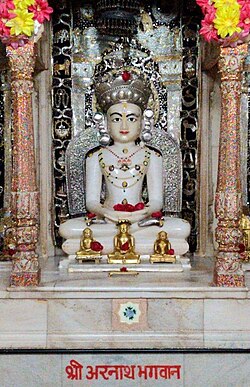
Aranath(Arnath) was the eighteenth Jain Tirthankar of the present half cycle of time (Avasarpini).2 He was also the eighth Chakravartin3 and thirteenth Kamadeva. According to Jain beliefs, he was born around 16,585,000 BCE. He became a siddha i.e. a liberated soul which has destroyed all of its karmas. Aranath was born to King Sudarshana and Queen Devi (Mitra) at Hastinapur in the Ikshvaku dynasty.2 His birth date was the tenth day of the Migsar Krishna month of the Indian calendar.
Life
Aranatha's height is mentioned as 30 dhanusha.4 Like all other Chakravartin, he also conquered all the lands3 and went to write his name on the foothills of mountains. Seeing the names of other Chakravartin already there, he saw his ambitions dwarfed. He then renounced his throne and became an ascetic for penance.3 At an age over 84,000 years he and attained Moksha (liberation) on Mount Shikharji.34
Aranatha is said to have been born 1/4 palya less 6,000 crore years after his predecessor, Kunthunatha.4 His successor, Mallinatha, is said to have been born 1,000 crore less 6,584,000 years after him.4
Worship
Svayambhūstotra by Acarya Samantabhadra is the adoration of twenty-four tirthankaras. Twenty slokas (aphorisms) of Svayambhūstotra are dedicated to Tirthankar Aranath.5 One such sloka is:
O Passionless Lord Aranatha! Your physical form which is free from all vestiges of ornaments, clothes and weapons, and the embodiment of unalloyed knowledge, control of the senses, and benevolence, is a clear indication that you have vanquished all blemishes.
— Svayambhustotra (18-2-12)6
As a historical figure
At Mathura, there is an old stupa with the inscription of 157 CE. This inscription records that an image of the tīrthankara Aranath was set up at the stupa built by the gods. However, Somadeva Suri stated in Yashstilaka and Jinaprabha Suri in Vividha Tirtha Kalpa that the stupa was erected for Suparśvanātha.7
Temples
As the 18th tirthankara, Aranatha is venerated across the Indian subcontinent with several historically and regionally significant temple complexes dedicated to him.8 The ancient city of Hastinapur in Uttar Pradesh, traditionally identified in Jain universal history as his royal birthplace, serves as a primary center for his worship.9 Within this city, the Digamber Jain Mandir Hastinapur stands as a highly revered Digambara temple complex that prominently features his idols and commemorates his early life and renunciation.9 In South India, the renowned late 16th-century Chaturmukha Basadi in Karkala, Karnataka, is heavily associated with his veneration.1011 Completed in 1586 CE, this fully symmetrical stone temple enshrines life-size idols of Aranatha, alongside the tirthankaras Mallinatha and Munisuvrata, facing all four cardinal directions.10
In western India, the Navagarh Tirth located in Maharashtra operates as a major regional pilgrimage site dedicated specifically to his worship.1 Finally, marking the geographic site of his ultimate spiritual liberation (moksha), a dedicated shrine (tonk) enshrining his footprints (charan) is actively worshipped by pilgrims on the peaks of Mount Shikharji in Jharkhand.12
-
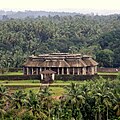 Chaturmukha basadi (Karnataka) dedicated to Tirthankara Aranath
 -
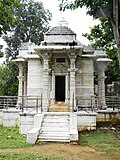 Jain temple dedicated to Tirthankar Aranath
 -
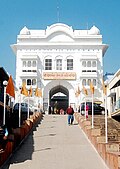 Prachin Bada Mandir, Hastinapur
 -
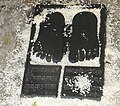 Footprints at Aranath Tonk, Shikhar Ji
References
References
Citations
- Tandon 2002, p. 45.
- Tukol 1980, p. 31.
- von Glasenapp 1999, p. 308.
- Finegan 1952, p. 190.
- Vijay K. Jain 2015, p. 118-129.
- Vijay K. Jain 2015, p. 122.
- Jain 2009, p. 77.
- Dundas 2002, p. 40.
- Titze & Bruhn 1998, p. 136.
- Michell 1990, p. 320.
- Sandhya, C D’Souza (19 November 2010), "Chaturmukha Basadi: Four doors to divinity Last updated", Deccan Herald
- Cort 2001a, p. 23.
Sources
- Cort, John E. (2001a), Jains in the World : Religious Values and Ideology in India, Oxford University Press, ISBN 978-0-19-513234-2
- Dundas, Paul (2002) [1992], The Jains (Second ed.), London and New York: Routledge, ISBN 0-415-26605-X
- Finegan, Jack (1952), The archeology of world religions, Princeton University Press
- Jain, Arun Kumar (2009), Faith & Philosophy of Jainism, Gyan Publishing House, ISBN 9788178357232, retrieved 23 September 2017
- Johnson, Helen M. (1931), Aranathacaritra (Book 6.2 of the Trishashti Shalaka Purusha Caritra), Baroda Oriental Institute
- Jain, Vijay K. (2015), Acarya Samantabhadra's Svayambhustotra: Adoration of The Twenty-four Tirthankara, Vikalp Printers, ISBN 978-81-903639-7-6, archived from the original on 16 September 2015,
This article incorporates text from this source, which is in the public domain.
- Michell, George (1990), The Penguin Guide to the Monuments of India, vol. 1, Penguin Books, ISBN 978-0140081442
- Titze, Kurt; Bruhn, Klaus (1998), Jainism: A Pictorial Guide to the Religion of Non-Violence (2 ed.), Motilal Banarsidass, ISBN 978-81-208-1534-6
- Tukol, T. K. (1980), Compendium of Jainism, Dharwad: University of Karnataka
- von Glasenapp, Helmuth (1999), Jainism: An Indian Religion of Salvation [Der Jainismus: Eine Indische Erlosungsreligion], Shridhar B. Shrotri (trans.), Delhi: Motilal Banarsidass, ISBN 81-208-1376-6
- Tandon, Om Prakash (2002) [1968], Jaina Shrines in India (1 ed.), New Delhi: Publications Division, Ministry of Information and Broadcasting, Government of India, ISBN 81-230-1013-3