Anti-Jewish boycotts are organized efforts to exclude Jews, Jewish-owned businesses, or Jewish institutions from economic, political, social, or cultural life. They have been described as a manifestation of economic antisemitism and broader antisemitic discrimination.1
19th and early 20th century boycotts
In Hungary, promotion for boycotts began in 1875 with an antisemitic speech from Győző Istóczy in the Hungarian House of Representatives.23 From the 1880s there were calls in some of the Catholic press, such as the daily newspaper Magyar Állam, for Jews to be boycotted.4 The government passed laws limiting Jewish economic activity from 1938 onwards.5
In Russia, after a series of anti-Jewish pogroms in the Russian Empire following the assassination of Tsar Alexander II, towards that end in 1880 they were forbidden from purchasing land or taking mortgages (see the May Laws). Quotas limited Jewish access to educational institutions and from 1892 they were banned from participation in local elections and could constitute no more than 10% of company shareholders.6
In 19th century Austria, Karl Lueger, an antisemitic mayor of Vienna who inspired Hitler,7 campaigned for a boycott of Jewish businesses as a last resort for his party.8 Jews were only allowed to live in Vienna from 1840. An organization called the Antisemitenbund campaigned against Jewish civil rights since 1919. Austrian campaigns tended to heighten around Christmas and became effective from 1932.9
In Ireland, Father John Creagh in Limerick campaigned against the town's small Jewish community in 1904, leading to a boycott of Jewish businesses and the departure of the Jewish population from the town.10
In Ukraine, there was a boycott of Jews in Galicia, with allegations of Jewish support for Poland, while Poles in Galicia boycotted Jews for supporting Ukraine.1 In 1921, the German student union, the Deutschen Hochschulring, barred Jews from membership. Since the bar was racial, it included Jews who had converted to Christianity.11 The bar was challenged by the government leading to a referendum in which 76% of students voted for the exclusion.11
In Quebec, French-Canadian nationalists organized boycotts of Jews in the thirties.12
Interwar and fascist-era boycotts
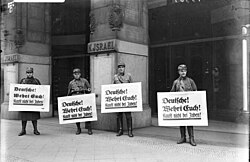
The Nazi boycott of Jewish businesses in Germany took place on 1 April 1933, soon after Adolf Hitler was sworn in as Chancellor on 30 January 1933. Nazi authorities presented it as retaliation for foreign criticism of the regime and for the anti-Nazi boycott of German goods, but historians describe it as an early stage in the regime's campaign to isolate Jews from German economic and public life.1314
It was the first of many measures against the Jews of Germany, which ultimately culminated in the "Final Solution". It was a state-managed campaign of ever-increasing harassment, arrests, systematic pillaging, forced transfer of ownership to Nazi party activists (managed by the Chamber of Commerce), and ultimately murder of owners defined as "Jews". In Berlin alone, there were 50,000 Jewish owned businesses.15
In Poland, National Democracy, known as Endeks, and other nationalist groups promoted economic boycotts of Jewish businesses, especially during the interwar period.16 The campaigns included public agitation against Jewish trade, pressure on customers, picketing and attacks on Jewish-owned shops and workshops, and efforts to exclude Jewish merchants and artisans from commercial associations and credit networks.17 Ritual Kosher slaughter was banned in Poland in 1936, in Germany in 1930 following the similar legislation enacted in many other European countries.18 In 1936, Prime Minister Felicjan Sławoj Składkowski publicly endorsed an "economic struggle" and "economic boycott" against Jews, becoming formal government policy from June 4, 1936.1920 Polish universities placed growing limits on the number of Jews allowed to attend, (see numerus clausus) and increasingly forced them to sit separately from non-Jewish students, a practice known as "Ghetto benches" which became law in 1937.21
In the United States, antisemitic supporters of the radio priest Charles Coughlin promoted "Buy Christian" campaigns that encouraged consumers to avoid Jewish-owned businesses. Coughlin, a Canadian-born Catholic priest based near Detroit, reached an estimated audience of 30 million listeners at the height of his radio career.2223 In 1939, the American Jewish Congress reported that a group organized by Coughlin followers in New York had distributed a "Christian Index" listing businesses to patronize as part of a "Buy Christian" drive.24
The related Christian Front, founded in response to Coughlin's appeals, organized boycotts of Jewish businesses and became associated with street harassment and attacks on Jews in New York City in 1939. These campaigns were often justified through anticommunist rhetoric that associated Jews with communism and presented Jewish businesses as legitimate targets for exclusion.2526
Anti-Zionist boycotts
In Palestine, the Arab leadership organized boycotts of Jewish businesses from 1929 onwards, with violence often directed at Arabs who did business with Jews.27 A series of riots in Egypt described by one British Embassy official as "clearly anti-Jewish" occurred in 1945, starting on the date of the Balfour Declaration. In the following weeks, the Egyptian press attacked Egyptian Jews as capitalists, white-slave traders, and other slurs while calling for a boycott of Jewish goods. Later in 1945, the Arab League began a boycott of Jewish businesses in British Mandatory Palestine.28
In the 2000s, the BDS movement, which advocates for a total boycott of Israeli products, is regarded by some Jewish civil rights organizations (such as the Anti-Defamation League and the Simon Wiesenthal Center), as well as pro-Israel organizations and scholars as driven by antisemitism.293031 This has been disputed by the BDS movement itself and Jewish supporters of BDS.323334
See also
See also
References
References
- "Anti-Semitism: Anti-Jewish Boycotts". Jewish Virtual Library. Retrieved 7 February 2014.
- Árpád Welker. "BETWEEN EMANCIPATION AND ANTISEMITISM: JEWISH PRESENCE IN PARLIAMENTARY POLITICS IN HUNGARY 1867–1884".
The first appearance of political antisemitism in Hungary was, as mentioned earlier, the speech of Győző Istóczy in the House of Representatives in 1875.
- Herbert A. Strauss (1 January 1993). Austria - Hungary - Poland - Russia. Walter de Gruyter. p. 873. ISBN 978-3-11-088329-9.
- Szabó, Miloslav (9 July 2012). ""Because words are not deeds." Antisemitic Practice and Nationality Policies in Upper Hungary around 1900". Retrieved 7 February 2014.
- L. Braham, Randolph. "The Christian Churches of Hungary and the Holocaust" (PDF). Yad Vashem. Retrieved 7 February 2014.
- "MAY LAWS". Jewish Encyclopedia. Retrieved 7 February 2014.
- Fareed Zacharia, The Future of Freedom: Illiberal Democracy at Home and Abroad, Norton, 2003, 2007, p. 60
- John W. Boyer (5 May 1995). Political Radicalism in Late Imperial Vienna: Origins of the Christian Social Movement, 1848-1897. University of Chicago Press. p. 379. ISBN 978-0-226-06956-2.
- Bruce F. Pauley, "From Prejudice to Persecution: A History of Austrian Anti-Semitism," (North Carolina, 1992), page 201.
- Jews in Twentieth Century Ireland by Dermot Keogh, Chapter 2
- Rubenstein, Richard L.; Roth, John K. (2003). "5. Rational Antisemitism". Approaches to Auschwitz: the Holocaust and its legacy (2nd ed.). Westminster John Knox Press. pp. 123–124. ISBN 978-0664223533.
- Abella, Irving; Bialystok, Franklin (1996). "Canada: Before the Holocaust". In Wyman, David S.; Rosenzveig, Charles H. (eds.). The World Reacts to the Holocaust. The Johns Hopkins University Press. pp. 751–753. ISBN 978-0801849695.
- Berel Lang, Philosophical Witnessing: The Holocaust as Presence, p.132
- "Boycott of Jewish Businesses". Holocaust Encyclopedia. Retrieved 2026-07-03.
- Kreutzmüller, Christoph (2012). Final Sale – The Destruction of Jewish Owned Businesses in Nazi Berlin 1930–1945. Metropol-Verlag. ISBN 978-3-86331-080-6.
- Cang, Joel (1939). "The Opposition Parties in Poland and Their Attitude towards the Jews and the Jewish Question". Jewish Social Studies. 1 (2): 241–256.
- "Economic boycott of Jews". Virtual Shtetl. POLIN Museum of the History of Polish Jews. Retrieved 3 July 2026.
- Bauer, Yehuda (1974). "Prelude of the Holocaust". My Brother's Keeper – A History of the American Jewish Joint Distribution Committee 1929-1939. Philadelphia: The Jewish Publication Society of America.
[...] Polish laws against ritual slaughter (shehita) enacted in April 1936 and, in a final and drastic form, in March 1939.
- Social and Political History of the Jews in Poland, 1919-1939 By Joseph Marcus page 366, Mouton 1983
- "Here and Now: The Vision of the Jewish Labor Bund in Interwar Poland". Institute for Jewish Research. Archived from the original on 12 February 2012. Retrieved 7 February 2014.
- No Way Out: The Politics of Polish Jewry, 1935-1939. Hebrew Union College Press, 1997. Page 6.
- "Coughlin, Father Charles". Encyclopedia of Detroit. Detroit Historical Society. Retrieved 3 July 2026.
- "CHARLES E. COUGHLIN". USHMM. Retrieved 7 February 2014.
- ""Buy Christian" Drive Launched by Coughlin Group Here". Jewish Telegraphic Agency. 2 May 1939. Retrieved 3 July 2026.
- "Christian Front". Encyclopaedia Britannica. Retrieved 3 July 2026.
- Fein, Gene. "For Christ and Country: The Anti-Semitic Anticommunism of Christian Front Street Meetings in New York City". U.S. Catholic Historian. 22 (4, Catholic Anticommunism): 37–56.
- Feiler, Gil (1998). From Boycott to Economic Cooperation: The Political Economy of the Arab Boycott of Israel. Routledge. ISBN 978-0714644233.
- Julius, Anthony (25 February 2010). Trials of the Diaspora: A History of Anti-Semitism in England (illustrated, reprint ed.). Oxford University Press. p. 481. ISBN 9780199297054. Retrieved 24 March 2015.
- "Simon Wiesenthal Center Report: BDS 'a Thinly-Veiled, Anti-Israel and Anti-Semitic "Poison Pill."' The Algemeiner. 19 March 2013. 7 June 2013.
- "Anti-Israel groups push product, performers boycott." USA Today. 17 March 2013. 8 June 2013.
- "Boycotts, Divestment, and Sanctions (BDS) Resource Page." NGO Monitor. 14 July 2011. 1 June 2013.
- "Poll finds alarming support for BDS among US Jews". Israel Hayom. Retrieved 2023-11-02.
- "ON ANTI-SEMITISM". BDS. Retrieved 2023-11-02.
- "FAQs". BDS Movement. Retrieved 2023-11-02.