| Anchitherium Temporal range: 1
| |
|---|---|
| |
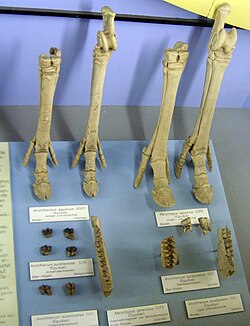
| Anchitherium aurelianense, Hypohippus equinus, Merychippus sejunctus, and M. sphenodus fossils in Museum für Naturkunde, Berlin | |
Scientific classification 
| |
| Kingdom: | Animalia |
| Phylum: | Chordata |
| Class: | Mammalia |
| Infraclass: | Placentalia |
| Order: | Perissodactyla |
| Family: | Equidae |
| Subfamily: | †Anchitheriinae |
| Genus: | †Anchitherium von Meyer, 1844 |
| Type species | |
| Anchitherium aurelianense | |
| Species1234 | |
| |
Anchitherium (meaning near beast) is a genus of extinct equid with a three-toed hoof.

Anchitherium was a browsing (leaf eating) horse that originated in the early Miocene of North America, being found as far south as Panama,5 and subsequently dispersed to Europe and Asia,34 where it gave rise to the larger bodied genus Sinohippus.1 It was around 60 centimetres (6.0 hands) high at the shoulder, and probably represented a side-branch of horse evolution that left no modern descendants.6
Palaeobiology
Life history
Compared to the modern plains zebra, Anchitherium had a lower daily secretion rate (DSR) of enamel, but a substantially faster enamel extension rate (EER) in the cusps of its teeth. However, the EER of Anchitherium was substantially lower than that of the plains zebra in the cervical and middle regions of the crown.7
Palaeoecology
The dental microwear and mesowear of Anchitherium aurelianense show that it had a browsing diet.8
References
References
- Salesa, M.J., Sánchez, I.M., and Morales, J. 2004. Presence of the Asian horse Sinohippus in the Miocene of Europe. Acta Palaeontologica Polonica, 49(2):189-196.
- Sánchez, I.M., Salesa, M.J., and Morales, J. 1998. Revisión sistemática del género Anchitherium Meyer, 1834 (Equidae; Perissodactyla) en España. Estudios Geológicos, 55(1-2):1-37
- Ye, J.; W.-Y. Wu; J. Meng (2005). "Anchitherium (Perissodactyla, Mammalia) from the Halamagai Formation of Northern Junggar Basin, Xinjiang". Vertebrata PalAsiatica. 43 (2): 100–109. Archived from the original on 2016-10-12.(in Chinese with English summary).
- MacFadden, B.J. 2001. Three-toed browsing horse Anchitherium clarencei from the early Miocene (Hemingfordian) Thomas Farm, Florida. Bulletin of the Florida Museum of Natural History, 43(3):79-109.
- MacFadden, Bruce J. (2009). "Three-toed browsing horse Anchitherium (Equidae) from the Miocene of Panama". Journal of Paleontology. 83 (3): 489. Bibcode:2009JPal...83..489M. doi:10.1666/08-155.1. hdl:10088/15923. ISSN 0022-3360.
- Palmer, D., ed. (1999). The Marshall Illustrated Encyclopedia of Dinosaurs and Prehistoric Animals. London: Marshall Editions. p. 274. ISBN 1-84028-152-9.
- Calderón, Teresa; Cuccu, Andrea; Morales, Jorge; Azanza, Beatriz; DeMiguel, Daniel (15 March 2026). "Quantitative histological analysis of dental variability in Anchitherium: insights into growth dynamics and dental development". Palaeogeography, Palaeoclimatology, Palaeoecology. 686 113557. doi:10.1016/j.palaeo.2026.113557. Retrieved 27 March 2026 – via Elsevier Science Direct.
- Merceron, Gildas (January 2009). "The early Vallesian vertebrates of Atzelsdorf (Late Miocene, Austria) 13. Dental wear patterns of herbivorous ungulates as ecological indicators" (PDF). Annalen des Naturhistorischen Museums in Wien. 111A: 647–660. Retrieved 21 September 2025.
Media related to Anchitherium at Wikimedia Commons