| Anago | |
|---|---|
Scientific classification
| |
| Kingdom: | Animalia |
| Phylum: | Chordata |
| Class: | Actinopterygii |
| Order: | Anguilliformes |
| Suborder: | Congroidei |
| Family: | Congridae |
| Groups included | |
| |
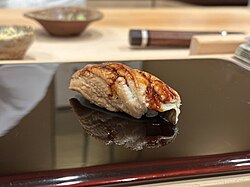
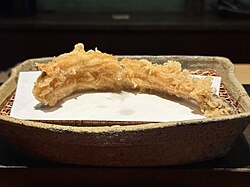
Anago (穴子, or アナゴ) is the Japanese word for saltwater eels, normally referring to ma-anago (Conger myriaster). Ma-anago are used for a seafood dish in Japan. They are often simmered (sushi) or deep-fried (tempura),8 compared to unagi (freshwater eels) which are usually barbecued with a sauce (kabayaki). Anago is also slightly less rich and oily than unagi. Anago has a very soft texture and sweet taste.8
Species
- Chin-anago (チンアナゴ) Heteroconger hassi (Klausewitz & Eibl-Eibesfeldt 1959)2
- Goten-anago (ゴテンアナゴ) Ariosoma anago, Anago anago or Conger anago (Temminck et Schlegel, 1846)3
- Kiri-anago (キリアナゴ) Conger cinereus (Rüppell, 1830)4
- Kuro-anago (クロアナゴ) Conger japonicus (Bleeker, 1879)5
- Ma-anago (マアナゴ) Conger myriaster (Brevoort, 1856)6
- Shinjyu-anago (シンジュアナゴ) Gorgasia japonica (Abe, Asai & Miki 1977)7
References
References
- Sepkoski, Jack (2002). "A compendium of fossil marine animal genera". Bulletins of American Paleontology. 364: 560. Archived from the original on 2011-07-23. Retrieved 2007-12-25.
- "Heteroconger hassi (Klausewitz & Eibl-Eibesfeldt 1959)". FishWise. Archived from the original on 2011-03-03.
- "Ariosoma anago (Schlegel & Temminck 1846)". FishWise. Archived from the original on 2011-07-20.
- "Conger cinereus Rüppell 1830". FishWise. Archived from the original on 2011-07-20.
- "Conger japonicus Bleeker 1879". FishWise. Archived from the original on 2011-07-20.
- Hosking, Richard (1996). A dictionary of Japanese food: ingredients & culture. Tuttle Publishing. p. 22. ISBN 0-8048-2042-2.
- "Gorgasia japonica Abe, Asai & Miki 1977". FishWise. Archived from the original on 2011-07-20.
- "Anago Sushi". www.sushi-pedia.com. 2022-01-11. Retrieved 2024-10-06.