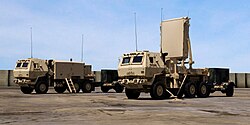
AN/TPQ-53 Quick Reaction Capability Radar is a mobile active electronically scanned array counter-battery radar system manufactured by Lockheed Martin. The radar is specifically designed to locate the firing positions of both rocket and mortar launchers. It has a maximum detection range of 56 mi (90 km) and has an operating frequency of 2–4 GHz (15.0–7.5 cm).
In accordance with the Joint Electronics Type Designation System (JETDS), the "AN/TPQ-53" designation represents the 53rd design of an Army-Navy electronic device for ground transportable special combination radar system. The JETDS system also now is used to name all Department of Defense electronic systems.
History
The TPQ-53 radar's delivery on 2 July 2009 followed its successful live-fire performance testing against indirect fire from mortars, artillery and rockets from a simulated enemy. The system has been tested and approved by the US Army. TPQ-53 radar systems will replace the aging AN/TPQ-36 and AN/TPQ-37 medium-range radars now in the Army's inventory.1
Prior to September 2011, the system was known as "EQ-36 Counterfire Target Acquisition Radar".2 EQ-36 was a Lockheed reference to the “Enhanced AN/TPQ-36", their program to develop what eventually became the AN/TPQ-53.1
In June 2013, the United States Army exercised a contract option to finish out the total production of 51 systems.1 After a contract award 24 April 2017 has completed production, the Army will hold more than 170 such systems.3 In April 2020, the first TPQ-53s with Gallium nitride (GaN) transmit-receive modules were delivered providing additional power, reliability and the possibility for extended range, and counterfire target acquisition (CTA).4
After Russian-backed separatists started operating tanks in Eastern Ukraine, the U.S. started sending military items to Ukraine, including twenty AN/TPQ-53 radar systems in 2015. As a result, Ukraine's units thus equipped saw casualty rates decline from 47 percent to around 18 percent.5 Ukrainian combat expertise with the system led to their providing training to U.S. forces.5
Operators


See also
See also
Notes
Notes
- "TPQ-53 Counterfire Radars: Incoming Where?". Defense Industry Daily. Retrieved 20 June 2025.
- Fein, Geoff (March 2012). "Weapon Finding Radars". Jane's International Defence Review: 37.
- "Protecting the Soldier: U.S. Army Orders More Q-53 Counterfire Radars from Lockheed Martin". PR Newswire (Press Release). 24 April 2017. Retrieved 20 June 2025.
- "First Q-53 Radar Equipped with Gallium Nitride Delivered to U.S. Army". Lockheed Martin (Press Release). 30 April 2020. Archived from the original on 6 May 2020. Retrieved 20 June 2025.
- Gould, Joe; Altman, Howard (25 September 2019). "Here's what you need to know about the US aid package to Ukraine that Trump delayed". DefenseNews. Retrieved 7 February 2022.
- Carlo Munoz (10 October 2022). "AUSA 2022: Lockheed Martin eyes multimission variant of AN/TPQ-53 radar". Janes.
- Patty Nieberg (4 June 2025). "Soldiers on US-Mexico border hunt drones with air defense radars typically used in combat". taskandpurpose.com.