
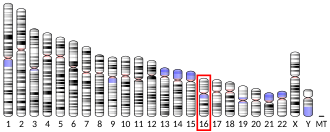



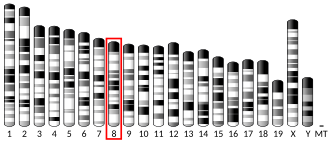



Autocrine motility factor receptor, isoform 2 is a protein that in humans is encoded by the AMFR gene.56
Autocrine motility factor is a tumor motility-stimulating protein secreted by tumor cells. The protein encoded by this gene is a glycosylated transmembrane protein and a receptor for autocrine motility factor. The receptor, which shows some sequence similarity to tumor protein p53, is localized to the leading and trailing edges of carcinoma cells.6
Interactions
AMFR has been shown to interact with Valosin-containing protein.78
References
References
- GRCh38: Ensembl release 89: ENSG00000159461 – Ensembl, May 2017
- GRCm38: Ensembl release 89: ENSMUSG00000031751 – Ensembl, May 2017
- "Human PubMed Reference:". National Center for Biotechnology Information, U.S. National Library of Medicine.
- "Mouse PubMed Reference:". National Center for Biotechnology Information, U.S. National Library of Medicine.
- Watanabe H, Carmi P, Hogan V, Raz T, Silletti S, Nabi IR, Raz A (Aug 1991). "Purification of human tumor cell autocrine motility factor and molecular cloning of its receptor". J Biol Chem. 266 (20): 13442–8. doi:10.1016/S0021-9258(18)98859-9. PMID 1649192.
- "Entrez Gene: AMFR autocrine motility factor receptor".
- Zhong, Xiaoyan; Shen Yuxian; Ballar Petek; Apostolou Andria; Agami Reuven; Fang Shengyun (Oct 2004). "AAA ATPase p97/valosin-containing protein interacts with gp78, a ubiquitin ligase for endoplasmic reticulum-associated degradation". J. Biol. Chem. 279 (44). United States: 45676–84. doi:10.1074/jbc.M409034200. ISSN 0021-9258. PMID 15331598.
- Lee, Joon No; Zhang Xiangyu; Feramisco Jamison D; Gong Yi; Ye Jin (Nov 2008). "Unsaturated fatty acids inhibit proteasomal degradation of Insig-1 at a postubiquitination step". J. Biol. Chem. 283 (48). United States: 33772–83. doi:10.1074/jbc.M806108200. ISSN 0021-9258. PMC 2586246. PMID 18835813.
External links
External links
- Human AMFR genome location and AMFR gene details page in the UCSC Genome Browser.
Further reading
Further reading
- Huang B, Xie Y, Raz A (1995). "Identification of an upstream region that controls the transcription of the human autocrine motility factor receptor". Biochem. Biophys. Res. Commun. 212 (3): 727–42. Bibcode:1995BBRC..212..727H. doi:10.1006/bbrc.1995.2031. PMID 7626106.
- Hillier LD, Lennon G, Becker M, et al. (1997). "Generation and analysis of 280,000 human expressed sequence tags". Genome Res. 6 (9): 807–28. doi:10.1101/gr.6.9.807. PMID 8889549.
- Shimizu K, Tani M, Watanabe H, et al. (1999). "The autocrine motility factor receptor gene encodes a novel type of seven transmembrane protein". FEBS Lett. 456 (2): 295–300. doi:10.1016/S0014-5793(99)00966-7. PMID 10456327. S2CID 39270348.
- Fang S, Ferrone M, Yang C, et al. (2002). "The tumor autocrine motility factor receptor, gp78, is a ubiquitin protein ligase implicated in degradation from the endoplasmic reticulum". Proc. Natl. Acad. Sci. U.S.A. 98 (25): 14422–7. Bibcode:2001PNAS...9814422F. doi:10.1073/pnas.251401598. PMC 64697. PMID 11724934.
- Luo Y, Long JM, Lu C, et al. (2002). "A link between maze learning and hippocampal expression of neuroleukin and its receptor gp78". J. Neurochem. 80 (2): 354–61. doi:10.1046/j.0022-3042.2001.00707.x. PMID 11902125. S2CID 29857457.
- Tímár J, Rásó E, Döme B, et al. (2002). "Expression and function of the AMF receptor by human melanoma in experimental and clinical systems". Clin. Exp. Metastasis. 19 (3): 225–32. doi:10.1023/A:1015595708241. PMID 12067203. S2CID 453423.
- Strausberg RL, Feingold EA, Grouse LH, et al. (2003). "Generation and initial analysis of more than 15,000 full-length human and mouse cDNA sequences". Proc. Natl. Acad. Sci. U.S.A. 99 (26): 16899–903. Bibcode:2002PNAS...9916899M. doi:10.1073/pnas.242603899. PMC 139241. PMID 12477932.
- Liang JS, Kim T, Fang S, et al. (2003). "Overexpression of the tumor autocrine motility factor receptor Gp78, a ubiquitin protein ligase, results in increased ubiquitinylation and decreased secretion of apolipoprotein B100 in HepG2 cells". J. Biol. Chem. 278 (26): 23984–8. doi:10.1074/jbc.M302683200. PMID 12670940.
- Takanami I, Takeuchi K (2003). "Autocrine motility factor-receptor gene expression in lung cancer". Jpn. J. Thorac. Cardiovasc. Surg. 51 (8): 368–73. doi:10.1007/BF02719469. PMID 12962414.
- Ota T, Suzuki Y, Nishikawa T, et al. (2004). "Complete sequencing and characterization of 21,243 full-length human cDNAs". Nat. Genet. 36 (1): 40–5. doi:10.1038/ng1285. PMID 14702039.
- Registre M, Goetz JG, St Pierre P, et al. (2004). "The gene product of the gp78/AMFR ubiquitin E3 ligase cDNA is selectively recognized by the 3F3A antibody within a subdomain of the endoplasmic reticulum". Biochem. Biophys. Res. Commun. 320 (4): 1316–22. Bibcode:2004BBRC..320.1316R. doi:10.1016/j.bbrc.2004.06.089. PMID 15303277.
- Zhong X, Shen Y, Ballar P, et al. (2004). "AAA ATPase p97/valosin-containing protein interacts with gp78, a ubiquitin ligase for endoplasmic reticulum-associated degradation". J. Biol. Chem. 279 (44): 45676–84. doi:10.1074/jbc.M409034200. PMID 15331598.
- Gerhard DS, Wagner L, Feingold EA, et al. (2004). "The status, quality, and expansion of the NIH full-length cDNA project: the Mammalian Gene Collection (MGC)". Genome Res. 14 (10B): 2121–7. doi:10.1101/gr.2596504. PMC 528928. PMID 15489334.
- Song BL, Sever N, DeBose-Boyd RA (2005). "Gp78, a membrane-anchored ubiquitin ligase, associates with Insig-1 and couples sterol-regulated ubiquitination to degradation of HMG CoA reductase". Mol. Cell. 19 (6): 829–40. doi:10.1016/j.molcel.2005.08.009. PMID 16168377.
- Kaynak K, Kara M, Oz B, et al. (2006). "Autocrine motility factor receptor expression implies an unfavourable prognosis in resected stage I pulmonary adenocarcinomas". Acta Chir. Belg. 105 (4): 378–82. doi:10.1080/00015458.2005.11679740. PMID 16184720. S2CID 3032480.
- Ye Y, Shibata Y, Kikkert M, et al. (2006). "Inaugural Article: Recruitment of the p97 ATPase and ubiquitin ligases to the site of retrotranslocation at the endoplasmic reticulum membrane". Proc. Natl. Acad. Sci. U.S.A. 102 (40): 14132–8. Bibcode:2005PNAS..10214132Y. doi:10.1073/pnas.0505006102. PMC 1242302. PMID 16186510.
- Chen B, Mariano J, Tsai YC, et al. (2006). "The activity of a human endoplasmic reticulum-associated degradation E3, gp78, requires its Cue domain, RING finger, and an E2-binding site". Proc. Natl. Acad. Sci. U.S.A. 103 (2): 341–6. Bibcode:2006PNAS..103..341C. doi:10.1073/pnas.0506618103. PMC 1326157. PMID 16407162.
- Haga A, Tanaka N, Funasaka T, et al. (2006). "The autocrine motility factor (AMF) and AMF-receptor combination needs sugar chain recognition ability and interaction using the C-terminal region of AMF". J. Mol. Biol. 358 (3): 741–53. doi:10.1016/j.jmb.2006.02.046. PMID 16563432.
- Shen Y, Ballar P, Fang S (2006). "Ubiquitin ligase gp78 increases solubility and facilitates degradation of the Z variant of alpha-1-antitrypsin". Biochem. Biophys. Res. Commun. 349 (4): 1285–93. Bibcode:2006BBRC..349.1285S. doi:10.1016/j.bbrc.2006.08.173. PMID 16979136.