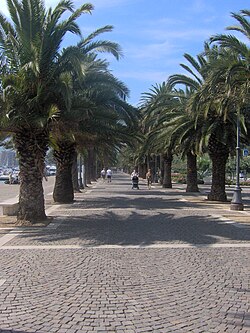
Ambulacrum is an architectural word that denotes an atrium, courtyard, or parvise in front of a basilica or church that is surrounded by arcades or colonnades, or trees, and which often contains a fountain. It also can denote a walking path that trees delineate.
Roman
In the Roman architecture, the term ambulatio or ambulacrum was used to designate walkways or corridors delineated on both sides by plants or colonnades.1
Etymology
From the Latin 'ambulācrum', meaning 'walk planted with trees', 'avenue', 'alley' and 'walking place' Derives from' 'ambulāre', meaning 'to walk' or 'Amble' meaning 'To walk slowly or leisurely'.2
Has Indo-European roots - deriving from 'Ambhi'3
References
References
- Yegül & Favro 2019, p. 868.
- The Free Dictionary (n.d.) amble, [online] Available at: http://www.thefreedictionary.com/amble [Accessed 14th Nov 2014].
- The Free Dictionary (n.d.) ambulacra, [online] Available at: http://www.thefreedictionary.com/ambulacra [Accessed 14th Nov 2014].
Sources
Sources
- James Stevens Curl, A Dictionary of Architecture and Landscape Architecture (Oxford University Press, 2006)
- Yegül, F.K.; Favro, D.G. (2019). "ambulatio". Roman Architecture and Urbanism: From the Origins to Late Antiquity. Cambridge EBA Collection. Cambridge University Press. ISBN 978-0-521-47071-1. Retrieved 2025-01-26.