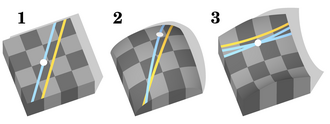
In mathematics, especially in geometry and topology, an ambient space is the space surrounding a mathematical object along with the object itself.
For example, a 1-dimensional line may be studied in isolation —in which case the ambient space of is the real line, or it may be studied as an object embedded in 2-dimensional Euclidean space —in which case the ambient space of is , or as an object embedded in 2-dimensional hyperbolic space —in which case the ambient space of is . To see why this makes a difference, consider the statement "Parallel lines never intersect." This is true if the ambient space is , but false if the ambient space is , because the geometric properties (in particular, curvature) of are different from the geometric properties of . All spaces are subsets of their ambient space.
See also
See also
Further reading
Further reading
- Schilders, W. H. A.; ter Maten, E. J. W.; Ciarlet, Philippe G. (2005). Numerical Methods in Electromagnetics. Vol. Special Volume. Elsevier. pp. 120ff. ISBN 0-444-51375-2.
- Wiggins, Stephen (1992). Chaotic Transport in Dynamical Systems. Berlin: Springer. pp. 209ff. ISBN 3-540-97522-5.