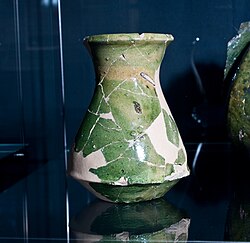
An aludel (Arabic: ﺍﻟﻮﺛﻞ al-ūṯal from Greek αἰθαλίων aithaliōn, 'smoky, sooty, burnt-colored')12 is a subliming pot used in alchemy. The term refers to a range of earthen tubes, or pots without bottoms, fitted one over another, and diminishing as they advance towards the top. The lowest is adapted to a pot, placed in a furnace, wherein the matter to be sublimed is placed. At the top is a head to retain the flowers, or condensation, which ascends.3: 73 An aludel was used as a condenser in the sublimation process and thus came to signify the end-stages of transformation and the symbol of creation. Also called the Hermetic Vase, the Philosopher's Egg, and the Vase of the Philosophy.
Description
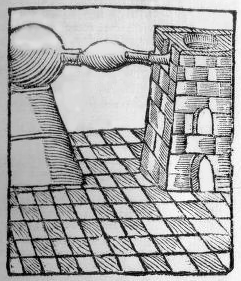
The aludel is illustrated in a Pseudo-Geber treatise,4 in the Bibliotheca Chemica Curiosa of Jean-Jacques Manget,5 and in a Syriac alchemy manuscript conserved in the British Museum.6 It is mentioned in the "Mafātīḥ al-ʿUlūm" ("Key of Sciences") of al-Khwarazmi.7
References
References
- M. Ullmann (1986), "Al-Kīmiyā", The Encyclopaedia of Islam, vol. 5 (2nd ed.), Brill, p. 111b, ISBN 90-04-07819-3
- Henry Liddell; Robert Scott, eds. (1897), "αἰθάλίον", A Greek–English Lexicon (8th ed.), Harper & Brothers, p. 34b
- Ephraim Chambers, ed. (1728), "Aludel", Cyclopædia, or an Universal Dictionary of Arts and Sciences, Knapton
- Marcellin Berthelot (1893), La chimie au moyen âge, vol. 1, Imprimerie nationale, pp. 149–150, 170
- Marcellin Berthelot (1889), Introduction à l'étude de la chimie des anciens et du moyen âge, Steinheil, p. 172
- Marcellin Berthelot (1893), La chimie au moyen âge, vol. 2, Imprimerie nationale, p. 109
- A. Dietrich (2000), "AL-UTHĀL", The Encyclopaedia of Islam, vol. 10 (2nd ed.), Brill, p. 946a, ISBN 90-04-11211-1
This article incorporates text from a publication now in the public domain: Chambers, Ephraim, ed. (1728). "Aludels". Cyclopædia, or an Universal Dictionary of Arts and Sciences. Vol. 1 (1st ed.). James and John Knapton, et al. p. 73.