| Native ginger | |
|---|---|
| |
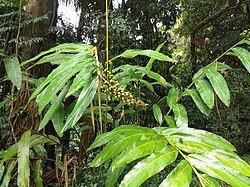
| Foliage and fruit | |
Scientific classification 
| |
| Kingdom: | Plantae |
| Clade: | Embryophytes |
| Clade: | Tracheophytes |
| Clade: | Spermatophytes |
| Clade: | Angiosperms |
| Clade: | Monocots |
| Clade: | Commelinids |
| Order: | Zingiberales |
| Family: | Zingiberaceae |
| Genus: | Alpinia |
| Species: | A. caerulea
|
| Binomial name | |
| Alpinia caerulea | |
| Synonyms3 | |
| |
Alpinia caerulea, commonly known as native ginger or Australian ginger, is an understorey perennial herb in the family Zingiberaceae which grows in rainforest, gallery forest and wet sclerophyll forest in eastern Australia.
Description
Alpinia caerulea is a rhizomatous plant with arching stalks growing to 2–3 m (6 ft 7 in – 9 ft 10 in) long.456 Each carries a number of large alternately arranged leaves up to 40 cm (16 in) long and 10 cm (3.9 in) wide.456 They are either sessile or with a very short petiole, glossy dark green above and lighter below, with an acuminate tip.456
The inflorescence is terminal on the stalks, up to 30 cm (12 in) long and contains numerous white flowers.456 The fruit is a capsule, blue, globose and about 1 cm (0.39 in) diameter. The casing is thin and brittle, containing numerous black seeds set in white pith.456
Flowering occurs from September to April, and the fruit may ripen in any month.7
Taxonomy
This species was first described – albeit very briefly – in 1810 by the Scottish botanist Robert Brown, who gave it the name Hellenia caerulea.8 The English botanist George Bentham reviewed the taxon in 1873 and gave it a much more detailed description, as well as the new combination Alpinia caerulea. It was published in the book Flora australiensis: a description of the plants of the Australian territory.9
Etymology
The genus name Alpinia was coined by Carl Linnaeus in honour of the Italian botanist Prospero Alpini, and the species epithet caerulea is derived from the Latin word caeruleus, meaning blue, which is a reference to the fruit colour.7
Vernacular names
This plant is known as Jun jun by the Kuku Yalanji people of coastal north east Queensland.10
Distribution and habitat
The native ginger is endemic to New South Wales and Queensland, Australia. The natural range is from the Gosford district north along the coast to the tip of Cape York Peninsula and the islands of the Torres Strait (see map of sightings in the External links section below).456 It grows in coastal and sub-coastal rainforest and wet sclerophyll forest, commonly beside waterways.456 The altitudinal range is from sea level to around 1,400 m (4,590 ft).47
It is thought that the species might also occur in New Guinea.5
Ecology
Alpinia caerulea is one of the host species for larvae of the banded demon butterfly (Notocrypta waigensis).4 The fruits are popular with a variety of birds including brush turkeys (Alectura lathami),10 southern cassowaries (Casuarius casuarius), crimson rosellas (Platycercus elegans), king parrots (Alisterus scapularis), regent bowerbirds (Sericulus chrysocephalus), satin bowerbirds (Ptilonorhynchus violaceus), and Lewin's honeyeaters (Meliphaga lewinii).7 Some Australian rodents also eat the fruit, including giant white-tailed rats (Uromys caudimaculatus) and fawn-footed melomys (Melomys cervinipes).7
Conservation
This species is listed by the Queensland Department of Environment and Science as least concern.1 As of 10 May 2023, it has not been assessed by the International Union for Conservation of Nature (IUCN).
Uses
For the Kuku Yalanji people of far northern Queensland, this plant had many uses – the fruit and rhizomes were eaten, the leaves were used to cover their shelters and to wrap meat when cooking in earth ovens.1011
New shoots are also edible, and have a mild ginger flavour.12 The white flesh surrounding the seeds is crisp and acidic,1113 and during long walks it was chewed by Indigenous Australians to activate the salivary glands and moisten the mouth, with the seeds usually being discarded.1314
Gallery
-
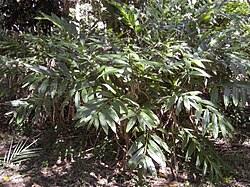 Habit
Habit -
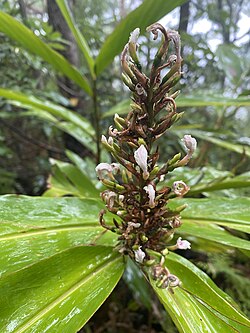 Inflorescence
 -
 Flowers
 -
 Foliage and immature fruit
 -
 Ripe fruit
References
References
- "Species profile—Alpinia caerulea". Queensland Department of Environment and Science. Queensland Government. 2022. Retrieved 10 May 2023.
- "Alpinia caerulea". Australian Plant Name Index (APNI). Centre for Australian National Biodiversity Research, Australian Government. Retrieved 10 May 2023.
- "Alpinia caerulea (R.Br.) Benth". Plants of the World Online. Royal Botanic Gardens, Kew. Archived from the original on 10 May 2023. Retrieved 10 May 2023.
- F.A.Zich; B.P.M.Hyland; T.Whiffen; R.A.Kerrigan (2020). "Alpinia caerulea". Australian Tropical Rainforest Plants Edition 8 (RFK8). Centre for Australian National Biodiversity Research (CANBR), Australian Government. Archived from the original on 10 May 2023. Retrieved 10 May 2023.
- Smith, R.M. (2020). "Alpinia caerulea". Flora of Australia. Australian Biological Resources Study, Department of Climate Change, the Environment and Water: Canberra. Archived from the original on 10 May 2023. Retrieved 10 May 2023.
- "PlantNET - FloraOnline". PlantNET (The NSW Plant Information Network System). Royal Botanic Gardens and Domain Trust, Sydney. Archived from the original on 10 May 2023. Retrieved 10 May 2023.
- Cooper, Wendy; Cooper, William T. (June 2004). Fruits of the Australian Tropical Rainforest. Clifton Hill, Victoria, Australia: Nokomis Editions. p. 562. ISBN 978-0-9581742-1-3. Archived from the original on 19 December 2021. Retrieved 6 July 2026.
- "Hellenia caerulea". Australian Plant Name Index (APNI). Centre for Australian National Biodiversity Research, Australian Government. Archived from the original on 10 May 2023. Retrieved 10 May 2023.
- Mueller, F. von; Bentham, G. (1873). Flora australiensis: a description of the plants of the Australian territory. London: L. Reeve & Co. p. 265. Archived from the original on 10 May 2023. Retrieved 10 May 2023.
- Roberts, John; Fisher, Colin (CJ); Gibson, Roy (1995). A Guide to Traditional Aboriginal Rainforest Plant Use, by the Kuku Yalanji of the Mossman Gorge. Mossman, Queensland: Bamanga Bubu Ngadimumku Inc. p. 24. ISBN 0-646-22991-5.
- Beasley, John (2009). Plants of Cape York - the compact guide. John Beasley. p. 147. ISBN 978-0-9806863-0-2.
- Howes, Jeff (21 February 2021). "Alpinia caerulea". Australian Plants Society NSW. Archived from the original on 23 March 2023. Retrieved 10 May 2023.
- Low, Tim (1998). Wild Food Plants of Australia. Sydney: Angus & Robertson Publishers. p. 64. ISBN 0-207-16930-6. Archived from the original on 24 November 2025. Retrieved 6 July 2026.
- "Red Back Australian Ginger". Tucker Bush. Archived from the original on 25 March 2023. Retrieved 10 May 2023.
External links
External links
- View a map of herbarium collections of this species at the Australasian Virtual Herbarium
- View observations of this species on iNaturalist
- View images of this species on Flickriver
- "Alpinia caerulea (R.Br.) Benth. — Native Ginger". Atlas of Living Australia.