  | |
| Observation data Epoch J2000.0 Equinox ICRS | |
|---|---|
| Constellation | Triangulum |
| A | |
| Right ascension | 01h 53m 04.90710s1 |
| Declination | +29° 34′ 43.7801″1 |
| Apparent magnitude (V) | +3.422 |
| C | |
| Right ascension | 01h 53m 01.04815s3 |
| Declination | +29° 37′ 03.9309″3 |
| Characteristics | |
| A | |
| Evolutionary stage | main sequence45 |
| Spectral type | F5III6 to F6IV7 + M4 |
| U−B color index | +0.062 |
| B−V color index | +0.482 |
| Variable type | Ellipsoidal7 |
| C | |
| Evolutionary stage | red dwarf8 |
| Astrometry | |
| A | |
| Radial velocity (Rv) | −12.69 km/s |
| Proper motion (μ) | RA: +10.821 mas/yr Dec.: −234.241 mas/yr |
| Parallax (π) | 51.50±0.23 mas1 |
| Distance | 63.3 ± 0.3 ly (19.42 ± 0.09 pc) |
| Absolute magnitude (MV) | 1.9810 |
| C | |
| Radial velocity (Rv) | −10.42±0.423 km/s |
| Proper motion (μ) | RA: +9.922 mas/yr3 Dec.: −236.07 mas/yr3 |
| Parallax (π) | 50.4136±0.0197 mas3 |
| Distance | 64.70 ± 0.03 ly (19.836 ± 0.008 pc) |
| Orbit11 | |
| Primary | Aa |
| Name | Ab |
| Period (P) | 1.767 days |
| Eccentricity (e) | 0.065 |
| Semi-amplitude (K1) (primary) | 10.64 km/s |
| Details | |
| α Tri Aa | |
| Mass | 1.6512 M☉ |
| Radius | 3.1312 R☉ |
| Luminosity | 12.912 L☉ |
| Surface gravity (log g) | 3.6612 cgs |
| Temperature | 6,18712 K |
| Metallicity [Fe/H] | −0.0910 to 0.0013 dex |
| Rotational velocity (v sin i) | 81.614 km/s |
| Age | 1.75 Gyr |
| α Tri Ab | |
| Mass | 0.114 M☉ |
| Radius | 0.144 R☉ |
| α Tri C | |
| Mass | 0.403±0.01315 M☉ |
| Radius | 0.406±0.01215 R☉ |
| Luminosity | 0.0210±0.000615 L☉ |
| Surface gravity (log g) | 4.06±0.773 cgs |
| Temperature | 3,420±11415 K |
| Metallicity [Fe/H] | −1.20±0.043 dex |
| Other designations | |
| Mothallah, Ras al Muthallah, Caput Trianguli, α Trianguli,16 2 Trianguli, HR 544, HD 11443, BD+28°312, FK5 64, HIP 8796, SAO 7499617 | |
| C: TIC 28244970, 2MASS J01530103+293704418 | |
| Database references | |
| SIMBAD | data |
| C | |
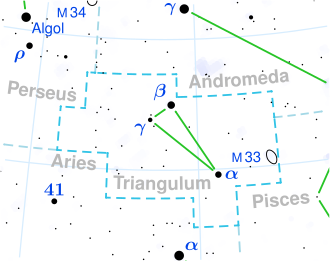
Alpha Trianguli (α Trianguli, abbreviated Alpha Tri, α Tri) is a triple star system19 in the constellation of Triangulum. Based on parallax measurements obtained during the Hipparcos mission, it is approximately 63.3 light-years (19.4 parsecs) distant from the Sun.1 The brighter or primary component is named Mothallah /məˈθælə/.20
Nomenclature
α Trianguli (Latinised to Alpha Trianguli) is the system's Bayer designation.
The system bore the traditional names Ras al Muthallah or Mothallah and Caput Trianguli derived from the Arabic رأس المثلث' raʼs al-muthallath "the head of the triangle" and its Latin translation.16 The International Astronomical Union Working Group on Star Names (WGSN)21 has approved the name Mothallah for this star.20 For members of multiple star systems, and where a component letter (e.g. from the Washington Double Star Catalog) is not explicitly shown in the namelist, the WGSN says that the name should be understood to be attributed to the visually brightest component by visual brightness.22
In combination with Beta Trianguli, these stars were called Al Mīzān, which is Arabic for "The Scale Beam".23
In Babylonian astronomy, Alpha Trianguli is listed as UR.BAR.RA "The Wolf", bearing the epithet "the seeder of the plough" in the MUL.APIN, listed after "The Plough", the name for a constellation formed of Triangulum plus Gamma Andromedae.24
Properties

Alpha Trianguli has been known to be a spectroscopic binary since 1915.26 In such systems, the binary nature is deduced from periodic variations in the spectral lines, corresponding to the orbital motion of the stars. In 2018, the red dwarf star8 Alpha Trianguli C, separated by 35.8' from the inner pair, was discovered to have common proper motion Alpha Trianguli A, thus making the system triple.19
Estimates of the combined stellar classification for the spectroscopic pair range from F5III6 to F6IV,7 with the luminosity class of 'IV' or 'III' indicating the primary component is a subgiant or giant star, respectively. It is a member of a close binary system—a spectroscopic binary—whose components complete an orbit about their center of mass once every 1.736 days. Because the primary star is rotating rapidly, it has assumed the shape of an oblate spheroid. The ellipsoidal profile of the star, as viewed from Earth, varies over the course of an orbit causing the luminosity to vary in magnitude during the same period.7 Such stars are termed ellipsoidal variables. Within a few million years, as the primary continues to evolve into a red giant star, the system may become a semi-detached binary with the Roche lobe becoming filled to overflowing.4
The mean apparent magnitude of +3.422 for this pair is bright enough to be readily seen with the naked eye. It forms the second brightest star or star system in this generally faint constellation, following Beta Trianguli. The effective temperature of the primary's outer envelope is 6,187 K giving it a yellow-white hue typical of F-type stars.27 It has a radius about three times the radius of the Sun.12 The system is an estimated 1.7 billion years old.5
A number of faint stars have been listed as companions to Alpha Trianguli in multiple star catalogues.28 Of these, all except the red dwarf Alpha Trianguli C are apparently unrelated background stars.29
References
References
- van Leeuwen, F. (November 2007). "Validation of the new Hipparcos reduction". Astronomy and Astrophysics. 474 (2): 653–664. arXiv:0708.1752. Bibcode:2007A&A...474..653V. doi:10.1051/0004-6361:20078357. S2CID 18759600.
- Johnson, H. L.; et al. (1966). "UBVRIJKL photometry of the bright stars". Communications of the Lunar and Planetary Laboratory. 4 (99): 99. Bibcode:1966CoLPL...4...99J.
- Vallenari, A.; et al. (Gaia collaboration) (2023). "Gaia Data Release 3. Summary of the content and survey properties". Astronomy and Astrophysics. 674: A1. arXiv:2208.00211. Bibcode:2023A&A...674A...1G. doi:10.1051/0004-6361/202243940. S2CID 244398875. Gaia DR3 record for this source at VizieR.
- Fuhrmann, Klaus (February 2008). "Nearby stars of the Galactic disc and halo - IV". Monthly Notices of the Royal Astronomical Society. 384 (1): 173–224. Bibcode:2008MNRAS.384..173F. doi:10.1111/j.1365-2966.2007.12671.x.
- Tuchow, Noah W.; Stark, Christopher C.; Mamajek, Eric (2024). "HPIC: The Habitable Worlds Observatory Preliminary Input Catalog". The Astronomical Journal. 167 (3): 139. Bibcode:2024AJ....167..139T. doi:10.3847/1538-3881/ad25ec.
- Abt, Helmut A. (January 2009). "MK Classifications of Spectroscopic Binaries". The Astrophysical Journal Supplement. 180 (1): 117–118. Bibcode:2009ApJS..180..117A. doi:10.1088/0067-0049/180/1/117. S2CID 122811461.
- Fekel, Francis C.; Warner, Phillip B.; Kaye, Anthony B. (April 2003). "Spectroscopy of Early F Stars: γ Doradus Candidates and Possible Metallic Shell Stars". The Astronomical Journal. 125 (4): 2196–2214. Bibcode:2003AJ....125.2196F. doi:10.1086/368239.
- Frith, J.; Pinfield, D. J.; Jones, H. R. A.; Barnes, J. R.; Pavlenko, Y.; Martin, E. L.; Brown, C.; Kuznetsov, M. K.; Marocco, F.; Tata, R.; Cappetta, M. (2013). "A catalogue of bright (K < 9) M dwarfs". Monthly Notices of the Royal Astronomical Society. 435 (3): 2161. arXiv:1308.0501. Bibcode:2013MNRAS.435.2161F. doi:10.1093/mnras/stt1436.
- Wilson, Ralph Elmer (1953). "General catalogue of stellar radial velocities". Carnegie Institute Washington D.C. Publication. Carnegie Institution of Washington. Bibcode:1953GCRV..C......0W.
- Nordström, B.; et al. (May 2004). "The Geneva-Copenhagen survey of the Solar neighbourhood. Ages, metallicities, and kinematic properties of ˜14 000 F and G dwarfs". Astronomy and Astrophysics. 418: 989–1019. arXiv:astro-ph/0405198. Bibcode:2004A&A...418..989N. doi:10.1051/0004-6361:20035959. S2CID 11027621.
- Pike, C. D.; Lloyd, C.; Stickland, D. J. (1978). "Radial velocity variations of alpha Trianguli from PDS scans". Acta Astronomica. 28: 235. Bibcode:1978AcA....28..235P.
- Ayres, Thomas (2023). "In the Trenches of the Solar-Stellar Connection. VII. Wilson-Bappu 2022". The Astrophysical Journal Supplement Series. 266 (1): 6. Bibcode:2023ApJS..266....6A. doi:10.3847/1538-4365/acb535.
- Balachandran, Suchitra (May 1990). "Lithium depletion and rotation in main-sequence stars". Astrophysical Journal, Part 1. 354: 310–332. Bibcode:1990ApJ...354..310B. doi:10.1086/168691.
- Schröder, C.; Reiners, Ansgar; Schmitt, Jürgen H. M. M. (January 2009). "Ca II HK emission in rapidly rotating stars. Evidence for an onset of the solar-type dynamo". Astronomy and Astrophysics. 493 (3): 1099–1107. Bibcode:2009A&A...493.1099S. doi:10.1051/0004-6361:200810377.
- Hardegree-Ullman, Kevin K.; Apai, Dániel; Bergsten, Galen J.; Pascucci, Ilaria; López-Morales, Mercedes (June 2023). "Bioverse: A Comprehensive Assessment of the Capabilities of Extremely Large Telescopes to Probe Earth-like O2 Levels in Nearby Transiting Habitable-zone Exoplanets". The Astronomical Journal. 165 (6): 267. arXiv:2304.12490. Bibcode:2023AJ....165..267H. doi:10.3847/1538-3881/acd1ec. ISSN 0004-6256.
- Allen, R. H. (1899). Star Names: Their Lore and Meaning. G. E. Stechert. p. 416.
- "Alpha Trianguli". SIMBAD. Centre de données astronomiques de Strasbourg. Retrieved 2011-12-12.
- "TIC 28244970". SIMBAD. Centre de données astronomiques de Strasbourg. Retrieved 2026-04-03.
- Fuhrmann, Klaus; Chini, Rolf (2018-06-01). "Nearby Gaia DR2 Companions". Research Notes of the AAS. 2 (2): 56. Bibcode:2018RNAAS...2...56F. doi:10.3847/2515-5172/aacc72. ISSN 2515-5172.
- "IAU-Catalog of Star Names". IAU. Retrieved 9 November 2025.
- "IAU Working Group on Star Names (WGSN)". International Astronomical Union. Retrieved 22 May 2016.
- "Bulletin of the IAU Working Group on Star Names, No. 2" (PDF). Retrieved 16 December 2017.
- Garfinkle, Robert A. (1997). Star-Hopping: Your Visa to Viewing the Universe. Cambridge University Press. p. 238. ISBN 0-521-59889-3.
- Rogers, J. H. (February 1998). "Origins of the ancient constellations: I. The Mesopotamian traditions". Journal of the British Astronomical Association. 108 (1): 9–28. Bibcode:1998JBAA..108....9R.
- "MAST: Barbara A. Mikulski Archive for Space Telescopes". Space Telescope Science Institute. Retrieved 13 September 2022.
- Moore, Joseph Haines; Neubauer, Ferdinand John (1948). "Fifth catalogue of the orbital elements of spectroscopic binary stars". Lick Observatory Bulletin. 521: 1. Bibcode:1948LicOB..20....1M. doi:10.5479/ADS/bib/1948LicOB.20.1M. ISSN 0075-9317.
- "The Colour of Stars". Australia Telescope, Outreach and Education. Commonwealth Scientific and Industrial Research Organisation. December 21, 2004. Archived from the original on March 18, 2012. Retrieved 2012-01-16.
- Mason, Brian D.; Wycoff, Gary L.; Hartkopf, William I.; Douglass, Geoffrey G.; Worley, Charles E. (2001). "The 2001 US Naval Observatory Double Star CD-ROM. I. The Washington Double Star Catalog". The Astronomical Journal. 122 (6): 3466. Bibcode:2001AJ....122.3466M. doi:10.1086/323920.
- Hoffleit, Dorrit; Jaschek, Carlos (1991). The Bright star catalogue. Bibcode:1991bsc..book.....H.
External links
External links
- Kaler, James B., "MOTHALLAH (Alpha Trianguli)", Stars, University of Illinois, archived from the original on 2008-07-04, retrieved 2011-12-12