  | |
| Observation data Epoch J2000.0 Equinox ICRS | |
|---|---|
| Constellation | Musca |
| Right ascension | 12h 37m 11.01789s1 |
| Declination | −69° 08′ 08.0332″1 |
| Apparent magnitude (V) | +2.692 |
| Characteristics | |
| Evolutionary stage | main sequence3 |
| Spectral type | B2 IV–V4 |
| U−B color index | −0.8542 |
| B−V color index | −0.2192 |
| Variable type | β Cep5 |
| Astrometry | |
| Radial velocity (Rv) | +136 km/s |
| Proper motion (μ) | RA: −40.201 mas/yr Dec.: −12.801 mas/yr |
| Parallax (π) | 10.34±0.11 mas1 |
| Distance | 315 ± 3 ly (97 ± 1 pc) |
| Absolute magnitude (MV) | −2.27 |
| Details | |
| Mass | 8.8±0.14 M☉ |
| Radius | 5.22 ± 0.068a R☉ |
| Luminosity | 4,270±1008 L☉ |
| Surface gravity (log g) | 4.067 cgs |
| Temperature | 20,4008 K |
| Rotational velocity (v sin i) | 1149 km/s |
| Age | 18.3±3.24 Myr |
| Other designations | |
| α Mus, CD−68 1104, CPD−68 1702, FK5 474, HD 109668, HIP 61585, HR 4798, SAO 25197410 | |
| Database references | |
| SIMBAD | data |
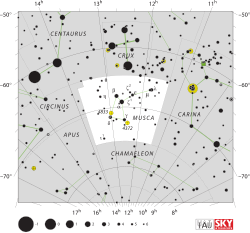
Alpha Muscae, Latinized from α Muscae, is a star in the southern circumpolar constellation of Musca. With an apparent visual magnitude of +2.7,2 it is the brightest star in the constellation. The distance to this star has been determined using parallax measurements, giving an estimate of about 315 light-years (97 parsecs) from Earth.1
With a stellar classification of B2 IV-V,4 this star appears to be in the process of evolving away from the main sequence of stars like the Sun and turning a subgiant star, as the supply of hydrogen at its core becomes exhausted. It is larger than the Sun, with nearly nine4 times the mass and 5.2 times the radius.a This star is radiating around 4,300 times as much luminosity as the Sun from its outer atmosphere at an effective temperature of 20,400 K,7 giving it the blue-white hue of a B-type star.11
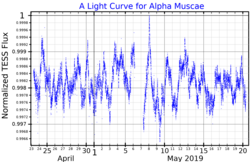
Alpha Muscae appears to be a Beta Cephei variable star. Telting and colleagues report it as a Beta Cephei with a high degree of confidence as they found regular pulsations in its spectrum in a high-resolution spectroscopy study published in 2006,5 although Stankov and Handler (2005) listed it as a poor or rejected candidate in their Catalog of Galactic β Cephei Stars.9 The International Variable Star Index lists it as a Beta Cephei variable which varies in brightness from magnitude 2.68 to 2.73, with a period of 2.17 hours.13 Alpha Muscae is rotating rapidly with a projected rotational velocity of 114 km s−19 and has an estimated age of about 18 million years.4
This star is a proper motion member of the Lower Centaurus–Crux sub-group in the Scorpius–Centaurus OB association, the nearest such association of co-moving massive stars to the Sun.7 Alpha Muscae has a peculiar velocity of 10 km s−1, which, while high, is not enough for it to be considered a runaway star.4
In the culture of the indigenous Wardaman people of Australia, this star has the name Burangalul, referring to the "forehead band" of the boomerang constellation Buran, which is equivalent to Musca.14
Notes
Notes
- Calculated, using the Stefan-Boltzmann law and the star's effective temperature and luminosity, with respect to the solar nominal effective temperature of 5,772 K:
References
References
- van Leeuwen, F. (November 2007), "Validation of the new Hipparcos reduction", Astronomy and Astrophysics, 474 (2): 653–664, arXiv:0708.1752, Bibcode:2007A&A...474..653V, doi:10.1051/0004-6361:20078357, S2CID 18759600
- Gutierrez-Moreno, Adelina; Moreno, Hugo (June 1968), "A photometric investigation of the Scorpio-Centaurus association", Astrophysical Journal Supplement, 15: 459, Bibcode:1968ApJS...15..459G, doi:10.1086/190168
- Jin, Harim; Langer, Norbert; Lennon, Daniel J.; Proffitt, Charles R. (2024). "Boron depletion in Galactic early B-type stars reveals two different main sequence star populations". Astronomy and Astrophysics. 690: A135. arXiv:2405.18266. Bibcode:2024A&A...690A.135J. doi:10.1051/0004-6361/202450896.
- Tetzlaff, N.; Neuhäuser, R.; Hohle, M. M. (January 2011), "A catalogue of young runaway Hipparcos stars within 3 kpc from the Sun", Monthly Notices of the Royal Astronomical Society, 410 (1): 190–200, arXiv:1007.4883, Bibcode:2011MNRAS.410..190T, doi:10.1111/j.1365-2966.2010.17434.x, S2CID 118629873
- Telting, J. H.; et al. (June 2006), "A high-resolution spectroscopy survey of β Cephei pulsations in bright stars", Astronomy and Astrophysics, 452 (3): 945–953, Bibcode:2006A&A...452..945T, doi:10.1051/0004-6361:20054730, hdl:2066/36162
- Evans, D. S. (June 20–24, 1966), Batten, Alan Henry; Heard, John Frederick (eds.), "The Revision of the General Catalogue of Radial Velocities", Determination of Radial Velocities and Their Applications, Proceedings from IAU Symposium No. 30, 30, University of Toronto: International Astronomical Union: 57, Bibcode:1967IAUS...30...57E
- de Geus, E. J.; de Zeeuw, P. T.; Lub, J. (June 1989), "Physical parameters of stars in the Scorpio-Centaurus OB association", Astronomy and Astrophysics, 216 (1–2): 44–61, Bibcode:1989A&A...216...44D
- Sharma, Awshesh N.; Bedding, Timothy R.; Saio, Hideyuki; White, Timothy R. (2022), "Pulsating B stars in the Scorpius–Centaurus Association with TESS", Monthly Notices of the Royal Astronomical Society, 515 (1): 828–840, arXiv:2203.02582, Bibcode:2022MNRAS.515..828S, doi:10.1093/mnras/stac1816
- Stankov, Anamarija; Handler, Gerald (June 2005), "Catalog of Galactic β Cephei Stars", The Astrophysical Journal Supplement Series, 158 (2): 193–216, arXiv:astro-ph/0506495, Bibcode:2005ApJS..158..193S, doi:10.1086/429408, S2CID 119526948
- "HD 109668 -- Variable Star of Beta Cep type", SIMBAD Astronomical Database, retrieved 2007-01-29
- "The Colour of Stars", Australia Telescope, Outreach and Education, Commonwealth Scientific and Industrial Research Organisation, December 21, 2004, archived from the original on November 8, 2004, retrieved 2012-01-16
- "MAST: Barbara A. Mikulski Archive for Space Telescopes". Space Telescope Science Institute. Retrieved 8 December 2021.
- "alf Mus". The International Variable Star Index. AAVSO. Retrieved 16 December 2022.
- "Burangalul". All Skies Encyclopaedia. IAU Working Group on Star Names. Retrieved 1 July 2025.