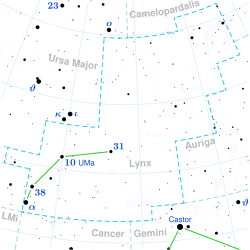
  | |
| Observation data Epoch J2000 Equinox ICRS | |
|---|---|
| Constellation | Lynx |
| Right ascension | 09h 21m 03.30021s1 |
| Declination | +34° 23′ 33.2134″1 |
| Apparent magnitude (V) | +3.142 |
| Characteristics | |
| Evolutionary stage | Giant star |
| Spectral type | K7 III3 |
| U−B color index | +1.954 |
| B−V color index | +1.554 |
| Astrometry | |
| Radial velocity (Rv) | 37.155 km/s |
| Proper motion (μ) | RA: −218.723 mas/yr1 Dec.: 16.555 mas/yr1 |
| Parallax (π) | 14.7±0.18 mas1 |
| Distance | 220.7+2.9 −2.6 ly (67.7+0.9 −0.8 pc)6 |
| Absolute bolometric magnitude (Mbol) | –2.32 ± 0.137 |
| Details | |
| Mass | 1.52±0.0778 M☉ |
| Radius | 58.15+0.73 −0.759 R☉ |
| Luminosity | 621.1±15.88 L☉ |
| Surface gravity (log g) | 1.06±0.048 cgs |
| Temperature | 3,881±208 K |
| Metallicity [Fe/H] | −0.26±0.058 dex |
| Rotational velocity (v sin i) | 6.45 km/s |
| Age | 1.410 Gyr |
| Other designations | |
| 40 Lyncis, HR 3705, HD 80493, BD+35°1979, HIP 45860, SAO 61414, FK5 352, NSV 4456, GC 1288011 | |
| Database references | |
| SIMBAD | data |
Alpha Lyncis (α Lyn, α Lyncis) is the brightest star in the northern constellation of Lynx with an apparent magnitude of +3.13.4 Unusually, it is the only star in the constellation that has a Bayer designation.10 Based upon parallax measurements, this star is located about 220 light-years (67 parsecs) from the Earth.1
Characteristics
This is a red giant star that has exhausted the hydrogen at its core and has evolved away from the main sequence. It has expanded to about 58 times the Sun's radius9 and it is emitting roughly 621 times the luminosity of the Sun. The estimated effective temperature of the star's outer envelope is 3,881 K,8 which is lower than the Sun's effective temperature of 5,778 K, and is giving Alpha Lyncis a red-orange hue that is characteristic of late K-type stars.12
Alpha Lyncis is a suspected small-amplitude red variable star13 that changes apparent magnitude from +3.17 up to +3.12.14 This variability pattern typically occurs in stars that have developed an inert carbon core surrounded by a helium-fusing shell, and suggests that Alpha Lyncis is starting to evolve into a Mira variable.10
References
References
- Vallenari, A.; et al. (Gaia collaboration) (2023). "Gaia Data Release 3. Summary of the content and survey properties". Astronomy and Astrophysics. 674: A1. arXiv:2208.00211. Bibcode:2023A&A...674A...1G. doi:10.1051/0004-6361/202243940. S2CID 244398875. Gaia DR3 record for this source at VizieR.
- Ducati, J. R. (2002). "VizieR Online Data Catalog: Catalogue of Stellar Photometry in Johnson's 11-color system". CDS/ADC Collection of Electronic Catalogues. 2237. Bibcode:2002yCat.2237....0D.
- Morgan, W. W.; Keenan, P. C. (1973). "Spectral Classification". Annual Review of Astronomy and Astrophysics. 11: 29–50. Bibcode:1973ARA&A..11...29M. doi:10.1146/annurev.aa.11.090173.000333.
- Johnson, H. L.; et al. (1966). "UBVRIJKL photometry of the bright stars". Communications of the Lunar and Planetary Laboratory. 4 (1): 99. Bibcode:1966CoLPL...4...99J.
- Massarotti, A.; et al. (2008). "Rotational and Radial Velocities for a Sample of 761 HIPPARCOS Giants and the Role of Binarity". The Astronomical Journal. 135 (1): 209–231. Bibcode:2008AJ....135..209M. doi:10.1088/0004-6256/135/1/209.
- Bailer-Jones, C. A. L.; Rybizki, J.; Fouesneau, M.; Demleitner, M.; Andrae, R. (2021). "Estimating Distances from Parallaxes. V. Geometric and Photogeometric Distances to 1.47 Billion Stars in Gaia Early Data Release 3". The Astronomical Journal. 161 (3): 147. arXiv:2012.05220. Bibcode:2021AJ....161..147B. doi:10.3847/1538-3881/abd806. S2CID 228063812. Data about this star can be seen here.
- Piau, L.; et al. (2010). "Surface convection and red giants radii measurements". Astronomy and Astrophysics. 526: 100. arXiv:1010.3649. Bibcode:2011A&A...526A.100P. doi:10.1051/0004-6361/201014442. S2CID 118533297. For Mbol, see Table 1.
- Soubiran, C.; Creevey, O. L.; Lagarde, N.; Brouillet, N.; Jofré, P.; Casamiquela, L.; Heiter, U.; Aguilera-Gómez, C.; Vitali, S.; Worley, C.; de Brito Silva, D. (2024-02-01). "Gaia FGK benchmark stars: Fundamental Teff and log g of the third version". Astronomy and Astrophysics. 682: A145. Bibcode:2024A&A...682A.145S. doi:10.1051/0004-6361/202347136. ISSN 0004-6361. Alpha Lyncis' database entry at VizieR.
- Baines, Ellyn K.; Armstrong, J. Thomas; Clark, James H.; Gorney, Jim; Hutter, Donald J.; Jorgensen, Anders M.; Kyte, Casey; Mozurkewich, David; Nisley, Ishara; Sanborn, Jason; Schmitt, Henrique R.; Belle, Gerard T. van (October 2021). "Angular Diameters and Fundamental Parameters of Forty-four Stars from the Navy Precision Optical Interferometer". The Astronomical Journal. 162 (5): 198. arXiv:2211.09030. Bibcode:2021AJ....162..198B. doi:10.3847/1538-3881/ac2431. ISSN 1538-3881.
- Kaler, J. B. (May 11, 2005). "ALPHA LYN (Alpha Lyncis) and ALSCIAUKAT (31 Lyncis)". Stars. University of Illinois. Retrieved 2011-12-26.
- "Alpha Lyncis". SIMBAD. Centre de données astronomiques de Strasbourg. Retrieved 2011-12-12.
- "The Colour of Stars". Australia Telescope Outreach and Education. Commonwealth Scientific and Industrial Research Organisation. December 21, 2004. Archived from the original on March 18, 2012. Retrieved 2012-01-16.
- Percy, J. R.; et al. (1994). "Photometric surveys of suspected small-amplitude red variables. III: An AAVSO photometric photometry survey". Publications of the Astronomical Society of the Pacific. 106 (700): 611–615. Bibcode:1994PASP..106..611P. doi:10.1086/133420.
- Kukarkin, B. V.; et al. (1981). "Catalogue of suspected variable stars". Nachrichtenblatt der Vereinigung der Sternfreunde E.V. Bibcode:1981NVS...C......0K.