 | |
 | |
| Clinical data | |
|---|---|
| Other names | ALEPH-6; DOT-6; 4-Phenylthio-2,5-dimethoxyamphetamine; 2,5-Dimethoxy-4-phenylthioamphetamine; 4-PhS-DMA |
| Routes of administration | Oral1 |
| Drug class | Serotonergic psychedelic; Hallucinogen |
| ATC code |
|
| Pharmacokinetic data | |
| Duration of action | "Probably long" (at least 12 hours)1 |
| Identifiers | |
| |
| CAS Number | |
| PubChem CID | |
| ChemSpider | |
| UNII | |
| CompTox Dashboard (EPA) | |
| Chemical and physical data | |
| Formula | C17H21NO2S |
| Molar mass | 303.42 g·mol−1 |
| 3D model (JSmol) | |
| |
| |
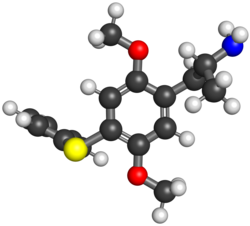
Aleph-6, or ALEPH-6, also known as 4-phenylthio-2,5-dimethoxyamphetamine, is a psychedelic drug of the phenethylamine, amphetamine, and DOx families.123 It is one of the Aleph series of compounds.123
In his book PiHKAL (Phenethylamines I Have Known and Loved), Alexander Shulgin lists Aleph-6's dose as greater than 40 mg orally and its duration as "probably long".123 The effects of Aleph-6 have been reported to include "un-worldliness", among others.1 It was reported to have synergized with LSD when taken in combination with it.1 Overall however, Shulgin regarded Aleph-6 as a "disappointment" and that it may be a "forever threshold thing".1
The chemical synthesis of Aleph-6 has been described.12 The 2C analogue, 2C-T-6, has never been synthesized.1
Aleph-6 was first described in the literature by Shulgin in PiHKAL in 1991.123 It is a controlled substance in Canada under phenethylamine blanket-ban language.4
References
References
- Shulgin A, Shulgin A (September 1991). PiHKAL: A Chemical Love Story. Berkeley, California: Transform Press. ISBN 0-9630096-0-5. OCLC 25627628. https://erowid.org/library/books_online/pihkal/pihkal006.shtml
- Shulgin A, Manning T, Daley P (2011). The Shulgin Index, Volume One: Psychedelic Phenethylamines and Related Compounds. Vol. 1. Berkeley: Transform Press. ISBN 978-0-9630096-3-0.
- Shulgin AT (2003). "Basic Pharmacology and Effects". In Laing RR (ed.). Hallucinogens: A Forensic Drug Handbook. Forensic Drug Handbook Series. Elsevier Science. pp. 67–137. ISBN 978-0-12-433951-4. Archived from the original on 13 July 2025.
- "Controlled Drugs and Substances Act". Department of Justice Canada. Retrieved 19 January 2026.