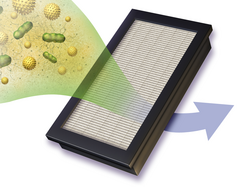
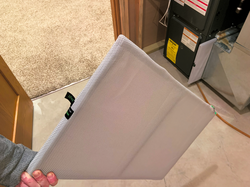
A particulate air filter is a device composed of fibrous or porous materials which removes particulates such as smoke, dust, pollen, mold, viruses, and bacteria from the air. Filters containing an adsorbent or catalyst such as charcoal (carbon) or baking sodamay also remove odors and gaseous pollutants, such as volatile organic compounds or ozone.1 Air filters are used in applications where air quality is important, notably in
- building ventilation systems
- engine, compressor, gas turbine compressor intakes
- equipment(autos, aircraft, construction) cabins.
- human-made environments (e.g., satellites, and Space Shuttles)
Air filters are typically constructed of foam, pleated paper, cotton, or spun fiberglass. Oil bath air filters have fallen out of favour aside from niche uses.
Air ionizers use a different method, static electric charge, than air filters to attract and remove dust particles but they may also be supplemented with an air filter.
HEPA filters
High efficiency particulate arrester (HEPA),23 originally called high-efficiency particulate absorber but also sometimes called high-efficiency particulate arresting or high-efficiency particulate arrestance, is a type of air filter. Filters meeting the HEPA standard have many applications, including use in clean rooms for IC fabrication, medical facilities, automobiles, aircraft and homes. The filter must satisfy certain standards of efficiency such as those set by the United States Department of Energy (DOE).
Varying standards define what qualifies as a HEPA filter. The two most common standards EN 1822 and ASME AG-1 require an air filter must remove (from the air that passes through) 99.95% (European Standard)4 or 99.97% (ASME standard)5 of particles that have a size greater than or equal to 0.3 μm.
Automotive cabin air filters
The cabin air filter, also known in the United Kingdom as a pollen filter, is typically a pleated-paper filter that is placed in the outside-air intake for the vehicle's passenger compartment. Some of these filters are rectangular, while others are uniquely shaped to fit the available space of particular vehicles' outside-air intakes.
History
The first automaker to include a disposable filter to keep the ventilation system clean was the Nash Motors "Weather Eye", introduced in 1940.6
A reusable heater core filter was available as an optional accessory on Studebaker models beginning in 1959, including Studebaker Lark automobiles (1959-1966), Studebaker Gran Turismo Hawk automobiles (1962-1964) and Studebaker Champ trucks (1960-1964). The filter was an aluminum frame containing an aluminum mesh and was located directly above the heater core. The filter was removed and installed from the engine compartment through a slot in the firewall. A long, thin rubber seal plugged the slot when the filter was installed. The filter could be vacuumed and washed prior to installation.
Performance
Clogged or dirty cabin air filters can reduce airflow available to the cabin vents, as well as introduce allergens into the cabin air stream. Since the cabin air temperature depends upon the flow rate of the air passing through the heater core, the evaporator, or both, clogged filters can greatly reduce the effectiveness and performance of the vehicle's air conditioning and heating systems.7
At the point of retail to the consumer, cabin air filter suppliers do not share performance testing characteristics listed below. However, some cabin air filter manufacturers do print a minimum efficiency reporting value (MERV) filter rating or cite N95 (however disclaim any NIOSH compliance) on their cabin air filter retail boxes.
Air filters may combine up to five layers or more to achieve the desired MERV performance levels, at the expense of increased pressure drop for each additional layer added that may reduce the overall effectiveness and performance of the vehicle's air conditioning and heating systems if the blower motor is not capable of maintaining the airflow across the heat exchangers of the baseline designed air filter by increasing speed (and power).8
Shape
Shape may vary from rectangular to fully custom in commom form factors:9
- Pleat (Plate or Banded)
- Cylinder
- V-shape
Air filter performance testing
Air filters can be tested using ISO 501110 or ISO 10263-211 separately from their use in application for various characteristics
- Volume flow rate vs pressure drop
- Dust(ISO 12103 A2 Fine or A4 Coarse) collection efficiency
- Dust holding capacity vs pressure drop
- Oil carryover(oil bath applications)
Internal combustion engine air filters
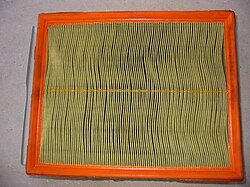


The combustion air filter prevents abrasive particulate matter from entering the engine's cylinders, causing mechanical wear, oil contamination, and change to emissions performance.12
Many modern fuel injected vehicles use a pleated paper filter element in the form of a flat panel, usually placed inside a plastic box connected to the throttle body with duct work.
Older vehicles that use carburetors or throttle body fuel injection typically use a cylindrical air filter, usually between 100 millimetres (4 in) and 400 millimetres (16 in) in diameter, positioned above or beside the carburetor or throttle body, usually in a metal or plastic container which may incorporate ducting to provide cool and/or warm inlet air, and secured with a metal or plastic lid.
The overall unit (filter and housing, and duct work together) is called the air cleaner.
Filter media types
Air intake filter media technology improvements have helped increase overall efficiency of gas turbine air-compressors by using simulation tools to optimize aerodynamics and fluid dynamics.13
Paper
Pleated paper filter elements are the nearly exclusive choice for automobile engine air cleaners, because they are efficient, easy to service, and cost-effective. The "paper" term is somewhat misleading, as the filter media are considerably different from papers used for writing or packaging, etc. There is a persistent belief among tuners, fomented by advertising for aftermarket non-paper replacement filters, that paper filters flow poorly and thus restrict engine performance. In fact, as long as a pleated-paper filter is sized appropriately for the airflow volumes encountered in a particular application, such filters present only a trivial restriction to flow until the filter has become significantly clogged with dirt. Construction equipment engines also use this. The reason is that the paper is bent in a zig-zag shape and therefore the surface area of the paper is very large, in the range of 50 times that of the air opening.
Foam
Oil-wetted polyurethane foam elements are used in some aftermarket replacement automobile air filters. Foam was in the past widely used in air cleaners on small engines on lawnmowers and other power equipment, but automotive-type paper filter elements have largely supplanted oil-wetted foam in these applications. Foam filters are still commonly used on air compressors for air tools up to 5 horsepower (3.7 kW). Depending on the grade and thickness of foam employed, an oil-wetted foam filter element can offer minimal airflow restriction or very high dirt capacity, the latter property making foam filters a popular choice in off-road rallying and other motorsport applications where high levels of dust will be encountered. Due to the way dust is captured on foam filters, large amounts may be trapped without measurable change in airflow restriction.
Cotton
Oiled cotton gauze is employed in a growing number of aftermarket automotive air filters marketed as high-performance items. In the past, cotton gauze saw limited use in original-equipment automotive air filters. However, since the introduction of the Abarth SS versions, the Fiat subsidiary supplies cotton gauze air filters as OE filters.
Stainless steel
Stainless steel mesh is another example of a medium which allows more air to pass through. Stainless steel mesh comes with different mesh counts, offering different filtration standards. In an extremely modified engine lacking the space for a cone-based air filter, some will opt to install a simple stainless steel mesh over the turbo to ensure no particles enter the engine via the turbo.
Oil bath
An oil bath air cleaner consists of a sump containing a pool of oil and an insert which is filled with fiber, mesh, foam, or another coarse filter media. The cleaner removes particles by adhering them to the oil-soaked filter media; as opposed to traditional filtration, the openings in the filter media are much larger than the particles that are to be filtered. When the cleaner is assembled, the media-containing body of the insert sits a short distance above the surface of the oil pool. The rim of the insert overlaps the rim of the sump. This arrangement forms a labyrinthine path through which the air must travel in a series of U-turns: up through the gap between the rims of the insert and the sump, down through the gap between the outer wall of the insert and the inner wall of the sump, and up through the filter media in the body of the insert. This U-turn takes the air at high velocity across the surface of the oil pool. Heavier (and typically larger) dust and dirt particles in the air cannot make the turn due to their inertia, so they fall into the oil and settle to the bottom of the base bowl. Lighter (and typically smaller) particles stick to the filtration media in the insert, which is wetted by oil droplets aspirated there by normal airflow. The constant aspiration of oil onto the filter media slowly carries most of the finer trapped particles downward and the oil drips back into the reservoir where the particles accumulate.
Oil bath air cleaners were very widely used in automotive and small engine applications until the widespread industry adoption of the paper filter in the early 1960s. Such cleaners are still used in off-road equipment where very high levels of dust are encountered, for oil bath air cleaners can sequester a great deal of dirt relative to their overall size without loss of filtration efficiency or airflow. However, the liquid oil makes cleaning and servicing such air cleaners messy and inconvenient, they must be relatively large to avoid excessive restriction at high airflow rates, and they tend to increase exhaust emissions of unburned hydrocarbons due to oil aspiration when used on spark-ignition engines.
Water bath
In the early 20th century (about 1900 to 1930), water bath air cleaners were used in some applications (cars, trucks, tractors, and portable and stationary engines). They worked on roughly the same principles as oil bath air cleaners. For example, the original Fordson tractor had a water bath air cleaner. By the 1940s, oil bath designs had displaced water bath designs because of better filtering performance. 14
Bulk solids handling filters
Bulk solids handling involves the transport of solids (mechanical transport, pneumatic transport) which may be in a powder form. Many industries are handling bulk solids (mining industries, chemical industries, food industries) which requires the treatment of air streams escaping the process so that fine particles are not emitted, for regulatory reasons or economical reasons (loss of materials). As a consequence, air filters are positioned at many places in the process, especially at the reception of pneumatic conveying lines15 where the quantity of air is important and the load in fine particle quite important. Filters can also be placed at any point of air exchange in the process to avoid that pollutants enter the process, which is particularly true in pharmaceuticals and food industries. The physical phenomena involved in catching particles with a filter are mainly inertial and diffusional16
Filter classes
Under European normalization standards EN 779, the following filter classes were recognized:
| Usage | Class | Performance | Performance test | Particulate size approaching 100% retention |
Test Standard |
|---|---|---|---|---|---|
| Coarse filters
(used as Primary) |
G1 | 65% | Average value | >5 μm | BS EN779 |
| G2 | 65–80% | Average value | >5 μm | BS EN779 | |
| G3 | 80–90% | Average value | >5 μm | BS EN779 | |
| G4 | 90%– | Average value | >5 μm | BS EN779 | |
| Fine filters
(used as Secondary) |
M5 | 40–60% | Average value | >5 μm | BS EN779 |
| M6 | 60–80% | Average value | >2 μm | BS EN779 | |
| F7 | 80–90% | Average value | >2 μm | BS EN779 | |
| F8 | 90–95% | Average value | >1 μm | BS EN779 | |
| F9 | 95%– | Average value | >1 μm | BS EN779 | |
| Semi HEPA | E10 | 85% | Minimum value | >1 μm | BS EN1822 |
| E11 | 95% | Minimum value | >0.5 μm | BS EN1822 | |
| E12 | 99.5% | Minimum value | >0.5 μm | BS EN1822 | |
| HEPA | H13 | 99.95% | Minimum value | >0.3 μm | BS EN1822 |
| H14 | 99.995% | Minimum value | >0.3 μm | BS EN1822 | |
| ULPA | U15 | 99.9995% | Minimum value | >0.3 μm | BS EN1822 |
| U16 | 99.99995% | Minimum value | >0.3 μm | BS EN1822 | |
| U17 | 99.999995% | Minimum value | >0.3 μm | BS EN1822 |
European standard EN 779, on which the above table is based, remained in effect from 2012 to mid-2018, when it was replaced by ISO 16890.17
See also
See also
- Air purifier
- Clean Air Delivery Rate
- CityTrees
- Corsi–Rosenthal Box
- Cyclonic separation
- Dehumidifier
- Diesel particulate filter
- Dust collector
- Humidifier
- Impingement filter
- Indoor air quality
- Mechanical filter (respirator)#Filtration standards
- Nose filter
- Pocket filter
- Respirator
- Scrubber
- Smog tower
- Swan neck duct
References
References
- "California Environmental Protection Agency - Air Cleaning Devices for the Home, Frequently Asked Questions" (PDF). California Environmental Protection Agency Air Resources Board. Retrieved 2016-12-14.
- HEPA Company glossary of terms Archived 2020-04-20 at the Wayback Machine
- Originally High Efficiency Particulate Arrestment - see thefreedictionary.com
- European Standard EN 1822-1:2009, "High efficiency air filters (EPA, HEPA and ULPA)", 2009
- American Society of Mechanical Engineers, ASME AG-1a–2004, "Addenda to ASME AG-1–2003 Code on Nuclear Air and Gas Treatment", 2004
- Vwlarry (19 May 2009). "Nils Wahlberg and Nash - Salute To A Great Engineer And Unsung Automobiles".
- "Dirty cabin air filter symptoms". FIRST BRANDS GROUP LLC. Retrieved 12 June 2024.
- HVAC, High Performance (2013-02-06). "Effects of a Clogged HVAC Air Filter - Dirty Furnace Filters". High Performance HVAC Heating & Cooling Reviews. Retrieved 2026-06-07.
- Zhang, 2 Liu, 3 Liu, 4 Liu, Xin , 2 Junjie , 3 Xuan, 4 Chaojun. "Performance optimization of airliner cabin air filters".
{{cite web}}: CS1 maint: multiple names: authors list (link) CS1 maint: numeric names: authors list (link) - Schirn, Alexandra (2025-10-14). "ISO 5011:2025—Inlet Air Cleaning Equipment - ANSI Blog". The ANSI Blog. Retrieved 2026-06-07.
- "ISO 10263-2:2009". ISO. Retrieved 2026-06-07.
- Dziubak, Taduesz. "Engine Study" (PDF).
- Robb, Drew (2026-06-07). "Better Filtration = Better Performance: Inlet air filtration in gas turbine performance and efficiency | Turbomachinery Magazine". www.turbomachinerymag.com. Retrieved 2026-06-07.
- Peter, Paul. "Isolier Konzept". Retrieved 26 September 2022.
- "Air filtration - Dust collectors".
- "Solid Gas separation (cyclone - filtration)".
- ISO 16890-1:2016(en) Air filters for general ventilation — Part 1: Technical specifications, requirements and classification system based upon particulate matter efficiency (ePM)