| Observation data Epoch J2000 Equinox ICRS | |
|---|---|
| Constellation | Vela |
| Right ascension | 08h 11m 59.96702s1 |
| Declination | −46° 38′ 39.6561″1 |
| Apparent magnitude (V) | 5.702 (5.50 – 5.89)3 |
| Characteristics | |
| Spectral type | F7 Ib-II4 |
| B−V color index | 0.595 |
| Variable type | δ Cep3 |
| Astrometry | |
| Radial velocity (Rv) | +26.0±2.96 km/s |
| Proper motion (μ) | RA: −4.4051 mas/yr Dec.: +6.7681 mas/yr |
| Parallax (π) | 1.2170±0.0570 mas1 |
| Distance | 2,700 ± 100 ly (820 ± 40 pc) |
| Absolute magnitude (MV) | −2.527 |
| Details | |
| Mass | 7.0±0.58 M☉ |
| Luminosity | 929.987 L☉ |
| Surface gravity (log g) | 1.665 cgs |
| Temperature | 6,1025 K |
| Metallicity [Fe/H] | +0.095 dex |
| Rotational velocity (v sin i) | 10.0±0.59 km/s |
| Age | 50.0±11.08 Myr |
| Other designations | |
| CD−46°3902, HD 68808, HIP 40155, HR 3232, SAO 21958710 | |
| Database references | |
| SIMBAD | data |
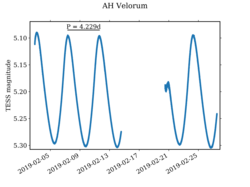
AH Velorum is a single,11 yellow-white hued star in the constellation Vela. It has an average apparent visual magnitude of 5.70,2 which makes it bright enough to be dimly visible to the naked eye in good seeing conditions. The distance to this star can be estimated from its annual parallax shift of 1.217 mas,1 which yields a separation of roughly 2,700 light years. It is moving further away from the Earth with a heliocentric radial velocity of +26 km/s.6
It is a bright giant/supergiant of spectral type F7 Ib-II.12 The star is around 508 million years old with a projected rotational velocity of 10 km/s.9 It has 78 times the mass of the Sun and is radiating 9307 times the Sun's luminosity from its photosphere at an effective temperature of 6,102 K.5
A classical Cepheid variable,3 its apparent magnitude ranges from 5.50 to 5.89 over 4.227171 days.12 It pulsates in the first overtone, with a fundamental period of 6.04 days.2
References
References
- Brown, A. G. A.; et al. (Gaia collaboration) (August 2018). "Gaia Data Release 2: Summary of the contents and survey properties". Astronomy & Astrophysics. 616. A1. arXiv:1804.09365. Bibcode:2018A&A...616A...1G. doi:10.1051/0004-6361/201833051. Gaia DR2 record for this source at VizieR.
- Evans, Nancy Remage; Bond, Howard E; Schaefer, Gail H; Mason, Brian D; Tingle, Evan; Karovska, Margarita; Pillitteri, Ignazio (2016). "Hubble Space Telescope Snapshot Survey for Resolved Companions of Galactic Cepheids". The Astronomical Journal. 151 (5): 129. arXiv:1603.02224. Bibcode:2016AJ....151..129E. doi:10.3847/0004-6256/151/5/129. S2CID 119248298.
- Samus', N. N; Kazarovets, E. V; Durlevich, O. V; Kireeva, N. N; Pastukhova, E. N (2017). "General catalogue of variable stars: Version GCVS 5.1". Astronomy Reports. 61 (1): 80–88. Bibcode:2017ARep...61...80S. doi:10.1134/S1063772917010085. S2CID 125853869.
- Houk, Nancy (1978). "Michigan catalogue of two-dimensional spectral types for the HD stars". Ann Arbor: Dept. Of Astronomy. 2. Ann Arbor. Bibcode:1978mcts.book.....H.
- Luck, R. Earle (2014). "Parameters and Abundances in Luminous Stars". The Astronomical Journal. 147 (6): 137. Bibcode:2014AJ....147..137L. doi:10.1088/0004-6256/147/6/137.
- de Bruijne, J. H. J.; Eilers, A.-C. (October 2012). "Radial velocities for the HIPPARCOS-Gaia Hundred-Thousand-Proper-Motion project". Astronomy & Astrophysics. 546: 14. arXiv:1208.3048. Bibcode:2012A&A...546A..61D. doi:10.1051/0004-6361/201219219. S2CID 59451347. A61.
- Anderson, E.; Francis, Ch. (2012). "XHIP: An extended hipparcos compilation". Astronomy Letters. 38 (5): 331. arXiv:1108.4971. Bibcode:2012AstL...38..331A. doi:10.1134/S1063773712050015. S2CID 119257644.
- Tetzlaff, N.; et al. (January 2011), "A catalogue of young runaway Hipparcos stars within 3 kpc from the Sun", Monthly Notices of the Royal Astronomical Society, 410 (1): 190–200, arXiv:1007.4883, Bibcode:2011MNRAS.410..190T, doi:10.1111/j.1365-2966.2010.17434.x, S2CID 118629873
- Ammler-von Eiff, Matthias; Reiners, Ansgar (June 2012), "New measurements of rotation and differential rotation in A-F stars: are there two populations of differentially rotating stars?", Astronomy & Astrophysics, 542: A116, arXiv:1204.2459, Bibcode:2012A&A...542A.116A, doi:10.1051/0004-6361/201118724, S2CID 53666672.
- "HD 68808". SIMBAD. Centre de données astronomiques de Strasbourg. Retrieved 16 August 2018.
- Eggleton, P. P.; Tokovinin, A. A. (2008). "A catalogue of multiplicity among bright stellar systems". Monthly Notices of the Royal Astronomical Society. 389 (2): 869. arXiv:0806.2878. Bibcode:2008MNRAS.389..869E. doi:10.1111/j.1365-2966.2008.13596.x. S2CID 14878976.
- Watson, Christopher (4 January 2010). "AH Velorum". AAVSO Website. American Association of Variable Star Observers. Retrieved 12 March 2014.