| Aglaocetus Temporal range: Early-Late Miocene
~ | |
|---|---|
| |
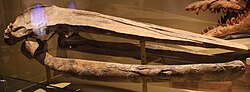
| A. moreni skull | |
Scientific classification 
| |
| Kingdom: | Animalia |
| Phylum: | Chordata |
| Class: | Mammalia |
| Infraclass: | Placentalia |
| Order: | Artiodactyla |
| Infraorder: | Cetacea |
| Superfamily: | Balaenopteroidea |
| Family: | †Aglaocetidae Steeman 2007 |
| Genus: | †Aglaocetus Kellogg 1934 |
| Species | |
| |
| Synonyms | |
| |
Aglaocetus is a genus of extinct baleen whales known from the Miocene of Patagonia, the US Eastern Seaboard, Japan and the Low Countries. It was once considered a member of Cetotheriidae along with many other putative cetotheres, but was recently recognized as representing a distinct family from true Cetotheriidae.
Species
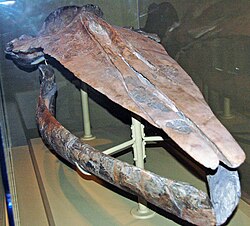
There are three currently recognized valid species: Aglaocetus moreni, A. latifrons, and A. rotundus.123
The type species, Aglaocetus moreni, was originally described as a species of Cetotherium, but later recognized as generically distinct from the latter.4 "Aglaocetus" patulus, described from the Calvert Formation by Remington Kellogg in 1968,5 was recovered by Bisconti et al. (2013) in a different phylogenetic position than the Aglaocetus type species.6 In 2020, A. patulus was renamed Atlanticetus.7
Distribution
Fossils of Aglaocetus have been found in:8
- Miocene
- Gaimán Formation (Colhuehuapian-Santacrucian), Argentina
- Diest and Berchem Formations, Belgium
- Eibergen Member, Netherlands
References
References
- R. Lydekker. 1894. Cetacean skulls from Patagonia. Anales del Museo de la Plata II:1-13
- P. J. Van Beneden. 1859. Rapport de M. Van Beneden. Bulletins de L'Academie Royale des Sciences, des Lettres et des Beaux-Arts de Belgique 8:123-146
- P. J. Van Beneden. 1880. Les mysticetes a courts fanons des sables des environs d'anvers. Bulletins de L'Academie Royale des Sciences, des Lettres et des Beaux-Arts de Belgique 1880:11-27
- R. Kellogg. 1934. The Patagonian Fossil Whalebone Whale, Cetotherium moreni (Lydekker). Carnegie Institution of Washington 447:64-81
- R. Kellogg. 1968. A sharp-nosed cetothere from the Miocene Calvert. Proceedings of the United States National Museum 247(7):163-173
- M. Bisconti, O. Lambert, and M. Bosselaers. 2013. Taxonomic revision of Isocetus depauwi (Mammalia, Cetacea, Mysticeti) and the phylogenetic relationships of archaic 'cetothere' mysticetes. Palaeontology 56(1):95-127
- Bisconti, M., Damarco, P., Mao, S., Pavia, M. and Carnevale, G. (2020). The earliest baleen whale from the Mediterranean: large-scale implications of an early Miocene thalassotherian mysticete from Piedmont, Italy. Papers in Palaeontology doi:10.1002/spp2.1336
- Aglaocetus at Fossilworks.org