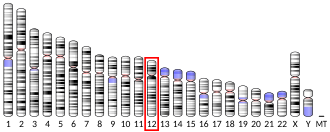
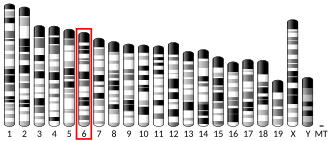
Adipocyte Enhancer-Binding Protein is a zinc finger protein that in humans is encoded by the evolutionarily well-conserved gene AEBP2. It was initially identified due to its binding capability to the promoter5 of the adipocyte P2 gene, and was therefore named Adipocyte Enhancer Binding Protein 2. AEBP2 is a potential targeting protein for the mammalian Polycomb Repression Complex 2 (PRC2).6
Function
AEBP2 is a DNA-binding transcriptional repressor. It may interact with and stimulate the activity of the PRC2 complex.7
AEBP2 may regulate the migration and development of the neural crest cells through the PRC2-mediated epigenetic mechanism and is most likely a targeting protein for the mammalian PRC2 complex.8
Clinical significance
Diseases associated with AEBP2 include Waardenburg's syndrome, and Hirschsprung's disease.8
References
References
- GRCh38: Ensembl release 89: ENSG00000139154 – Ensembl, May 2017
- GRCm38: Ensembl release 89: ENSMUSG00000030232 – Ensembl, May 2017
- "Human PubMed Reference:". National Center for Biotechnology Information, U.S. National Library of Medicine.
- "Mouse PubMed Reference:". National Center for Biotechnology Information, U.S. National Library of Medicine.
- Imhof, Axel; Kim, Hana; Bakshi, Arundhati; Kim, Joomyeong (2015). "Retrotransposon-Derived Promoter of Mammalian Aebp2". PLOS ONE. 10 (4) e0126966. Bibcode:2015PLoSO..1026966K. doi:10.1371/journal.pone.0126966. ISSN 1932-6203. PMC 4411029. PMID 25915901.
- Kim H, Kang K, Ekram MB, Roh TY, Kim J (2011). "Aebp2 as an epigenetic regulator for neural crest cells". PLOS ONE. 6 (9) e25174. Bibcode:2011PLoSO...625174K. doi:10.1371/journal.pone.0025174. PMID 21949878.
- Cao R, Zhang Y (July 2004). "SUZ12 is required for both the histone methyltransferase activity and the silencing function of the EED-EZH2 complex". Mol. Cell. 15 (1): 57–67. doi:10.1016/j.molcel.2004.06.020. PMID 15225548.
- Kim H, Kang K, Kim J (2009). "AEBP2 as a potential targeting protein for Polycomb Repression Complex PRC2". Nucleic Acids Res. 37 (9): 2940–50. doi:10.1093/nar/gkp149. PMC 2685092. PMID 19293275.
External links
External links