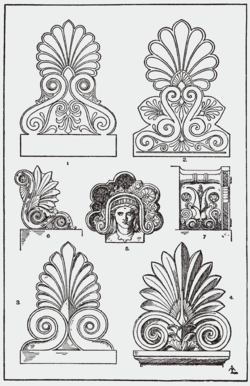
An acroterion or acroterium (pl. akroteria)1 is an architectural ornament placed on a flat pedestal, the acroter or plinth, and mounted at the apex or corner of the pediment of a building in the classical style.2 An acroterion placed at the outer angles of the pediment is an acroterion angularium (angulārium means ‘at the corners’).
The acroterion may take a wide variety of forms, such as a statue, tripod, disc, urn, palmette or some other sculpted feature. Acroteria are also found in Gothic architecture.3 They are sometimes incorporated into furniture designs.4
Etymology
The word comes from the Greek akrōtḗrion (ἀκρωτήριον 'summit, extremity'), from the comparative form of the adjective ἄκρος, ("extreme", "endmost") + -τερος (comparative suffix) + -ιον (substantivizing neuter form of adjectival suffix -ιος). It was Latinized by the Romans as acroterium.5 Akroteria or Acroteria is the plural of both the original Greek6 and the Latin form.7
According to Webb, during the Hellenistic period the winged victory or Nike figure was considered to be "the most appropriate motif for figured akroteria.”1
Gallery
-
 Ancient Greek marble acroterion in the form of Nike, Archaeological Museum of Samothrace, Samothrace, Greece
 -
 Ancient Greek acroterion of a Nereid on horseback, c.380 BC, marble, National Archaeological Museum, Athens
 -
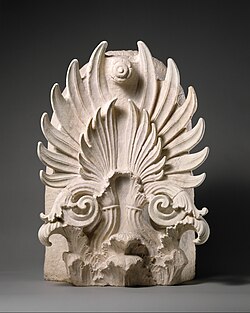 Ancient Greek akroterion, 350–325 BC, marble, Metropolitan Museum of Art, New York
 -
 Akroterion of the grave monument of Timotheos and Nikon, 350–325 BC, marble, Metropolitan Museum of Art
 -
 Ancient Greek acroteria from a temple of Artemis, 330-300 BC, marble, Archaeological Museum of Epidaurus, Epidaurus, Greece,
 -
 Ancient Greek acroteria of the Tomb III, Agios Athanasios, Greece, 325-300 BC
 -
![Simplified Ancient Greek acroteria of the pediment on an honorary decree, c.300-250 BC, bronze, National Archaeological Museum, Athens[8]](/api/ext/img?url=https%3A%2F%2Fupload.wikimedia.org%2Fwikipedia%2Fcommons%2Fthumb%2F5%2F5c%2F%25CE%2592ronze_inscribed_plaque_with_an_honorary_decree_of_the_Eleians_for_the_Olympic_victor_Demokrates_from_the_island_of_Tenedos%252C_written_in_the_Eleian_dialect%252C_from_the_Sanctuary_of_Zeus_at_Olympia%252C_300-250_BC_%252828382489002%2529.jpg%2F250px-thumbnail.jpg) Simplified Ancient Greek acroteria of the pediment on an honorary decree, c.300-250 BC, bronze, National Archaeological Museum, Athens8
Simplified Ancient Greek acroteria of the pediment on an honorary decree, c.300-250 BC, bronze, National Archaeological Museum, Athens8 -
 Romanesque acroterion of the Église Saints-Pierre-et-Paul de Rosheim, Rosheim, France, unknown sculptor or architect, c.1150
 -
![Renaissance acroteria of the Villa La Rotonda, outside Vicenza, Italy, designed by Andrea Palladio, 1566-1590s[9]](/api/ext/img?url=https%3A%2F%2Fupload.wikimedia.org%2Fwikipedia%2Fcommons%2Fthumb%2Fa%2Fa8%2F06-Villa-Rotonda-Palladio.jpg%2F500px-06-Villa-Rotonda-Palladio.jpg) Renaissance acroteria of the Villa La Rotonda, outside Vicenza, Italy, designed by Andrea Palladio, 1566-1590s9
Renaissance acroteria of the Villa La Rotonda, outside Vicenza, Italy, designed by Andrea Palladio, 1566-1590s9 -
 Neoclassical acroteria with mascarons on the Grave of Lupin-Roux family, Loyasse Cemetery, Lyon, sculpted by Pierre-Marie Prost, c.1830
 -
 Neoclassical acroteria of a window of the Großer Blumenberg, Leipzig, Germany, designed by Albert Geutebrück mid-19th century
 -
 Neoclassical pediment with acroteria of the Grave of Alexandrina Grejdanescu and Barbu Grejdanescu, Bellu Cemetery, Bucharest, Romania, unknown architect or sculptor, c.1871
 -

-
 Japanese acroterion, illustrations by Abel Guérineau, 1887
 -
 Beaux Arts acroterion of the Collège Franklin (Boulevard Louis-XIV no. 5), Lille, France, unknown architect or sculptor, c.1900
 -
 Beaux Arts acroterion above a window of Strada Grigore Cobălcescu no. 14, Bucharest, unknown architect or sculptor, c.1900
 -
 Beaux Arts acroterion above a window of Strada Bocșa no. 2, Bucharest, unknown architect or sculptor, c.1900
 -
![Art Nouveau acroterion of a stove in the Mița the Cyclist House (Strada Biserica Amzei no. 9), Bucharest, possibly designed by Nicolae C. Mihăescu,[10] 1908](/api/ext/img?url=https%3A%2F%2Fupload.wikimedia.org%2Fwikipedia%2Fcommons%2Fthumb%2F2%2F2c%2FArt_Nouveau_polychrome_tiled_stove_in_the_Mi%25C8%259Ba_the_Cyclist_House%252C_Bucharest_%252804%2529.jpg%2F330px-Art_Nouveau_polychrome_tiled_stove_in_the_Mi%25C8%259Ba_the_Cyclist_House%252C_Bucharest_%252804%2529.jpg) Art Nouveau acroterion of a stove in the Mița the Cyclist House (Strada Biserica Amzei no. 9), Bucharest, possibly designed by Nicolae C. Mihăescu,10 1908
Art Nouveau acroterion of a stove in the Mița the Cyclist House (Strada Biserica Amzei no. 9), Bucharest, possibly designed by Nicolae C. Mihăescu,10 1908 -
![Art Deco acroterion of the Dinicu Golescu Entrance of the Northern Railway Station, Bucharest, designed by Victor Gh. Ștephănescu, 1935[11]](/api/ext/img?url=https%3A%2F%2Fupload.wikimedia.org%2Fwikipedia%2Fcommons%2Fthumb%2F4%2F41%2FBucharest%252C_Gara_de_Nord_%252815483566168%2529.jpg%2F500px-Bucharest%252C_Gara_de_Nord_%252815483566168%2529.jpg) Art Deco acroterion of the Dinicu Golescu Entrance of the Northern Railway Station, Bucharest, designed by Victor Gh. Ștephănescu, 193511
Art Deco acroterion of the Dinicu Golescu Entrance of the Northern Railway Station, Bucharest, designed by Victor Gh. Ștephănescu, 193511 -
![Postmodern acroterion of the Harold Washington Library, Chicago, by Hammond, Beeby & Babka, 1991[12]](/api/ext/img?url=https%3A%2F%2Fupload.wikimedia.org%2Fwikipedia%2Fcommons%2Fthumb%2F2%2F28%2FChicago_%25283392204396%2529.jpg%2F500px-Chicago_%25283392204396%2529.jpg)
-
![Postmodern acroteria on the pediment of the Children's Museum of Houston, Houston, US, by Robert Venturi, 1992[13]](/weird-wikipedia/img/c/7f/7fc2515edc415d8f.jpg) Postmodern acroteria on the pediment of the Children's Museum of Houston, Houston, US, by Robert Venturi, 199213
Postmodern acroteria on the pediment of the Children's Museum of Houston, Houston, US, by Robert Venturi, 199213 -
 New Classical acroteria on the pediment of the Maitland Robinson Library, Downing College, Cambridge University, Cambridge, UK, by Quinlan Terry, 1992
References
References
- Webb, Pamela A. (1996). Hellenistic Architectural Sculpture: Figural motifs in western Anatolia and the Aegean islands. Madison, Wisconsin: The University of Wisconsin Press. p. 26.
- "Acroterian". Merriam Webster.
- Harris, Cyril M. (1983). Illustrated Dictionary of Historic Architecture. Courier Corporation. p. 5. ISBN 9780486244440.
- "acroterion - architecture".
- "acroter". Oxford English Dictionary (online ed.). Oxford University Press. (Subscription or participating institution membership required.)
- McCarver (ed.). "Glossary of architectural terms". McArver Ancient History. Greek Architecture. Porter-Gaud School. Archived from the original on 8 September 2006. Retrieved 26 January 2021.
- Smith, Philip (1875). "Acroterium". In Thayer, Bill (ed.). A Dictionary of Greek and Roman Antiquities. University of Chicago. Retrieved 26 January 2021.
- Smith, David Michael (2017). Pocket Museum - Ancient Greece. Thames & Hudson. p. 235. ISBN 978-0-500-51958-5.
- Hopkins, Owen (2022). Reading Architecture - A Visual Lexicon. Laurence King. p. 35. ISBN 978-1-52942-034-0.
- Mariana Celac, Octavian Carabela and Marius Marcu-Lapadat (2017). Bucharest Architecture - an annotated guide. Ordinul Arhitecților din România. p. 85. ISBN 978-973-0-23884-6.
- Mariana Celac, Octavian Carabela and Marius Marcu-Lapadat (2017). Bucharest Architecture - an annotated guide. Ordinul Arhitecților din România. p. 171. ISBN 978-973-0-23884-6.
- Gura, Judith (2017). Postmodern Design Complete. Thames & Hudson. p. 77. ISBN 978-0-500-51914-1.
- Eleanor Gibson. "Seven of Robert Venturi's best postmodern projects". dezeen.com. Retrieved 25 June 2023.
Further reading
Further reading
- Danner, Peter (1989). Griechische Akrotere der archaischen und klassischen Zeit [Greek acroteria of the archaic and classical periods]. Rivista di archeologia, supplementary vol. 5. Rome: Bretschneider, ISBN 88-7698-045-8.
- Goldberg, Marilyn Y. (1977). Types and distribution of archaic Greek akroteria. Bryn Mawr.
- Reinhardt, Corinna (2018). Akroter und Architektur. Figürliche Skulptur auf Dächern griechischer Bauten vom 6. bis zum 4. Jahrhundert v. Chr. [Acroter and architecture. Figurative sculpture on the roofs of Greek buildings from the 6th to the 4th century BC]. Image & Context, vol. 18. Berlin/Boston: de Gruyter, ISBN 978-3-11-053880-9.