| Acrolepis Temporal range: Possible Famennian & Tournaisian records
| |
|---|---|
| |
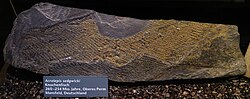
| Fossil of Acrolepis sedgwicki | |
| |
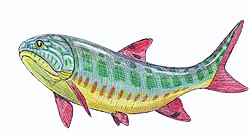
| Restoration of A. gigas | |
Scientific classification 
| |
| Kingdom: | Animalia |
| Phylum: | Chordata |
| Class: | Actinopterygii |
| Order: | †Elonichthyiformes |
| Family: | †Acrolepididae |
| Genus: | †Acrolepis Agassiz, 1833 |
| Type species | |
| †Acrolepis sedgwicki Agassiz, 1833
| |
| Other species | |
|
See text | |
Acrolepis (Ancient Greek for "tip scale") is an extinct genus of prehistoric marine & freshwater bony fish that lived from the Visean stage of the Carboniferous to the early Triassic epoch.13 It is a large piscivorous predatory fish in the acrolepid family, which occupied an apex predator niche in its locale. A. gigas was estimated to have grown up to 1.25 metres (4.1 ft) in length.4
The earliest definitive species are known from the mid-Mississippian stage of Europe, and the last surviving species of Acrolepis are known from the Early Triassic of Tasmania.2 Potentially earlier, but more dubious records are known from the late Devonian (Famennian) of Russia and the early Carboniferous (Tournaisian) of Canada.5 This genus was most diverse and speciose during the Permian.6
A close relationship between the mostly Palaeozoic Acrolepidae and the Mesozoic Ptycholepiformes was proposed, but support from phylogenetic analyses is scarce.7 More recent studies place it in the order Elonichthyiformes.89
Diet
Acrolepis possibly used its sharp, pointed teeth to catch smaller fishes (such as other "palaeoniscoid" fish).10
Fossil record
The type species is Acrolepis sedgwicki from the late Permian Marl Slate of England and the coeval Kupferschiefer of Germany. It is named after British geologist Adam Sedgwick. Other species are known from Carboniferous and Permian rocks in the Czech Republic and Triassic layers of Tasmania.
Specimens in possession of Tyne & Wear Archives and Museums comprise a fossilized jawbone from the Marl Slate of Durham Province.
Taxonomy
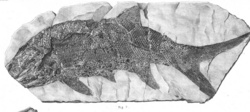
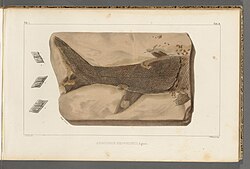
The following species are known:56
- †A. barbarus Minikh, 2006 - Middle Permian (Wordian) of Arkhangelsk, Russia
- †A. chuvashovi Yankevich, 2001 - Early Permian (Artinskian) of Perm, Russia (Urminskaya Formation)
- †A. frequens Yankevich & Minikh, 1998 - Middle Permian (Kungurian) of Perm, Russia (Intinsky Formation)
- †A. gigas Frič, 1877 - Late Pennsylvanian (Moscovian to Gzhelian) of the Czech Republic (Slaný & Syřenov Formations)
- †A. hamiltoni Johnston & Morton, 1890 - Early Triassic (Induan) of Tasmania, Australia (Knocklofty Formation)
- †A. hopkinsi McCoy, 1848 - mid-late Mississippian (Visean to Serpukhovian) of England (Millstone Grit & Pendleside Limestone), Serpukhovian of Belgium (Chokier Formation)
- †?A. hortonensis Dawson, 1868 - early Mississippian (Tournaisian) of New Brunswick (Albert Formation) & Nova Scotia (Horton Bluff Formation), Canada
- †A. hussakofi Hay, 1929 - Kungurian of South Dakota, US (Minnekahta Formation)
- †A. languescens Yankevich & Minikh, 1998 - Kungurian of Perm, Russia (Intinsky Formation)
- †A. macroderma Eichwald, 1860 - Middle Permian (Roadian) of Tatarstan (Baitugan Formation) & Wordian of Chuvashia (Isheevo Formation), Russia
- †A. minichi Yankevich, 2001 - Kungurian of Perm, Russia (Intinsky Formation)
- †A. ortholepis Traquair, 1884 - Visean of Scotland (Glencartholm Volcanic Beds)
- †?A. reticulata Eichwald, 1860 - Late Devonian (Famennian) of Oryol, Russia (Dankov-Lebedyan Beds Formation) (potentially Glyptopomus)5
- †A. semigranulosa Traquair, 1890 - Visean of Scotland (West Lothian Oil Shale Formation)
- †A. sedgwicki Agassiz, 1833 (type species) - Kungurian of Saratov, Russia (Baytugan Formation), Roadian of Udmurtia, Russia (Intinsky Formation), Late Permian (Wuchiapingian) of England (Marl Slate/Raisby Formation) & Germany (Kupferschiefer)
- †A. tasmanicus Johnston & Morton, 1891 - Induan of Tasmania, Australia (Knocklofty Formation)11
- †A. wilsoni Traquair, 1888 - Visean of England (Yoredale Group)
Synonyms
Several species have been referred to the genus Acrolepis. The following species were subsequently reascribed to other genera:2
- †Acrolepis arctica Woodward, 1912 → †Boreosomus acticus (Woodward, 1912)
- †Acrolepis digitata Woodward, 1891 → †Namaichthys digitata (Woodward, 1891)
- †Acrolepis laetus Lambe, 1916 → †Pteronisculus? laetus (Lambe, 1916)
In culture
The flag and coat of arms of the village and municipality of Žilov, Plzeň-North District in the Plzeň Region of the Czech Republic, feature a restoration of Acrolepis gigas in the center of the black-silver-red divided fabric or shield, respectively.
-
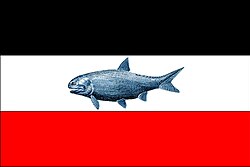 Žilov flag
 -
 Žilov coat of arms
References
References
- Sepkoski, Jack (2002). "A compendium of fossil marine animal genera". Bulletins of American Paleontology. 363: 1–560. Archived from the original on 2011-07-23. Retrieved 2009-04-24.
- Romano, Carlo; Koot, Martha B.; Kogan, Ilja; Brayard, Arnaud; Minikh, Alla V.; Brinkmann, Winand; Bucher, Hugo; Kriwet, Jürgen (February 2016). "Permian-Triassic Osteichthyes (bony fishes): diversity dynamics and body size evolution". Biological Reviews. 91 (1): 106–147. doi:10.1111/brv.12161. PMID 25431138. S2CID 5332637.
- "PBDB". paleobiodb.org. Retrieved 2024-03-10.
- Štamberg, Stanislav (2006). "Carboniferous-Permian actinopterygian fishes of the continental basins of the Bohemian Massif, Czech Republic: an overview". Geological Society, London, Special Publications. 265 (1): 217–230. Bibcode:2006GSLSP.265..217S. doi:10.1144/gsl.sp.2006.265.01.10. ISSN 0305-8719. S2CID 129300756.
- Geology, British Museum (Natural History) Department of; Woodward, Arthur Smith (1891). Catalogue of the Fossil Fishes in the British Museum (Natural History): Elasmobranchii (Acanthodii), Holocephali, ichthyodorulites, Ostracodermi, Dipnoi, and Teleostomi (Crossopterygii and chondrostean Actinopterygii). order of the Trustees.
- "PBDB". paleobiodb.org. Retrieved 2024-01-29.
- Mutter, Raoul (2011). "A case study of the palaeobiogeography of Early Mesozoic actinopterygians, the family Ptycholepidae.". In Upchurch, P.; McGowan, A.J.; Slater, C.S.C. (eds.). Palaeogeography and Palaeobiogeography: Biodiversity in Space and Time. CRC Press, Boca Raton. pp. 143–171.
- "PBDB". paleobiodb.org. Retrieved 2024-01-29.
- Bakaev, Aleksandr S.; Kogan, Ilja; Yankevich, Dmitri (2020-06-22). "On the validity of names of some Permian actinopterygians from European Russia". Neues Jahrbuch für Geologie und Paläontologie - Abhandlungen. 296 (3): 305–316. doi:10.1127/njgpa/2020/0907. ISSN 0077-7749.
- "Geofinder - Discover the fossil and mineral collections of Tyne & Wear Museums". collectionsprojects.org.uk. Retrieved 2022-07-26.
- Dziewa, T. J. (1980). "Early Triassic osteichthyans from the Knocklofty Formation of Tasmania". Papers and Proceedings of the Royal Society of Tasmania. 114: 145–160. doi:10.26749/rstpp.114.145. ISSN 0080-4703.