| Acrogeria | |
|---|---|
| Other names | Acrogeria, Gottron type, Gottron's syndrome1 |
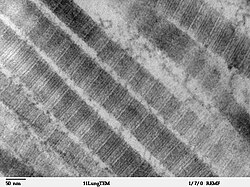 | |
| Fibers of Collagen Type I - TEM | |
| Specialty | Dermatology |
| Usual onset | Childhood |
| Duration | Lifelong |
| Causes | Genetic |
| Differential diagnosis | Werner's syndrome |
| Prognosis | Normal life expectancy |
Acrogeria (Gottron's syndrome) is a skin condition characterized by premature aging, typically in the form of unusually fragile, thin skin on the hands and feet (distal extremities).1
This is one of the classic congenital premature aging syndromes, occurring early in life, others being pangeria (Werner's syndrome) and progeria (Hutchinson–Gilford's syndrome), and was characterized in 1940.2 Acrogeria was originally described by Gottron in 1941, when he noticed premature cutaneous aging localized on the hands and feet in two brothers. The problem had been present since birth.2
Onset is often in early childhood, it progresses over the next few years and then remains stable over time with morphology, colour and site remaining constant. A bruising tendency has been observed.3 Mutations in the COL3A1 gene, located at chromosome 2q31–q32, have been reported in varied phenotypes, including acrogeria and vascular rupture in Ehlers–Danlos' syndrome (more especially type IV).4
Presentation
The most characteristic symptom of acrogeria is thin, atrophic skin with mottled pigmentation and telangiectasia, most severe in the limbs and extremities.5 This is accompanied by easy bruising, hyperkeratosis, and a loss of subcutaneous fat,6 which is replaced by connective tissue.7 Patients have a facies with a pinched face, hollow cheeks, prominent eyes without exophthalmos, a beak-like nose and thin lips.8 Though the hair and nails are normal in many cases,9 alopecia and nail dystrophies, such as onychogryphosis and koilonychia, have been reported.10 Stature is short in some patients11 and normal in others.10 The general skeletal structure is unremarkable,10 but acrogeria results in delayed closure of the cranial sutures, notching of the mandible, and micrognathia;11 and may also coincide with spina bifida, clubfoot and congenital dislocation of the hips.7 Sexual development, including the development of secondary sex characteristics, is normal, and so is intelligence.10 There is no correlation of acrogeria with metabolic, opthamological or cardiovascular disorders, and patients have a normal life expectancy.10 Similarities between the clinical features of acrogeria and Werner's syndrome have been observed.12
References
References
- Rapini, Ronald P.; Bolognia, Jean L.; Jorizzo, Joseph L. (2007). Dermatology: 2-Volume Set. St. Louis: Mosby. ISBN 978-1-4160-2999-1.
- Gottron, H. Familiaere Akrogerie. Arch. Derm. Syph. 181: 571-583, 1940.
- Blaszczyk M, Depaepe A, Nuytinck L, Glinska-Ferenz M, Jablonska S (2000). "Acrogeria of the Gottron type in a mother and son". Eur J Dermatol. 10 (1): 36–40. PMID 10694296.
- Pope FM, Narcisi P, Nicholls AC, et al. (1996). "COL3A1 mutations cause variable clinical phenotypes including acrogeria and vascular rupture". Br J Dermatol. 135 (2): 163–181. doi:10.1046/j.1365-2133.1996.d01-971.x. PMID 8881656.
- "Editorial: Premature ageing syndromes". BMJ. 4 (5943): 489. 30 November 1974. doi:10.1136/bmj.4.5943.489. ISSN 0959-8138.
- Morris, David (May 1957). "Acrogeria". Proceedings of the Royal Society of Medicine. 50 (5): 330–331. doi:10.1177/003591575705000510. PMID 19993915.
- Miteva, L. (30 June 2010). "A case of acrogeria". European Journal of Pediatric Dermatology. 20 (2): 107–110. ISSN 2281-9649.
- Maiese, Aniello; La Russa, Raffaele; Fazio, Valentina; De Matteis, Alessandra; Frati, Paola; Fineschi, Vittorio (December 2019). "Sudden death in acrogeria Gottron type". Forensic Science, Medicine and Pathology. 15 (4): 667–670. doi:10.1007/s12024-019-00182-7. PMID 31673870.
- Gottron, H. (December 1940). "Familiäre Akrogerie". Archiv für Dermatologie und Syphilis. 181 (5): 571–583. doi:10.1007/BF01828361.
- Thirumalaiswamy, Aparna; Kharkar, Vidya D; Bhargava, Anmol (October 2023). "Acrogeria: A Rare Congenital Aging Syndrome". Indian Journal of Paediatric Dermatology. 24 (4): 307–310. doi:10.4103/ijpd.ijpd_10_23.
- Nikolova, Silviya Y.; Toneva, Diana H.; Yordanov, Yordan A.; Lazarov, Nikolai E. (2014). "Multiple Wormian bones and their relation with definite pathological conditions in a case of an adult cranium". Anthropologischer Anzeiger. 71 (3): 169–190. doi:10.1127/0003-5548/2014/0355. ISSN 0003-5548. JSTOR 24252988. PMID 25065115.
- Wells, R S (June 1972). "? Werner's Syndrome ? Acrogeria". Proceedings of the Royal Society of Medicine. 65 (6): 525–526. doi:10.1177/003591577206500611. PMID 5035903.