| Acritohippus Temporal range: Miocene
| |
|---|---|
| |
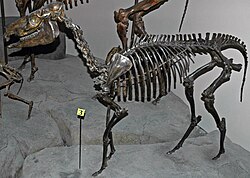
| A. isonesus skeleton | |
Scientific classification 
| |
| Kingdom: | Animalia |
| Phylum: | Chordata |
| Class: | Mammalia |
| Infraclass: | Placentalia |
| Order: | Perissodactyla |
| Family: | Equidae |
| Subfamily: | Equinae |
| Genus: | †Acritohippus Kelly, 1995 |
| Species | |
| |
Acritohippus is an extinct genus of Miocene area equine from North America.1 Fossils of Acritohippus have been found in Florida,23 New Mexico,4 Montana,5 California,67 and Oregon, where its fossils were first unearthed and described as a species of Merychippus back in 1928.8910 It was a grazer that ate C4 grasses.111213
References
References
- T. S. Kelly. 1995. New Miocene horses from the Caliente Formation, Cuyama Valley Badlands, California. Contributions in Science, Natural History Museum of Los Angeles County 455:1-33
- Bryant, J. Daniel (1991). "New Early Barstovian (Middle Miocene) Vertebrates from the Upper Torreya Formation, Eastern Florida Panhandle". Journal of Vertebrate Paleontology. 11 (4): 472–489. Bibcode:1991JVPal..11..472B. doi:10.1080/02724634.1991.10011416. ISSN 0272-4634. JSTOR 4523407.
- Morgan, Gary S.; Hulbert, Richard C. (1995-03-14). "Overview of the geology and vertebrate biochronology of the Leisey Shell Pit Local Fauna, Hillsborough County, Florida". Bulletin of the Florida Museum of Natural History. 37 (1): 1–92. doi:10.58782/flmnh.sdnh9875. ISSN 0071-6154.
- Richard H. Tedford (1981). "Mammalian Biochronology of Late Cenozoic Basins of New Mexico: ABSTRACT". AAPG Bulletin. 65. doi:10.1306/2f919954-16ce-11d7-8645000102c1865d. ISSN 0149-1423.
- KUENZI, W. DAVID; FIELDS, ROBERT W. (1971). "Tertiary Stratigraphy, Structure, and Geologic History, Jefferson Basin, Montana". Geological Society of America Bulletin. 82 (12): 3373. doi:10.1130/0016-7606(1971)82[3373:tssagh]2.0.co;2. ISSN 0016-7606.
- Quinn, James Patrick (1987-12-18). "Stratigraphy of the Middle Miocene Bopesta Formation, southern Sierra Nevada, California". Contributions in Science. 393: 1–31. doi:10.5962/p.241282. ISSN 0459-8113.
- Geology of the Alvord Mountain quadrangle, San Bernardino County, California (Report). US Geological Survey. 1960. doi:10.3133/b1089a.
- "Merychippus Isonesus (Cope) from the Later Tertiary of the Crooked River Basin, Oregon". authors.library.caltech.edu. Retrieved 2025-02-18.
- Maguire, Kaitlin Clare; Samuels, Joshua X.; Schmitz, Mark D. (2018-01-15). "The fauna and chronostratigraphy of the middle Miocene Mascall type area, John Day Basin, Oregon, USA". PaleoBios. 35. doi:10.5070/p9351037578. ISSN 2373-8189.
- "A Miocene mammalian fauna from Beatty Buttes, Oregon". authors.library.caltech.edu. Retrieved 2025-02-18.
- Maguire, Kaitlin Clare (May 2015). "Dietary niche stability of equids across the mid-Miocene Climatic Optimum in Oregon, USA". Palaeogeography, Palaeoclimatology, Palaeoecology. 426: 297–307. Bibcode:2015PPP...426..297M. doi:10.1016/j.palaeo.2015.03.012. ISSN 0031-0182.
- Feranec, Robert S.; Pagnac, Darrin C. (2017). "Hypsodonty, horses, and the spread of C4 grasses during the middle Miocene in southern California". Evolutionary Ecology Research. 18 (2): 201–223. ISSN 1522-0613. Archived from the original on September 25, 2017.
- Feranec, Robert S.; Pagnac, Darrin (October 2013). "Stable carbon isotope evidence for the abundance of C4 plants in the middle Miocene of southern California". Palaeogeography, Palaeoclimatology, Palaeoecology. 388: 42–47. Bibcode:2013PPP...388...42F. doi:10.1016/j.palaeo.2013.07.022. ISSN 0031-0182.