| Acanthicus hystrix | |
|---|---|
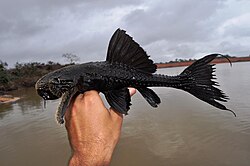
| |
| From the Xingu River (Altamira, Pará, Brazil) | |
Scientific classification 
| |
| Kingdom: | Animalia |
| Phylum: | Chordata |
| Class: | Actinopterygii |
| Order: | Siluriformes |
| Family: | Loricariidae |
| Genus: | Acanthicus |
| Species: | A. hystrix
|
| Binomial name | |
| Acanthicus hystrix | |
| Synonyms2 | |
| |

Acanthicus hystrix, the lyre-tail pleco,3 is a species of freshwater ray-finned fish belonging to the family Loricariidae, the suckermouth armoured catfishes, and the subfamily Hypostominae, the suckermouth catfishes. This species is found in South America.
Taxonomy
Acanthicus hystrix was first formally described in 1829 by the naturalists Johann Baptist von Spix and Louis Agassiz with its type locality given as the Amazon River.2 When the species was described Agassiz proposed the new monospecific genus Acanthicus, so this species is the type species of that genus by monotypy.4 A second species, A. adonis was added in 1988 by Isbrücker and Han Nijssen.2 There arepossibly another two undescribed species in the genus, although these may just be variants of A. hystrix.5 Eschmeyer's Catalog of Fishes classified the genus Acanthicus in the subfamily Hypostominae, the suckermouth catfishes, within the suckermouth armored catfish family Loricariidae.46
Etymology
Acanthicus hystrix is the type species of the genus Acanthicus, which is derived from the Greek akánthinos, meaning "thorny", alluding to entire upper surface of the head of this species, being armed with long erectile odontodes. The specific name, hystrix, means "porcupine", another references to the erectile, long spine-like odontodes on the upper head of this species.6
Appearance
Acanthicus hystrix grows to 62.8 cm (2.06 ft) in standard length,5 but may possibly reach 100 cm (3.3 ft).3 Its color ranges from medium-brown to near-black (especially those from the Madeira, Branco and Xingu rivers are dark), and the underparts often have a vermiculated pattern.5 Some of the variants are commonly considered as separate, undescribed species in the aquarium trade (e.g., L193 from the Orinoco basin and L407 from the Branco basin; in the L-number system), but there is extensive overlap in the morphometrics of the different populations.5 Unlike the polka dot lyre-tail pleco (A. adonis), A. hystrix never has white spots.5 Adult males are especially spiny with extensive odontodes on the cheeks and opercle.5
Distribution and habitat
Acanthicus hystrix is found in South America where it is found in the Amazon basin of Brazil, the Orinoco system in Colombia and Venezuela and the Ucayali River in Peru, it may also occur in Guyana and Suriname. This species is found along shorelines with fallen wood where it feeds on the periphyton growing on submerged wood.1
Utilisation
Acanthicus hystrix is occasionally seen in the aquarium trade, but its adult size and territorially aggressive behavior means that a very large tank is required.3
References
References
- Salvador, G.N. (2023). "Acanthicus hystrix". IUCN Red List of Threatened Species. 2023 e.T49830272A158549940. doi:10.2305/IUCN.UK.2023-1.RLTS.T49830272A158549940.en. Retrieved 5 March 2024.
- Fricke, Ron; Eschmeyer, William N. & van der Laan, Richard (eds.). "Species in the genus Acanthicus". Catalog of Fishes. California Academy of Sciences. Retrieved 24 May 2026.
- "Acanthicus hystrix". SeriouslyFish. Retrieved 31 October 2017.
- Fricke, Ron; Eschmeyer, William N. & van der Laan, Richard (eds.). "Genera in the family Hypostominae". Catalog of Fishes. California Academy of Sciences. Retrieved 24 May 2026.
- Chamon, C.C. (2016). "Redescription of Acanthicus hystrix Agassiz, 1829 (Siluriformes: Loricariidae), with comments on the systematics and distribution of the genus". Zootaxa. 4088 (3): 395–408. doi:10.11646/zootaxa.4088.3.5.
- Christopher Scharpf (18 January 2026). "Family LORICARIIDAE: Subfamily HYPOSTOMINAE Kner 1853 (Suckermouth Catfishes or Plecos)". The ETYFish Project Fish Name Etymology Database. Christopher Scharpf. Retrieved 24 May 2026.