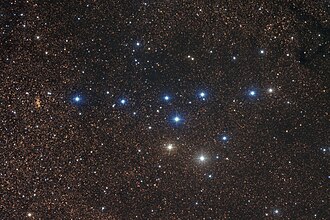
 7 Vulpeculae is at the eastern (left) end of an asterism called the coathanger, or "Brocchi's Cluster". | |
| Observation data Epoch J2000.0 Equinox J2000.0 | |
|---|---|
| Constellation | Vulpecula |
| Right ascension | 19h 29m 20.8974s1 |
| Declination | 20° 16′ 47.0583″1 |
| Apparent magnitude (V) | 6.3372 |
| Characteristics | |
| Spectral type | B4–5 III–IVe3 + sdB/sdO4 |
| U−B color index | −0.5852 |
| B−V color index | −0.1572 |
| Astrometry | |
| Radial velocity (Rv) | −16.5±0.24 km/s |
| Proper motion (μ) | RA: 2.555±0.0691 mas/yr Dec.: −15.383±0.0711 mas/yr |
| Parallax (π) | 3.5826±0.04 mas5 |
| Distance | 910 ± 10 ly (279 ± 3 pc) |
| Absolute magnitude (MV) | −1.66+0.44 −0.513 |
| Orbit4 | |
| Period (P) | 69.30±0.07 d |
| Semi-major axis (a) | 0.5553±0.0096 AU |
| Eccentricity (e) | 0 |
| Inclination (i) | 98.7±1.2° |
| Longitude of the node (Ω) | 151.0±0.6° |
| Periastron epoch (T) | 2,454,248.1±2.7 HJD3 |
| Argument of periastron (ω) (secondary) | 90° |
| Semi-amplitude (K1) (primary) | 8.7±0.2 km/s |
| Semi-amplitude (K2) (secondary) | 77.2±1.5 km/s |
| Details3 | |
| 7 Vul A | |
| Mass | 4.25±0.234 M☉ |
| Radius | 5.2 R☉ |
| Surface gravity (log g) | 3.75±0.02 cgs |
| Temperature | 15,600±200 K |
| Rotational velocity (v sin i) | 300±30 km/s |
| Age | 50–80 Myr |
| 7 Vul B | |
| Mass | 0.477±0.0204 M☉ |
| Other designations | |
| 7 Vul, BD+19 4039, HD 183537, HIP 95818, HR 7409, SAO 872696 | |
| Database references | |
| SIMBAD | data |
7 Vulpeculae is a binary star system approximately 9105 light years away in the slightly northern constellation of Vulpecula.6 It is a challenge to view with the naked eye, having an apparent visual magnitude of 6.3.2 The system has a heliocentric radial velocity of −16.5 km/s.4
This is a single-lined spectroscopic binary star system with an orbital period of 69.3 days and an eccentricity of 0.16.3 The visible component is a Be star with a stellar classification of B4–5 III–IVe that appears to be nearing the end of its main sequence lifetime. The system shows a rapid projected rotational velocity of 300 km/s, which is just below the estimated critical velocity for a binary of 367 km/s.3
There is a small variability in the magnitude over a 0.559-day cycle;2 this is likely the rotation period of the primary star.2
The companion is a hot subdwarf, either a subdwarf B or subdwarf O star, with a mass of 48% the Sun's mass. It has a close orbital separation of half an astronomical unit and take 69 days to complete an orbit.4
References
References
- Brown, A. G. A.; et al. (Gaia collaboration) (August 2018). "Gaia Data Release 2: Summary of the contents and survey properties". Astronomy & Astrophysics. 616. A1. arXiv:1804.09365. Bibcode:2018A&A...616A...1G. doi:10.1051/0004-6361/201833051. Gaia DR2 record for this source at VizieR.
- Harmanec, P.; et al. (2020). "A new study of the spectroscopic binary 7 Vul with a Be star primary". Astronomy and Astrophysics. 639. Table A.1. arXiv:2005.11089. Bibcode:2020A&A...639A..32H. doi:10.1051/0004-6361/202037964. S2CID 218862853.
- Vennes, S.; et al. (2011). "On the nature of the Be star HR 7409 (7 Vul)". Monthly Notices of the Royal Astronomical Society. 413 (4): 2760–2766. arXiv:1101.2622. Bibcode:2011MNRAS.413.2760V. doi:10.1111/j.1365-2966.2011.18350.x. S2CID 118519164.
- Klement, Robert; Rivinius, Thomas; Gies, Douglas R.; Baade, Dietrich; Mérand, Antoine; Monnier, John D.; Schaefer, Gail H.; Lanthermann, Cyprien; Anugu, Narsireddy; Kraus, Stefan; Gardner, Tyler (February 2024). "The CHARA Array Interferometric Program on the Multiplicity of Classical Be Stars: New Detections and Orbits of Stripped Subdwarf Companions". The Astrophysical Journal. 962 (1): 70. arXiv:2312.08252. Bibcode:2024ApJ...962...70K. doi:10.3847/1538-4357/ad13ec. ISSN 0004-637X.
- Vallenari, A.; et al. (Gaia collaboration) (2023). "Gaia Data Release 3. Summary of the content and survey properties". Astronomy and Astrophysics. 674: A1. arXiv:2208.00211. Bibcode:2023A&A...674A...1G. doi:10.1051/0004-6361/202243940. S2CID 244398875. Gaia DR3 record for this source at VizieR.
- "7 Vul". SIMBAD. Centre de données astronomiques de Strasbourg. Retrieved 28 August 2012.
External links
External links
- 7 Vulpeculae on WikiSky: DSS2, SDSS, GALEX, IRAS, Hydrogen α, X-Ray, Astrophoto, Sky Map, Articles and images