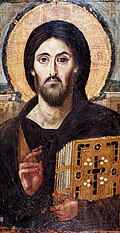
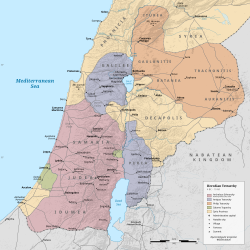

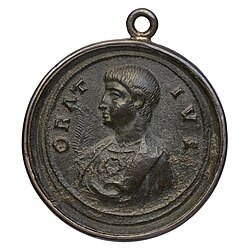
Clockwise from upper left: Jesus is generally considered to be born this decade. Historians usually consider his birth to be between 7 BC and 4 BC; Herod the Great dies in 4 BC, and the Kingdom of Judea is split; Horace and Maecenas die in 8 BC, marking the end of the Golden Age of Latin Literature; Drusus's campaigns in Germania end after he falls from a horse and dies.
The 0s BC is the period between 9 BC and 1 BC, the last nine years of the before Christ era. It is one of two "0-to-9" decade-like timespans that contain nine years, along with the 0s.
This is a list of events that occurred during the 0s BC, ordered chronologically.
Events
9 BC
Roman Empire
- January 30 – The Ara Pacis ("Altar of Augustan Peace"), which was voted for by the Senate four years earlier, is dedicated.1
- Pannonia is incorporated into the Roman Empire as a part of Illyria.2
- Nero Claudius Drusus, Emperor Augustus' stepson, begins a campaign against the Marcomanni, but dies soon after, due to a fall from his horse.3
Arabia
- Aretas IV Philopatris ascended to become the King of the Nabataeans (modern Jordan).4
8 BC
Roman Empire
- King Maroboduus becomes ruler of the Marcomanni5 and fights against the Roman Empire's expansion in Bohemia.6
India
- Strato II, the last Indo-Greek king, rules the eastern Punjab alongside his co-regent son Strato III (r.c. 25BC - AD 10)
Germania
- Arminius, son of a Cheruscan chieftain, is taken as a hostage to Rome, where he receives a military education.78
- After 20 years, Emperor Augustus initiates his second census of the Roman Empire.9
- Sextilis, the eighth month of the early Julian calendar, is renamed Augustus (August) by a decree of the Roman Senate in honor of Augustus.10
7 BC
Han China
- May 7 – Emperor Ai becomes the emperor of Han China.11
Roman Empire
- Augustus' second census of the Roman Empire reports a total of 4,233,000 citizens.12 However, the specific criteria of the census are still not clear.13
- The city of Rome is divided into 14 administrative regions.14
Astronomy
- Appearance of a very bright triple conjunction of the royal star Jupiter and Saturn in the sign of Pisces (land in the west) in May until December of that year since 854 years, with a retrogradation and stationing in November 12. Robert A. Powell (1996) proposes that this is the birth date of Jesus.15
6 BC
Roman Empire
- Tiberius retires to Rhodes, to the inconvenience of Emperor Augustus.16 He is recalled to Rome years later in 4 AD, becoming Augustus' adopted son and heir following the deaths of Lucius and Gaius Caesar.
5 BC
Astronomy
- March – Probable nova in the constellation Aquila.17
- c. December – Probable supernova in the constellation Capricornus.17
4 BC
Roman Empire
- Herod the Great dies, which causes unrest in his client kingdom of Judea. His son, Herod Archelaus, becomes the new ruler. Herod Antipas becomes tetrarch of Galilee and Perea,and the governor of Syria, Publius Quinctilius Varus, marches down to Jerusalem from Antioch to restore order; around 3000 Jews are crucified.18
Korea
3 BC
Han China
Roman Empire
- The Pont Julien was constructed in modern southern France.21
2 BC
Roman Empire
- February 5 – Augustus is proclaimed pater patriae ("father of the country") by the Roman Senate. This bestowed title is the logical consequence and final proof of Augustus' supreme position as princeps, the first in charge over the Roman state.22
- Julia the Elder, a daughter of Augustus, is exiled on charges of treason and adultery to Pandateria; her mother Scribonia accompanies her.2324
- The Forum Augustum is dedicated.25
Parthia
- Phraates V and his mother Musa become rulers of the Parthian Empire following the murder of Phraates IV.
Armenia
- Tigranes IV and Erato are restored to the throne after deposing Artavasdes III.
1 BC
Han dynasty
- August 15 – Emperor Ai dies and is succeeded by his 8-year-old cousin Ping, who is enthroned on October 17. Wang Mang is appointed regent by Empress Dowager Wang Zhengjun, his aunt.2627
- Former regent Dong Xian, who was previously Ai's lover, commits suicide with his wife.28
Roman Empire
- Gaius Caesar marries Livilla, (daughter of Antonia Minor and Nero Claudius Drusus) in an effort to gain prestige.29
- The Roman theatre in Cartagena, which was built by Gaius and Lucius Caesar, finishes construction.30
- Aulus Caecina Severus was appointed consul by Emperor Augustus, succeeding Cossus Cornelius Lentulus Gaetulicus and Lucius Calpurnius Piso.31
India
- In the Satavahana dynasty, Kunatala Satakarni is succeeded by Satakarni II.32
- Zeionises, an Indo-Scythian satrap, begins his rule in the northern Indian subcontinent (r.c.10 BC - AD 10).
Year unknown
Kingdom of Kush
- c. 1 BC: Natakamani succeeds Amanishakheto as the King of Kush.33
Roman Empire
- c. 9 BC: Livy completes compilation of his Ab Urbe Condita Libri, 142 books covering the history of Rome since its foundation to the present.34
- c. 2 BC: The Aqua Alsietina (or Aqua Augusta), which was a Roman aqueduct in Rome, is constructed during the reign of Augustus.35
Births
9 BC
- Ping, Chinese emperor of the Han dynasty (d. AD 6)
- Quintus Asconius Pedianus, Roman historian (d. AD 76)
8 BC
- Wang, Chinese empress of the Han dynasty (d. AD 23)
5 BC
- January 15 – Guang Wu, Chinese emperor of the Han Dynasty (d. AD 57)
- Aemilia Lepida, Roman noblewoman and fiancée of Claudius (d. AD 43)
- Domitia Lepida, daughter of Lucius Domitius Ahenobarbus and Antonia Major (d. AD 54)
- Lucius Vitellius the Elder, Roman consul and governor of Syria (d. AD 51)
- John the Baptist (d. c. AD 30)
4 BC
- Approximate date – Seneca the Younger, Córdoban-born Roman Stoic philosopher, statesman and dramatist (d. AD 65)
3 BC
- December 24 – Servius Sulpicius Galba, Roman emperor in AD 69.36
2 BC
- Gnaeus Domitius Ahenobarbus, father of Nero37
Year unknown
- Jesus, first-century Jewish religious leader and founder of Christianity (d. AD 33). Modern estimates are usually between 7–4 BC153839 Dionysius Exiguus assigned the date 1 BC in his Anno Domini;40 Tertullian, Eusebius and Epiphanius date it to approximately 2 BC.41
Deaths
9 BC
- Nero Claudius Drusus, son of Livia and stepson of Augustus (b. 38 BC)
8 BC
- November 27 – Horace, Roman lyric poet and writer (b. 65 BC)42
- Gaius Maecenas, Roman politician and advisor (b. 70 BC)
- Polemon I, Roman client king of the Bosporan Kingdom
- Xu, Chinese empress of the Han dynasty
7 BC
- April 17 – Cheng, Chinese emperor of the Han dynasty (b. 51 BC)
- Aristobulus IV, Jewish prince of Judea (b. 31 BC)
- Geumwa of Dongbuyeo, Korean king
- Zhao Hede, Chinese consort of the Han dynasty
6 BC
- Lady Ban (or Ban Jieyu), Chinese concubine and poet (b. 48 BC)
- Feng Yuan (or Zhaoyi), Chinese concubine of the Han Dynasty
- Liu Xiang, Chinese scholar, editor of Shan Hai Jing and compiler of Lienü zhuan, father of Liu Xin (b. 77 BC)
- Soseono, Korean queen of Goguryeo (b. 67 BC)
5 BC
- Acme (enslaved woman), Jewish slave and personal maid in the service of the Empress Livia Drusilla, wife of Augustus
- Curia, Roman noblewoman and wife of Quintus Lucretius Vespillo
4 BC
- March or April – Herod the Great, king of Judea (b. 73 BC);43 some authors date his death to 1 BC (see Date of Herod's death).
- Antipater, Jewish heir and son of Herod the Great
- Malthace, Jewish woman and wife of Herod the Great
- Marcus Porcius Latro, Roman rhetorician
- Marcus Tullius Tiro, Roman writer, freedman of Cicero
2 BC
- Fu, Chinese Grand Empress of the Han dynasty
- Iullus Antonius, Roman consul and son of Mark Antony (b. 43 BC)
- Phraates IV, king of the Parthian Empire
1 BC
- August 15 – Ai of Han, Chinese emperor of the Han dynasty (b. 27 BC)4445
- Dong Xian, Chinese politician and commander-in-chief (b. 23 BC)28
- Xiaoai, Chinese empress and wife of Ai of Han46
- Zhao Feiyan, Chinese empress and wife of Cheng of Han (b. 45 BC)47
Year unknown
- Cleopatra Selene II, Ptolemaic princess of Egypt
- Dionysius of Halicarnassus, Greek historian48
- Fu, Chinese grand empress of the Han Dynasty
Significant people
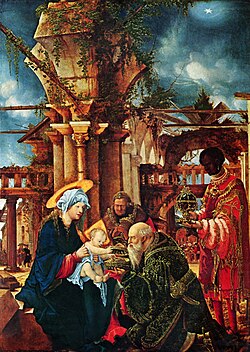
- Tigranes IV, King of Armenia, r. 12–1 BC
- Erato, Queen of Armenia, 8–5 BC, 2 BC – AD 2, AD 6–11
- Artavasdes III, King of Armenia, r. 5–2 BC
- Jesus Christ, Jewish preacher and central figure of Christianity, (ca. 4 BC–ca. AD 33)
- Ariobarzan of Atropatene, Client King of Armenia, r. 1 BC – AD 2
- Chend Di, Emperor of Han dynasty China, r. 32–7 BC
- Ai Di, Emperor of Han dynasty China, r. 7–1 BC
- Ping Di, Emperor of Han dynasty China, r. 1 BC – AD 5
- Wang Mang, Chinese statesman and future emperor of China
- Dong Xian, Han dynasty Chinese official under Emperor Ai of Han
- Antiochus III, King of Commagene, r. 12 BC – AD 17
- Arminius, Germanic war chief (18/17 BC – AD 21)
- Arshak II, King of Caucasian Iberia, r. 20 BC – AD 1
- Strato II and Strato III, co-kings of the Indo-Greek Kingdom, r. 25 BC – AD 10
- Kunatala Satakarni, king of the Satavahana dynasty, r. 9-1 BC
- Satakarni III, king of the Satavahana dynasty, r. 1 BC - AD 1
- Zeionises, Indo-Scythian satrap in the northen Indian subcontinent, r.c. 10 BC - AD 10
- Lugaid Riab nDerg, legendary High King of Ireland, r. 33–9 BC
- Conchobar Abradruad, legendary High King of Ireland, r. 9–8 BC
- Crimthann Nia Náir, legendary High King of Ireland, r. (8 BC – AD 9)
- Suinin, legendary Emperor of Japan, r. 29 BC – AD 70
- Amanishakheto, King of Kush, r. 10–1 BC
- Natakamani, King of Kush, r. 1 BC – AD 20
- Ma'nu III, King of Osroene, r. 23–4 BC
- Abgar V, King of Osroene, r. 4 BC-AD 7, AD 13–50
- Phraates IV, king of the Parthian Empire, r. 38–2 BC
- Phraates V, king of the Parthian Empire, r. 2 BC – AD 4
- Musa of Parthia, mother and co-ruler with Phraates V, r. 2 BC – AD 4
- Caesar Augustus, Roman Emperor (27 BC – AD 14)
- Nero Claudius Drusus, Roman Consul, in office 9 BC
- Gaius Caesar, Roman general
- Livy, Roman historian
- Ovid, Roman poet
- Quirinius, Roman nobleman and politician
- Tiberius, Roman general, statesman, and future emperor.
- Herod the Great, client king of Judea
- Hillel the Elder, Jewish scholar and Nasi of the Sanhedrin, in office c. 31 BC – AD 9
- Shammai, Jewish scholar and Av Beit Din of the Sanhedrin, in office 20 BC – AD 20
- Hyeokgeose, King of Silla, r. 57 BC – AD 4
References
References
- Conlin, Diane Atnally (1997). The Artists of the Ara Pacis: The Process of Hellenization in Roman Relief Sculpture. UNC Press Books. ISBN 978-0-8078-2343-9.
- Pannonia — United Nations of Roma Victrix
- Levick, Barbara (1990). Claudius. Yale University Press. ISBN 978-0-300-05831-4.
- Healey, J. F. (2015). The Religion of the Nabataeans: A Conspectus. BRILL. ISBN 978-90-04-30148-1.
- 7, 1, 3, p. 290; Marcus Velleius Paterculus, Compendium of Roman History 2, 108
- "Maroboduus". britannica.com. Encyclopædia Britannica, inc. 20 March 2016. Retrieved 21 June 2020.
Maroboduus, (died AD 37, Ravenna, Italy), king of the Marcomanni who organized the first confederation of German tribes.
- "Arminius". Encyclopædia Britannica Ultimate Reference Suite. Chicago: Encyclopædia Britannica. 2014.
- Durschmied, Erik (11 April 2013). The Weather Factor. Hodder & Stoughton. p. 1759. ISBN 978-1-4447-6965-4.
- "LacusCurtius • Res Gestae Divi Augusti (II)". penelope.uchicago.edu. Retrieved 2017-02-22.
- Preserved by Macrobius, Saturnalia 1.12.35; entry on calendarium, in William Smith, A Dictionary of Greek and Roman Antiquities (John Murray, London, 1875), at LacusCurtius.
- Barbieri-Low, Anthony J.; Yates, Robin D.S. (2015). "Recognized Rulers of the Qin and Han Dynasties and the Xin Period". Law, State, and Society in Early Imperial China. BRILL. ISBN 978-90-04-30053-8.
- "LacusCurtius • Res Gestae Divi Augusti (II)". penelope.uchicago.edu. Retrieved 2017-02-22.
- Hin, Saskia (2007-11-01), Counting Romans (SSRN Scholarly Paper), Rochester, NY: Social Science Research Network, doi:10.2139/ssrn.1426932, SSRN 1426932, retrieved 2024-02-16
- "The Fourteen Regions of Augustus (Platner & Ashby, 1929)". LacusCurtius. Retrieved 2024-02-16.
- Powell, Robert A. (1996). Chronicle of the living Christ : the life and ministry of Jesus Christ : foundations of cosmic Christianity. Hudson, NY: Anthroposophic Press. p. 68. ISBN 9780880104074.
- Pettinger, Andrew (2012). The Republic in Danger: Drusus Libo and the Succession of Tiberius. OUP Oxford. pp. 62ff. ISBN 978-0-19-960174-5.
- Matthews, Roberts (2011). Why Don't Spiders Stick to Their Webs. Oxford: Oneworld. p. 66. ISBN 978-1-85168-900-2.
- Evans, Craig A. (2004). Of Scribes and Sages: Ancient versions and traditions. A&C Black. pp. 137–140. ISBN 978-0-567-08083-7.
- "List of Rulers of Korea". www.metmuseum.org. Retrieved 21 April 2019.
- Charles A. Frazee (2002). Two Thousand years ago. Wm. B. Eerdmans Publishing. p. 133. ISBN 978-0-8028-4805-5.
- Julien Bridge. Avignon & Provence
- Swan, Peter M. (2004). The Augustan Succession. Oxford University Press. pp. 103–104. ISBN 978-0-19-534714-2.
- Velleius Paterculus, 2.100
- Cassius Dio 55.10
- Stambaugh, John E. (1988). The Ancient Roman City. Baltimore: Johns Hopkins University Press. p. 54. ISBN 0-8018-3574-7.
- Bowman, John Stewart, ed. (2000). Columbia Chronologies of Asian history and Culture. New York: Columbia University Press. p. 12. ISBN 978-0-231-50004-3. OCLC 51542679.
- Furth, Charlotte (1991). "Passions of the Cut Sleeve: The Male Homo[sex]ual Tradition in China. By Bret Hinsch. Berkeley: University of California Press, 1990. xvii, 232 pp. $22.50". The Journal of Asian Studies. 50 (4): 911–912. doi:10.2307/2058567. ISSN 0021-9118. JSTOR 2058567.
- Hinsch, Bret. (1990) Passions of the Cut Sleeve. University of California Press.
- "Cassius Dio - Book 55". penelope.uchicago.edu. Retrieved 2021-05-25.
- "Cartagena Roman Theatre Museum". murciatoday.com. Retrieved 2021-05-26.
- Syne, Ronald (1995). Anatolica : studies in Strabo. Clarendon Press. ISBN 0-19-814943-3. OCLC 30318791.
- Singh, Rajesh Kumar (2013). Ajanta Paintings: 86 Panels of Jatakas and Other Themes. Hari Sena. pp. 15–16. ISBN 9788192510750.
- Garlake, Peter S. (2002). Early Art and Architecture of Africa. Oxford University Press. ISBN 978-0-19-284261-9.
- Ramsay, William (1870). . In Smith, William (ed.). Dictionary of Greek and Roman Biography and Mythology. Vol. II. pp. 790–796.
- "Roman aqueducts: Rome Aqua Alsietina (Italy)". www.romanaqueducts.info. Retrieved 2023-09-22.
- "Galba | Roman Emperor, Death of Nero, Murder | Britannica". www.britannica.com. 2023-08-03. Retrieved 2023-09-22.
- Smith, William (1867), "Ahenobarbus (10), Gnaeus Ahenobarbus", in Smith, William (ed.), Dictionary of Greek and Roman Biography and Mythology, vol. 1, Boston: Little, Brown and Company, p. 86.
- Spears, Tom (2005-12-04). "Star of Wonder". Ottawa Citizen. p. A7. "Michael Molnar announced 10 years ago his conclusion that the Star of Bethlehem was in fact a double eclipse of Jupiter in a rare astrological conjunction that occurred in Aries on March 20, 6 BC, and again on April 17, 6 BC. ... Mr. Molnar believes that Roman astrologers would have interpreted the double-eclipse as signifying the birth of a divine king in Judea." However, astronomical software such as Stellarium shows that on March 20, the occultation of Jupiter by the Moon could not be seen from Rome, as the Moon passed by the planet without obscuring it. Furthermore, the event on April 17 began when Jupiter was 38 degrees above the horizon, at 2pm, i.e. in daylight, so it is extremely unlikely that this event would have been seen either.
- Dunn, James D.G. (2003). Jesus Remembered. Wm. B. Eerdmans Publishing. p. 344. ISBN 978-0-8028-3931-2.
- James D. G. Dunn, Jesus Remembered, Eerdmans Publishing (2003), page 324.
- Beyer, David (1998). "Josephus Reexamined: Unraveling the Twenty-Second Year of Tiberius". In Vardaman, Jerry (ed.). Chronos, Kairos, Christos II: Chronological, Nativity, and Religious Studies in Memory of Ray Summers. Mercer University Press. pp. 85–96. ISBN 978-0-86554-582-3.
- Grant, Michael. "Horace". Encyclopaedia Britannica. Retrieved February 22, 2024.
- "Herod | Biography & Facts". Encyclopedia Britannica. Retrieved 7 April 2019.
- Fairbank, John (1986). The Cambridge History of China: Volume 1, The Ch'in and Han Empires, 221 BC-AD 220. Cambridge University Press. p. 227. ISBN 9780521243278.
- Loewe, Michael (2018) [1974]. Crisis and Conflict in Han China. Routledge. ISBN 9780429849107.
- Thomsen, Rudi (1988). Ambition and Confucianism : a biography of Wang Mang. [Aarhus, Denmark]: Aarhus University Press. ISBN 87-7288-155-0. OCLC 19912826.
- Peterson, Barbara Bennett, ed. (2015). Notable women of China: Shang dynasty to the early twentieth century. Armonk, New York: M. E. Sharpe (Routledge). pp. 75–77. ISBN 978-0-7656-0504-7. OCLC 41231560.
- Claridge, Amanda (1998). Rome: An Oxford Archaeological Guide. Oxford University Press. pp. 33. ISBN 9780192880031.
- "Number of Christians in the world". Adherents.com. Archived from the original on 2009-08-02. Retrieved 2009-09-10.