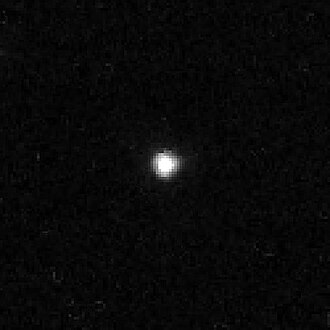
 2002 XV93 imaged by the Hubble Space Telescope in August 2005 | |||||||||
| Discovery1 | |||||||||
|---|---|---|---|---|---|---|---|---|---|
| Discovered by | Palomar | ||||||||
| Discovery site | Palomar Observatory | ||||||||
| Discovery date | 10 December 2002 | ||||||||
| Designations | |||||||||
| TNO2 · plutino34 · distant1 | |||||||||
| Orbital characteristics (barycentric)5a | |||||||||
| Epoch 21 November 2025 (JD 2461000.5) | |||||||||
| Uncertainty parameter 22 | |||||||||
| Observation arc | 35+ yr2 | ||||||||
| Earliest precovery date | 16 October 1990 | ||||||||
| Aphelion | 44.212 AU | ||||||||
| Perihelion | 34.405 AU | ||||||||
| 39.309 AU | |||||||||
| Eccentricity | 0.1247 | ||||||||
| 246.29 yr (89,958 d) | |||||||||
| 295.225° | |||||||||
| 0° 0m 12.241s / day | |||||||||
| Inclination | 13.270° | ||||||||
| 19.043° | |||||||||
| 20 March 2070 ±1.10 days62 | |||||||||
| 164.647° | |||||||||
| Known satellites | 0 | ||||||||
| Physical characteristics | |||||||||
| >0.040+0.020 −0.015 (2012)7c | |||||||||
| |||||||||
| 20.810 | |||||||||
| Atmosphere | |||||||||
Surface pressure | 100–200 nbar (0.01–0.02 Pa)4 | ||||||||
| Composition by volume | unknown; nitrogen, argon, or methane?11 | ||||||||
(612533) 2002 XV93 is an unnamed trans-Neptunian object (TNO) in the Kuiper belt, discovered by Palomar Observatory in December 2002. It is a member of the plutinos, a population of TNOs in a 2:3 orbital resonance with Neptune, like the dwarf planet Pluto. 2002 XV93 has a diameter of around 430 to 510 km (270 to 320 mi), which makes it about one-seventh the diameter of Earth's moon and about one-fifth the diameter of Pluto. It has a dark gray surface containing high amounts of water ice and some frozen carbon dioxide, but no detectable signs of frozen methane, nitrogen, or carbon monoxide. The mass, density, shape, and rotation of 2002 XV93 are all unknown, but are expected to resemble those of other similarly-sized TNOs like Huya.
In 2026, astronomers announced the discovery of a thin atmosphere around 2002 XV93, making it likely the first TNO after Pluto discovered to have an atmosphere,d and defying expectations that it should be too small to hold onto an atmosphere. With a surface pressure of 100–200 nanobars (roughly 5 million to 10 million times thinner than Earth's atmosphere or 50 to 100 times thinner than Pluto's atmosphere), it is predicted that 2002 XV93 should lose all of its atmosphere in 100 to 1,000 years. The existence of 2002 XV93's atmosphere suggests it was recently replenished, either by a comet impact or outgassing via cryovolcanic eruptions. The composition of the atmosphere is unknown, but it is thought to contain either nitrogen, argon, or methane.11
Discovery and observation history
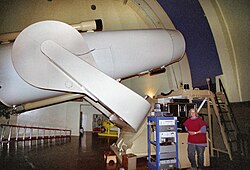
2002 XV93 was discovered on 10 December 2002 (Universal Time; UT) by Palomar Observatorye in California, United States.1 At that time, a team of astronomers led by Chad Trujillo and Michael E. Brown were working in Palomar Observatory using its 1.2-m Samuel Oschin telescope, operating jointly with the Near-Earth Asteroid Tracking (NEAT) program.1213: 100, 103 The object's discovery was announced by the Minor Planet Center (MPC) on 5 January 2003.12 Precovery observations of 2002 XV93 from Palomar Observatory were later identified in 2008, with the observations dating to 16 October 1990, 12 October 1991, and 28 September 1992.14
On 10 January 2024 (UT), 2002 XV93 passed in front of a magnitude-15.8 star in the constellation Auriga, causing it to briefly dim from Earth for up to 20 seconds.1516: 4 f This event, known as a stellar occultation, was predicted and observed in Japan by a team of astronomers led by Ko Arimatsu of the National Astronomical Observatory of Japan.15174: 1, 8 Telescopes were stationed at Kyoto University, Kiso Observatory, Fukushima Prefecture, and Okayama Observatory, but only the first three sites detected the occultation.4: 2 All detections showed that the star faded gradually (lasting up to 1.5 seconds) rather than abruptly during the occultation, revealing that 2002 XV93 had an atmosphere.154: 2 The discovery was announced on 4 May 2026, making 2002 XV93 likely the first trans-Neptunian object after Pluto discovered to have an atmosphere.171819d
Name
This object is currently known by its minor planet provisional designation 2002 XV93, given by the MPC upon its discovery.12 The MPC gave it the minor planet number of 612533 on 28 March 2022.20 As of May 2026, it has not been named.1 According to naming guidelines by the International Astronomical Union's Working Group for Small Bodies Nomenclature, trans-Neptunian objects classified as plutinos, such as 2002 XV93, should be given mythological names related to the underworld.21: 8 Since 2002 XV93 received its minor planet number less than 10 years ago, only the discoverer has the privilege of naming it.21: 6
In an interview with Reuters on 4 May 2026, Arimatsu remarked that the current designation of 2002 XV93 is unmemorable and advocated for a name related to Okinawan mythology, such as Amamikyu (/əˈmɑːmikjuː/).22 Michael E. Brown, who was involved in Palomar Observatory's discovery of 2002 XV93, commented that the object did not get named because it had no known remarkable properties before Arimatsu's discovery of its atmosphere.23
Orbit
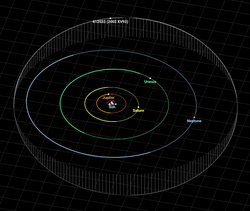
2002 XV93 orbits the Sun's barycenter with a semi-major axis of 39.3 astronomical units (AU), putting it in the Kuiper belt beyond Neptune's orbit.16a 2002 XV93 takes 246 years to complete one orbit, which places it in a 2:3 mean-motion resonance with Neptune.54: 1 For every two revolutions it makes around the Sun, Neptune makes exactly three.2526 It is therefore a member of the plutinos, a large population of trans-Neptunian objects (TNOs) named after its largest member Pluto.47: 2
2002 XV93's orbit is elliptical, with an orbital eccentricity of 0.12, and inclined by 13° with respect to the ecliptic.a Its distance from the Sun ranges from 34.4 AU at perihelion to 44.2 AU at aphelion.a 2002 XV93 will come to perihelion in March 2070.6 Due to gravitational perturbations by the giant planets,27: 4 28: 3 the orbital elements of 2002 XV93 vary over time.3 Simulations of 2002 XV93's orbit show that in 10 million years, its semi-major axis can fluctuate between 39.1–39.9 AU, eccentricity between 0.10–0.15, and inclination between 12.5–13.9°.3
Physical characteristics
Size

Observations of a stellar occultation in 2024 show that 2002 XV93 has a radius of 235+22
−15 km, or a diameter of 470+44
−30 km, assuming it has a spherical shape.4: 1 For comparison, 2002 XV93 is about one-seventh the diameter of Earth's moon and about one-fifth the diameter of Pluto.2917 The mass, bulk density, and shape of 2002 XV93 are unknown, though they can be inferred from those of other similarly-sized TNOs like Huya.4: 2–3 A 2026 study by Arimatsu and colleagues assumed 2002 XV93 had a bulk density between 1.0 and 1.5 g/cm3, similar to those of Huya and Pluto's moon Charon, respectively.4: 3, 6 The surface gravity of 2002 XV93 is estimated to be around 100 times weaker than Earth's.29 Arimatsu and colleagues expect that 2002 XV93 has a non-spherical shape due to its relatively small diameter of a few hundred kilometres.4: 2 The rotation period of 2002 XV93 is unknown and it has not yet been studied via light curves, according to the Asteroid Lightcurve Database.30
Some astronomers, including Noemi Pinilla-Alonso and Michael E. Brown, previously suggested that 2002 XV93 could be theoretically large enough to become spherical and be possibly a dwarf planet, based on a larger diameter estimate from 2012.313233 This outdated estimate had 2002 XV93 549.2+21.7
−23.0 km in diameter, based on mid- to far-infrared measurements of its thermal emission by the Herschel Space Observatory and Spitzer Space Telescope.74: 1
Surface
Albedo, color, and temperature
Measurements of 2002 XV93's visible brightness and infrared thermal radiation suggest that its surface is dark, with a very low geometric albedo of 0.040+0.020
−0.015.7: 13 4: 1 However, this estimate was made in 2012 using a visible-light (V-band) absolute magnitude 5.42±0.46 and thermal emission-derived diameter of 549.2+21.7
−23.0 km.7: 4 More recent measurements have since found a brighter V-band absolute magnitude of 4.7328: 5 and a smaller diameter of 470+44
−30 km,4 which should indicate a higher albedo for 2002 XV93.b However, as of May 2026, no peer-reviewed studies have recalculated 2002 XV93's albedo using newer measurements of its absolute magnitude and diameter.4
Telescopic observations in visible light show that the surface color of 2002 XV93 is gray,g similar to some centaurs and Kuiper belt objects including Achlys and 2004 EW95.8: 5, 7 Due to 2002 XV93's great distance from the Sun, its surface temperature averages around 47 K (−226.2 °C; −375.1 °F), cold enough to freeze substances like water into solid ice.4
Composition and spectrum

Near-infrared spectroscopy by the James Webb Space Telescope (JWST) has shown that the surface of 2002 XV93 is rich in water ice, in both amorphous and crystalline phases.34: 3–4 The abundance of water ice in 2002 XV93's surface is indicated by the presence of absorption bands at wavelengths of 1.5, 2.0, 3.0, and 4.5 μm in the object's near-infrared spectrum, alongside a reflectance peak at 3.1 μm due to crystalline water ice.34: 4 In the Kuiper belt, crystalline water ice tends to transform into amorphous water ice due to irradiation by cosmic rays, though both phases are expected to be in equilibrium (i.e. amounts of crystalline and amorphous water ice remain constant).34: 4 2002 XV93 shares its water ice-rich surface composition with other TNOs, including the plutinos 2004 EW95 and 2003 UZ413.34: 4 These TNOs are classified as "prominent water"-type or "Bowl"-type TNOs, because their near-infrared spectra display a significant bowl-shaped water ice absorption band at the wavelength of 3.0 μm.359: 4
Besides water, JWST has detected frozen carbon dioxide (CO
2) on 2002 XV93's surface.34: 4 JWST has also detected trace amounts of 13CO
2 (a rare isotopologue of CO
2).11 In observations from 2022 and 2024, JWST found no signs of hypervolatile compounds such as methane, nitrogen, and carbon monoxide (which can sublimate into gases at 2002 XV93's temperature).114: 3–4 The lack of hypervolatiles on 2002 XV93's surface suggests that most of them had already sublimated and escaped into space.4: 3–4
Atmosphere

In May 2026, a research team led by Ko Arimatsu announced the discovery of a thin atmosphere around 2002 XV93, making it possibly the first TNO after Pluto discovered to have an atmosphere.17d The atmosphere was inferred from observations of a stellar occultation in January 2024, when 2002 XV93 passed in front of a star and dimmed its light gradually (lasting 1.5 seconds) instead of abruptly, indicating refraction by an atmosphere.1516 The gradual disappearance and reappearance of the star was observed to occur within radii of 230 to 270 km (140 to 170 mi) from 2002 XV93's center.4: 4 Alternate explanations for this gradual fading, such as a ring system or a shell of dust, are considered unlikely.184: 2
Based on the observed fading of the occulted star, Arimatsu's team estimated that the atmospheric pressure on 2002 XV93's surface is between 100 and 200 nanobars—roughly 5 million to 10 million times thinner than Earth's atmosphere and about 50 to 100 times thinner than Pluto's atmosphere,36 but about 100 to 200 times denser than Europa's exosphere.37 At this pressure, 2002 XV93's atmosphere is dense enough (>0.001 nanobar) that its gas molecules can collide amongst themselves, making it a true atmosphere rather than an exosphere.11 No other TNO besides Pluto is known to have an atmospheric pressure this high.4: 3 However, it is unclear how the density of 2002 XV93's atmosphere changes with altitude.11
The composition 2002 XV93's atmosphere is unknown, and there are competing hypotheses for it.11 One possible composition is methane, a common hypervolatile found in TNOs.4 In occultation observations, 2002 XV93's atmosphere appeared to show a sudden change in refraction at a certain altitude, suggesting that it has a thermal inversion caused by upper-atmospheric heating of trace methane gas (similar to Pluto).4: 2 However, JWST observed the object after its 2024 occultation and found no signs of methane and carbon monoxide gas, suggesting they do not make up much of its atmosphere.11 If these gases exist over a large altitude range, their partial pressures at 2002 XV93's surface must be less than 0.0003 nanobars (0.3 picobars).11 However, it remains possible that a low-altitude atmosphere of pure methane could exist.11 Using these JWST observations, a research team headed by Ian Wong proposed that 2002 XV93's atmosphere could contain either nitrogen, argon, or any other gas that couldn't be detected by JWST.11
The discovery of an atmosphere around 2002 XV93 was unexpected because the object is too small to have a surface gravity strong enough to theoretically hold on to an atmosphere over the age of the Solar System.152916 Physical models predict that 2002 XV93 should lose all of its atmosphere within 100 to 1,000 years via Jeans escape.154: 3 The present-day existence of 2002 XV93's atmosphere implies that it was recently replenished, though the cause is unknown.15 Sublimation of volatile ices on 2002 XV93's surface is unlikely, because it was not detected in earlier JWST observations.174: 4 Arimatsu's team hypothesized that 2002 XV93 obtained its atmosphere via either an impact by a hundred-meter-radius comet, or outgassing by cryovolcanic eruptions.154: 4 These hypotheses can be tested with later observations by occultations: if the atmosphere came from an impact, then its surface pressure should decrease over time, whereas if the atmosphere is sustained by outgassing, then the surface pressure should stay consistent with possibly slow seasonal changes.194: 4
See also
See also
- 208996 Achlys – a large plutino and possible dwarf planet with an elongated ellipsoid shape
- (84922) 2003 VS2, a similarly-sized plutino whose shape has been characterized by stellar occultations
- (84522) 2002 TC302, another similarly-sized trans-Neptunian object whose shape has been characterized by stellar occultations
- (119951) 2002 KX14, another similarly-sized trans-Neptunian object whose shape has been characterized by stellar occultations
Notes
Notes
- These orbital elements are expressed in terms of the Solar System Barycenter (SSB) as the frame of reference.5 Due to planetary perturbations, the Sun revolves around the SSB at non-negligible distances, so heliocentric-frame orbital elements and distances (such as those given in JPL's Small-Body Database2) can vary on short timescales.24
- The diameter (d), visual albedo (pV), and visual absolute magnitude (H) are related via the equation , where is 2002 XV93's distance from Earth and is the Sun's visual (V-band) apparent magnitude.7: 5 The diameter of 2002 XV93 was determined from its thermal emission, while its absolute magnitude was determined from optical measurements of its brightness. The albedo is derived from these two quantities via the equation given here.
- This albedo estimate was made in 2012 using an absolute magnitude 5.42±0.46 and thermal emission-derived diameter of 549.2+21.7
−23.0 km.7: 4 More recent measurements have since found a brighter absolute magnitude of 4.7328: 5 and a smaller diameter of 470+44
−30 km,4 which should indicate a higher albedo for 2002 XV93.b - The James Webb Space Telescope has shown evidence of gaseous methane on the trans-Neptunian dwarf planet Makemake, but it is unclear whether its methane comes from an atmosphere or temporary outgassing.411
- The discoverer is labelled "Palomar" by the MPC.1
- The occulted star on 10 January 2024 was Gaia DR3 940732910252854272.4: 1
- Tegler et al. (2016) define "gray" as having a B–R color index around or less than 1.22.8: 7 The B–R color index of 2002 XV93 is 1.10±0.02.8: 4
References
References
- "(612533) = 2002 XV93". Minor Planet Center. Retrieved 4 May 2026.
- "JPL Small-Body Database Lookup: 2002 XV93" (2026-01-11 last obs). Retrieved 4 May 2026.
- Buie, Marc W. (5 May 2026). "Orbit Fit and Astrometric record for 612533". Southwest Research Institute. Retrieved 5 May 2026.
- Arimatsu, Ko; Yoshida, Fumi; Hayamizu, Tsutomu; Takita, Satoshi; Hosoi, Katsumasa; Ootsubo, Takafumi; Watanabe, Jun-ichi (4 May 2026). "Detection of an atmosphere on a trans-Neptunian object beyond Pluto". Nature Astronomy. arXiv:2605.02243. Bibcode:2026NatAs.tmp...99A. doi:10.1038/s41550-026-02846-1.
{{cite journal}}: CS1 maint: bibcode (link) - "JPL Horizons On-Line Ephemeris for 612533 (2002 XV93) at epoch JD 2461000.5". JPL Horizons On-Line Ephemeris System. Jet Propulsion Laboratory. Retrieved 4 May 2026. Solution using the Solar System Barycenter. Ephemeris Type: Elements and Center: @0)
- "JPL Horizons On-Line Ephemeris for 612533 (2002 XV93) from 2086-Sep-01 to 2086-Oct-01". JPL Horizons On-Line Ephemeris System. Jet Propulsion Laboratory. Retrieved 4 May 2026. (Perihelion occurs when radial velocity or "rdot" changes from negative to positive.)
- Mommert, M.; Harris, A. W.; Kiss, C.; Pál, A.; Santos-Sanz, P.; Stansberry, J.; et al. (May 2012). "TNOs are cool: A survey of the trans-Neptunian region V. Physical characterization of 18 Plutinos using Herschel-PACS observations". Astronomy & Astrophysics. 541 (A93): 17. arXiv:1202.3657. Bibcode:2012A&A...541A..93M. doi:10.1051/0004-6361/201118562. S2CID 119253817.
- Tegler, S. C.; Romanishin, W.; Consolmagno, G. J. (December 2016). "Two Color Populations of Kuiper Belt and Centaur Objects and the Smaller Orbital Inclinations of Red Centaur Objects". The Astronomical Journal. 152 (6): 13. Bibcode:2016AJ....152..210T. doi:10.3847/0004-6256/152/6/210. S2CID 125183388. 210.
- Pinilla-Alonso, Noemí; Brunetto, Rosario; De Prá, Mário N.; Holler, Bryan J.; Hénault, Elsa; Feliciano, Ana Carolina de Souza; et al. (December 2024). "A JWST/DiSCo-TNOs portrait of the primordial Solar System through its trans-Neptunian objects" (PDF). Nature Astronomy. 9 (2): 230–244. Bibcode:2025NatAs...9..230P. doi:10.1038/s41550-024-02433-2. S2CID 274932942.
- "AstDys (612533) 2002XV93 Ephemerides". Asteroids - Dynamic Site. Department of Mathematics, University of Pisa, Italy. Retrieved 2 June 2026.
- Wong, Ian; Protopapa, Silvia; Lellouch, Emmanuel (29 May 2026). "Constraints on the Atmospheric Composition of 2002 XV93 from JWST Spectroscopy". arXiv:2605.29206 [astro-ph.EP].
- Trujillo, C. A.; Brown, M. E.; Helin, E. F.; Pravdo, S.; Lawrence, K.; Hicks, M. (5 January 2003). Marsden, Brian G. (ed.). "MPEC 2003-A25 : 2002 WC19, 2002 XV93, 2002 XW93". Minor Planet Electronic Circular. 2003-A25. Minor Planet Center. Retrieved 30 October 2025.
- Trujillo, C. A.; Brown, M. E. (June 2003). "The Caltech Wide Area Sky Survey". Earth, Moon, and Planets. 92 (1): 99–112. Bibcode:2003EM&P...92...99T. doi:10.1023/B:MOON.0000031929.19729.a1. S2CID 189905639.
- "M.P.S. 233346" (PDF). Minor Planets and Comets Supplement (231751). Minor Planet Center: 66. 13 January 2008. Retrieved 4 May 2026.
- Starr, Michelle (5 May 2026). "Scientists Found An 'Impossible' Atmosphere on A Tiny World Beyond Neptune". ScienceAlert. Retrieved 5 May 2026.
- "冥王星以外で初めて、太陽系外縁天体に大気を発見(詳しい解説)" (PDF) (in Japanese). National Astronomical Observatory of Japan. 5 May 2026. Retrieved 5 May 2026.
- "Outer Solar System Object Has an Atmosphere But Shouldn't". National Astronomical Observatory of Japan. 5 May 2026. Retrieved 5 May 2026.
- "Mysterious world beyond Pluto may have an atmosphere, astronomers say". CBS News. 4 May 2026. Retrieved 5 May 2026.
- Grossman, Lisa (4 May 2026). "A small object past Pluto may have a thin atmosphere". ScienceNews. Retrieved 4 May 2026.
- "M.P.C. 139896" (PDF). Minor Planet Circulars (139896). Minor Planet Center: 1508. 28 March 2022. Retrieved 4 May 2026.
- "Rules and Guidelines for Naming Non-Cometary Small Solar-System Bodies" (PDF). IAU Working Group for Small Bodies Nomenclature. 22 February 2025. Retrieved 5 May 2026.
- Dunham, Will (4 May 2026). Wallis, Daniel (ed.). "Atmosphere detected on celestial body in solar system's far reaches". Reuters. Retrieved 5 May 2026.
- Chang, Kenneth (7 May 2026). "Surprising Signs of an Atmosphere Around a Tiny World, Billions of Miles Away". The New York Times. Retrieved 7 May 2026.
- "JPL Horizons On-Line Ephemeris for 612533 (2002 XV93) at epochs JD 2460800.5–2461000.5". JPL Horizons On-Line Ephemeris System. Jet Propulsion Laboratory. Retrieved 4 May 2026. Solution using the Sun. Ephemeris Type: Elements and Center: @sun)
- "Plutinos". COSMOS - The SAO Encyclopedia of Astronomy. Swinburne University of Technology. Retrieved 30 November 2025.
- Dunn, Marcia (4 May 2026). "Astronomers believe they've detected an atmosphere around a tiny, icy world beyond Pluto". AP News. Retrieved 4 May 2026.
- Volk, Kathryn; Malhotra, Renu (July 2011). "Inclination Mixing in the Classical Kuiper Belt". The Astrophysical Journal. 736 (1): 11. arXiv:1104.4967. Bibcode:2011ApJ...736...11V. doi:10.1088/0004-637X/736/1/11.
- Muñoz-Gutiérrez, Marco A.; Ramírez-Vargas, Sebastián; Peimbert, Antonio; Pérez-Villegas, Angeles; Petrovich, Petrovich (March 2026). "The Effect of Massive Trans-Neptunian Objects in the Long-term Evolution and Leakage Rates of Neptune's 3:2 and 2:1 Mean Motion Resonances". The Astronomical Journal. 171 (3): 177. arXiv:2503.03900. Bibcode:2026AJ....171..177M. doi:10.3847/1538-3881/ae3e51.
- 伊藤 壽一郎 (5 May 2026). "太陽系の果ての小天体に大気 常識覆す発見 冥王星以外で初、恒星の光の「にじみ」から". Sankei Shimbun (in Japanese). Retrieved 5 May 2026.
- "MinorPlanet.info: One Asteroid Information". Asteroid Lightcurve Database (LCDB). Retrieved 7 March 2026. Search using Number = "612533"
- Pinilla-Alonso, Noemi (August 2015). "Icy Dwarf Planets: Colored Popsicles in the Outer Solar System". Proceedings of the International Astronomical Union. 11: 241–246. Bibcode:2016IAUFM..29A.241P. doi:10.1017/S1743921316002970. A29A.
- Michael E. Brown (25 November 2025). "How many dwarf planets are there in the outer solar system? (updates daily)". California Institute of Technology. Retrieved 5 May 2026.
- Christodoulou, Dimitris M.; Laycock, Silas G. T.; Kazanas, Demosthenes (November 2024). "An Objective Classification Scheme for Solar-System Bodies Based on Surface Gravity". Galaxies. 12 (6): 74. Bibcode:2024Galax..12...74C. doi:10.3390/galaxies12060074. 6.
- Souza-Feliciano, A. C.; Holler, B. J.; Pinilla-Alonso, N.; De Prá, M.; Brunetto, R.; Müller, T.; et al. (January 2024). "Spectroscopy of the binary TNO Mors-Somnus with the JWST and its relationship to the cold classical and plutino subpopulations observed in the DiSCo-TNO project". Astronomy & Astrophysics. 681: 8. Bibcode:2024A&A...681L..17S. doi:10.1051/0004-6361/202348222. S2CID 267154656. L17.
- Holler, Bryan J.; Brunetto, Rosario; Cruikshank, Dale P.; Cryan, Sasha; Guilbert-Lepoutre, Aurelie; Harvison, Brittany; et al. (September 2025). "A Descriptive Taxonomic Nomenclature for Intermediate-sized Trans-Neptunian Object Spectra". Research Notes of the American Astronomical Society. 9 (9): 241. Bibcode:2025RNAAS...9..241H. doi:10.3847/2515-5172/ae03a2.
- Woodford, James (4 May 2026). "Tiny frozen world unexpectedly appears to have an atmosphere". New Scientist. Retrieved 5 May 2026.
- Carpineti, Alfredo (4 May 2026). Simmons, Laura (ed.). "Small Trans-Neptunian World Has An Atmosphere, Laughing In The Face Of Astronomers And Expected Physics". IFLScience. Retrieved 5 May 2026.
External links
External links
Videos
- Nature Portfolio (28 April 2026). Arimatsu et al. (Nature Astronomy) - Kiso Observatory recording of stellar occultation by 2002 XV93 – via YouTube.
- Nature Portfolio (28 April 2026). Arimatsu et al. (Nature Astronomy) - Animation of a stellar occultation by 2002 XV93 with an atmosphere vs. without an atmosphere – via YouTube.
- National Astronomical Observatory of Japan (4 May 2026). Conceptual video for Arimatsu et al. (2026) - Animation of a stellar occultation by 2002 XV93 with lightcurve – via YouTube.
Databases
- Arimatsu, Ko; et al. (12 March 2026). "Raw movie data, reduced light curves, and model profiles for the 2024-01-10 occultation by (612533) 2002 XV93". Zenodo. doi:10.5281/zenodo.18976430.
- (612533) 2002 XV93 at AstDyS-2, Asteroids—Dynamic Site
- (612533) 2002 XV93 at ESA–space situational awareness
- (612533) 2002 XV93 at the JPL Small-Body Database