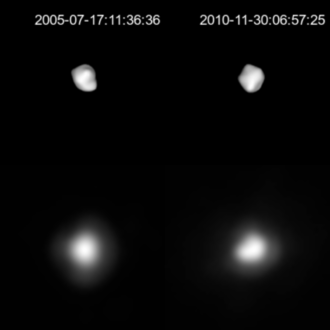
 Images of 5 Astraea (bottom) compared with 3D models based on lightcurve data (top) | |
| Discovery1 | |
|---|---|
| Discovered by | K. L. Hencke |
| Discovery site | Driesen Obs. |
| Discovery date | 8 December 1845 |
| Designations | |
| Pronunciation | /æˈstriːə/2 |
Named after | Astraea (Greek goddess)3 |
| 1969 SE | |
| main-belt14 · (middle) Astraea5 | |
| Adjectives | Astraean |
| Symbol |  (historical astronomical) (historical astronomical) (modern astrological) (modern astrological) |
| Orbital characteristics4 | |
| Epoch 23 March 2018 (JD 2458200.5) | |
| Uncertainty parameter 0 | |
| Observation arc | 171.93 yr (62,799 d) |
| Aphelion | 3.0659 AU |
| Perihelion | 2.0810 AU |
| 2.5735 AU | |
| Eccentricity | 0.1914 |
| 4.13 yr (1,508 d) | |
| 186.83° | |
| 0° 14m 19.32s / day | |
| Inclination | 5.3677° |
| 141.58° | |
| 358.75° | |
| Proper orbital elements6 | |
Proper semi-major axis | 2.5761849 AU |
Proper eccentricity | 0.1980486 |
Proper inclination | 4.5118628° |
Proper mean motion | 87.046396 deg / yr |
Proper orbital period | 4.13573 yr (1510.574 d) |
Precession of perihelion long. | 52.210903 arcsec / yr |
Precession of asc. node | −57.357951 arcsec / yr |
| Physical characteristics | |
| Dimensions | 169 km × 125 km × 83 km7 |
| 125 km7 | |
| 48 900 km2a | |
| Volume | 920 000 km3a |
| Mass | (2.716 ± 0.326/0.45)×1018 kg8 |
Mean density | 3.501 ± 0.420/0.581 g/cm38b |
| 0.700 04 d (16.801 h)7 | |
Equatorial rotation velocity | 6.49 m/sa |
North pole right ascension | 115°/310° ± 5° |
North pole declination | 55° ± 5° |
| 0.2279 | |
| S | |
| 9.010 to 13.0 | |
| 6.85 | |
| 0.15" to 0.041" | |
5 Astraea (/æˈstriːə/) is an asteroid in the asteroid belt. This object is orbiting the Sun at a distance of 385 million kilometres (2.5735 AU) with a period of 4.13 yr and an orbital eccentricity of 0.19. The orbital plane is inclined at an angle of 5.37° to the plane of the ecliptic. It is spinning with a period of 16.8 h. The surface of Astraea is highly reflective and its composition is probably a mixture of nickel–iron with silicates of magnesium and iron. It is an S-type asteroid in the Tholen classification system.4
Discovery and name
Astraea was the fifth asteroid discovered, on 8 December 1845, by Karl Ludwig Hencke and named for Astraea, a Greek goddess of justice named after the stars. It was his first of two asteroid discoveries. The second was 6 Hebe. A German amateur astronomer and post office headmaster, Hencke was looking for 4 Vesta when he stumbled on Astraea. The King of Prussia awarded him an annual pension of 1200 marks for the discovery.11
Hencke's symbol for Astraea is an inverted anchor, encoded in Unicode 17.0 as U+1F778 ( ),1213 though given Astraea's role with justice and precision, it is perhaps a stylized set of scales, or a typographic substitute for one.1415
This symbol is no longer used. The astrological symbol is a percent sign, encoded specifically at U+2BD9 ⯙:16, or a standard percent sign ("%") can also be used.12 The modern astronomical symbol is a simple encircled 5 (⑤).
),1213 though given Astraea's role with justice and precision, it is perhaps a stylized set of scales, or a typographic substitute for one.1415
This symbol is no longer used. The astrological symbol is a percent sign, encoded specifically at U+2BD9 ⯙:16, or a standard percent sign ("%") can also be used.12 The modern astronomical symbol is a simple encircled 5 (⑤).
For 38 years after the discovery of the fourth known asteroid, Vesta, in 1807, no further asteroids were discovered.17 After the discovery of Astraea, 8 more were discovered in the following 5 years, and 24 were found in the 5 years after that. The discovery of Astraea proved to be the starting point for the eventual reclassification of the four original asteroids (which were identified as planets at the time)17, as it became apparent that these were only the largest of a new type of celestial body with thousands of members.
Characteristics
Photometry indicates prograde rotation, that the north pole points in the direction of right ascension 115° or 310° and declination 55°, with a 5° uncertainty.7 This gives an axial tilt of about 33°. With an apparent magnitude of 8.7 (on a favorable opposition on 15 February 2016), it is only the seventeenth-brightest main-belt asteroid, and fainter than, for example, 192 Nausikaa or even 324 Bamberga (at rare near-perihelion oppositions).
A stellar occultation on 6 June 2008 allowed Astraea's diameter to be estimated; it was found to be 115 ± 6 km.18
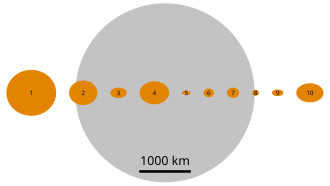
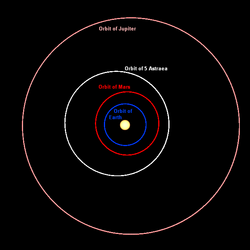
Right: The orbit of 5 Astraea in white compared with those of Earth, Mars and Jupiter.
Notes
Notes
- Calculated based on the known parameters
- Assuming a diameter of 114 ± 4 km.
References
References
- "5 Astraea". Minor Planet Center. Retrieved 1 June 2018.
- "Astraea". Lexico UK English Dictionary. Oxford University Press. Archived from the original on 22 March 2020.
- Schmadel, Lutz D. (2007). "(5) Astraea". Dictionary of Minor Planet Names – (5) Astraea. Springer Berlin Heidelberg. p. 15. doi:10.1007/978-3-540-29925-7_6. ISBN 978-3-540-00238-3.
- "JPL Small-Body Database Browser: 5 Astraea" (2017-11-22 last obs.). Jet Propulsion Laboratory. Retrieved 1 June 2018.
- "Asteroid (5) Astraea – Proper Elements". AstDyS-2, Asteroids – Dynamic Site. Retrieved 25 May 2018.
- "AstDyS-2 Astraea Synthetic Proper Orbital Elements". Department of Mathematics, University of Pisa, Italy. Retrieved 1 October 2011.
- M. J. López-Gonzáles; E. Rodríguez (2005). "Lightcurves and poles of seven asteroids". Planetary and Space Science. 53: 1147. doi:10.1016/j.pss.2005.04.010.
- Fienga, A.; Avdellidou, C.; Hanuš, J. (February 2020). "Asteroid masses obtained with INPOP planetary ephemerides". Monthly Notices of the Royal Astronomical Society. 492 (1). doi:10.1093/mnras/stz3407.
- Tedesco, E. F.; Noah, P. V.; Noah, M.; Price, S. D. (October 2004). "IRAS Minor Planet Survey V6.0". NASA Planetary Data System. 12: IRAS-A-FPA-3-RDR-IMPS-V6.0. Bibcode:2004PDSS...12.....T. Retrieved 22 October 2019.
- Perihelic opposition
- "Dawn Community". NASA. Archived from the original on 21 May 2009. Retrieved 17 April 2009.
- Bala, Gavin Jared; Miller, Kirk (18 September 2023). "Unicode request for historical asteroid symbols" (PDF). unicode.org. Unicode. Retrieved 26 September 2023.
- "Alchemical Symbols" (PDF). unicode.org. The Unicode Consortium. 2025. Retrieved 17 September 2025.
-
Bericht über die zur Bekanntmachung geeigneten Verhandlungen der Königl. Preuss. Akademie der Wissenschaften zu Berlin. Deutsche Akademie der Wissenschaften zu Berlin; Königlich Preussische Akademie der Wissenschaften zu Berlin. 1845. p. 406.
Der Planet hat mit Einwilligung des Entdeckers den Namen Astraea erhalten, und sein Zeichen wird nach dem Wunsche des Hr. Hencke ein umgekehrter Anker sein.
- Schmadel, Lutz D. (2003). Dictionary of Minor Planet Names. Springer. pp. 15–18. ISBN 978-0-354-06174-2.
- Faulks, David (28 May 2016). "L2/16-080: Additional Symbols for Astrology" (PDF).
- "The Planet Hygea". spaceweather.com. 1849. Archived from the original on 9 April 2008. Retrieved 18 April 2008.
- Ďurech, Josef; Kaasalainen, Mikko; Herald, David; Dunham, David; Timerson, Brad; Hanuš, Josef; et al. (2011). "Combining asteroid models derived by lightcurve inversion with asteroidal occultation silhouettes" (PDF). Icarus. 214 (2): 652–670. arXiv:1104.4227. Bibcode:2011Icar..214..652D. doi:10.1016/j.icarus.2011.03.016. Archived from the original (PDF) on 3 March 2016. Retrieved 26 January 2012.
External links
External links
- 2 Telescope images of 5 Astraea
- MNRAS 7 (1846) 27
- Physical characteristics of (5) Astraea at the Small Bodies Data Ferret
- Discovery Circumstances: Numbered Minor Planets (1)-(5000) – Minor Planet Center
- Dictionary of Minor Planet Names, Google books
- 5 Astraea at AstDyS-2, Asteroids—Dynamic Site
- 5 Astraea at the JPL Small-Body Database